The Oakland house is sitting quiet.
The mail is still coming. Mortgage letters. County tax notices. Insurance papers. Maybe a PG&E bill. Maybe a letter from the city that nobody opened.
If you inherited property in the Bay Area, the first step is not price, cleanout, repairs, or calling a realtor. The first step is finding out who has the legal right to sell.
Your family may already be talking.
One sibling wants to sell. One wants to wait. One lives out of state and says, “Just tell me what to sign.”
The first question is not what the house is worth.
The first question is this:
Who has the legal right to sell it?
After 27 years in this business, I have learned that families usually call about price first, but the deal usually gets decided by paperwork, signatures, repairs, timing, and whether escrow can actually close.
I have seen deals fall apart because everybody talked about price before checking title. A buyer can offer money. A realtor can suggest a list price. A contractor can tell you what repairs cost.
But if the wrong person is signing, escrow cannot close.
Twin Home Buyer is not a law firm. We do not give legal advice. If the ownership path is unclear, talk with a California probate attorney, estate attorney, tax professional, or title company before signing sale papers.
That is not overcomplicating it. That is protecting the family from making promises the paperwork cannot support.
Quick Answer: Can You Sell Inherited Property in the Bay Area?
Sometimes yes. Sometimes no.
If you inherited a house in the Bay Area, the sale depends on title, authority, probate, trust documents, and who has the legal right to sign.
The house may be in a trust. It may need probate. It may still be in your parent’s name. It may involve siblings, heirs, or a quitclaim deed that needs review.
California has some simpler transfer procedures, but they are limited. Not every estate needs full formal probate, but the answer depends on how the property is owned, the type of property, the value, the date of death, whether the property was the deceased owner’s primary residence, whether a probate case has already been opened, and who has authority to sign.
For real property, the procedure matters. A very small-value real property affidavit is different from the separate California petition process for certain primary residences. That distinction matters in the Bay Area because property values can be high, but some primary-residence situations may still need to be reviewed under the correct procedure instead of being dismissed too quickly.
Do not assume. Review the California Courts guide on when formal probate may not be needed and the Judicial Council primary residence petition form, then talk with a probate attorney or title company about your specific situation.
What the family believes happened has to match the county record.
That is where many inherited sales get stuck.
Before You Talk Price, Find Out Who Can Sign
Start with authority.
When someone passes away, the house does not always move cleanly to the family. The family may feel like they inherited it. The county record may show something different.
That difference matters because the buyer, realtor, title company, and family all have to work from the same legal record.
Selling a house is not just agreeing on a number. Someone has to sign the purchase agreement. Someone has to open escrow. Someone has to approve title documents. Someone has to sign the deed.
If that person does not have authority, the sale stops.
I have walked into houses in Oakland, Fruitvale, Hayward, San Mateo County, and the Peninsula where the family already had a price in mind. Sometimes they already had a buyer.
Then title came back with a problem.
For example, I have seen a family believe the house was in the trust, only to find out the deed was still in the parent’s personal name. The buyer was ready. The family was ready. But escrow could not close until the authority issue was handled.
The parent was still on title. The trust was never recorded. One sibling was missing. Probate had not been opened. The person signing did not have court authority yet.
That is why I always look at the authority question early.
A buyer cannot talk around it. A realtor cannot list around it. A cash sale cannot close around it.
Do not argue about price before you know who can sign.
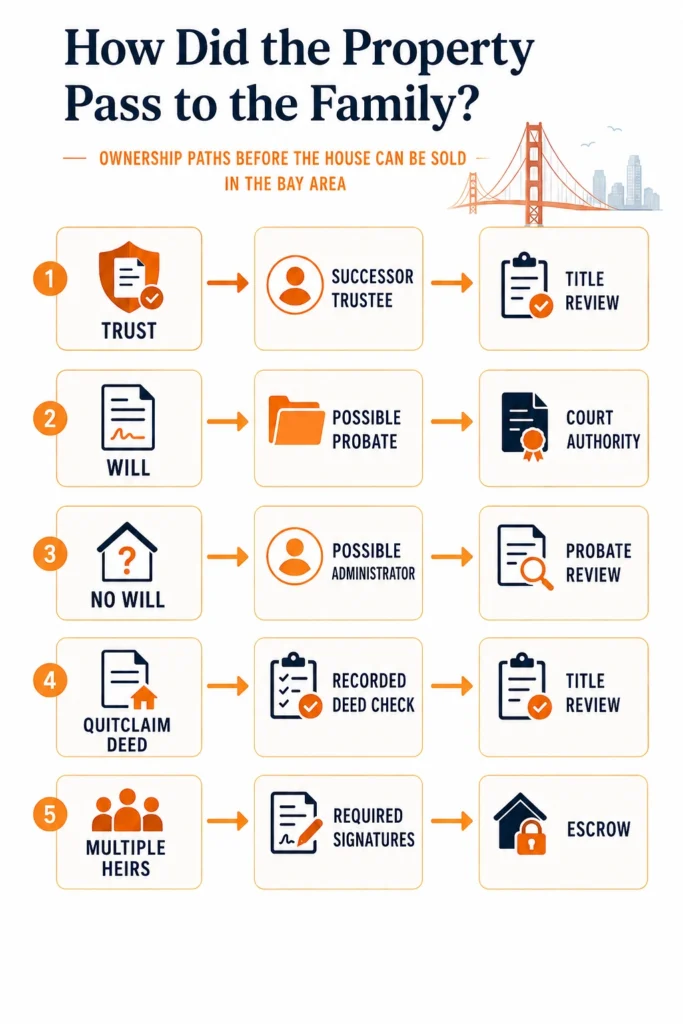
How Did You Inherit Property in the Bay Area?
The path changes the sale.
A lot of families say, “We inherited the house.” I understand what they mean. But escrow needs more than that.
Escrow needs the legal path.
The house may have passed through:
- A living trust
- A will
- Probate court
- A recorded deed
- A quitclaim deed
- Joint ownership
- Multiple heirs
- Missing paperwork
Each one creates a different road.
A trust sale is not the same as a probate sale. A will is not the same as being on title. A family promise is not the same as a recorded deed.
That sounds technical, but it matters in real life.
I have seen families spend weeks talking about cleaning the garage, replacing carpet, or picking an agent. Then escrow asks for documents nobody can find.
That is painful because the family already feels behind.
Most heirs do not know the full property history. That is normal. You may not know if there are back taxes. You may not know if a deed was recorded. You may not know if your parent refinanced years ago.
You are not supposed to know everything on day one.
You just need to find the right documents before making promises.
Documents to Look For Before You Promise a Sale
You do not need every answer before asking questions. But you should start gathering the papers that help a title company, attorney, tax professional, or buyer understand the situation.
Look for:
- The most recent recorded deed
- Trust documents or certification of trust
- Will, if there is one
- Death certificate
- Mortgage statement or payoff information
- County property tax bill
- Insurance papers
- HOA papers, if the property has an HOA
- Probate paperwork, if probate has already started
- Names and contact information for heirs, trustees, or decision makers
This is not busywork. These papers help everyone see whether the sale path is clean, delayed, or needs professional help first.
Was the House Really in a Trust?
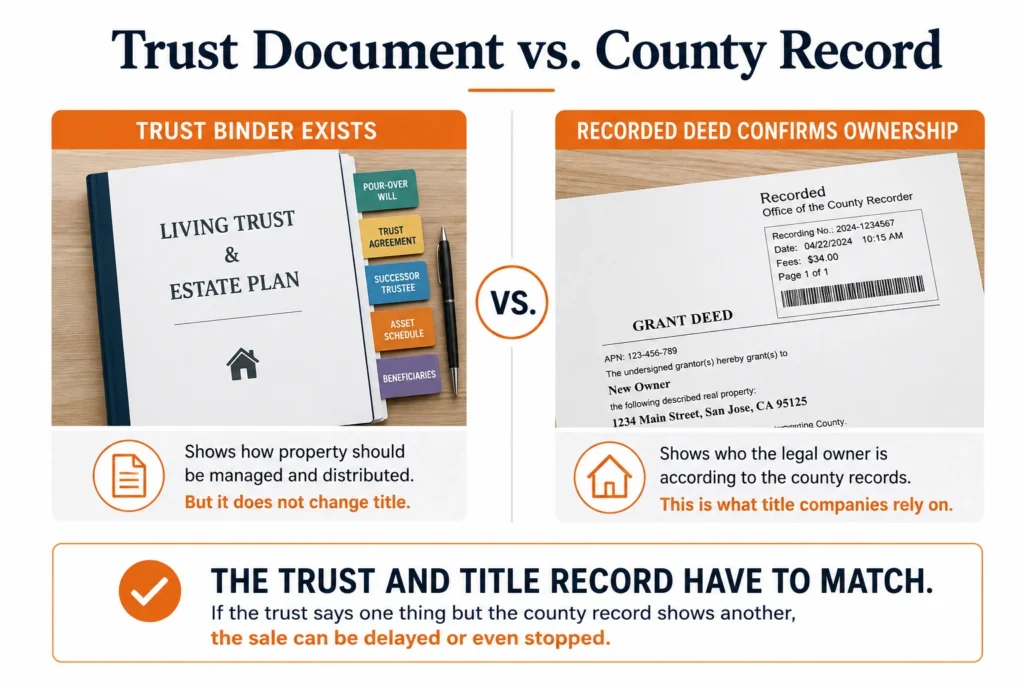
A trust has to match title.
This is one of the biggest issues I see with inherited houses.
A family says, “The house is in the trust.” Sometimes it is. Sometimes the trust exists, but the house was never actually transferred into it.
That is a big difference.
If the house was properly placed into a living trust, the successor trustee may be able to manage or sell it. But the title company still has to review the paperwork.
They may ask for:
- The trust agreement
- Certification of trust
- Death certificate
- Recorded deed
- Trustee identification
- Trust amendments
- Required signatures
The deed is the part people miss.
The trust binder may be sitting in the closet. But if the deed still shows your parent’s personal name, the title company may not treat it like a clean trust sale.
I have seen this happen.
The family thought the trust solved everything. Then the title report showed the house was still in the deceased owner’s name. Now the family had to slow down and get legal help.
That does not mean the house cannot be sold.
It means the paperwork has to be fixed first.
What If the House Has to Go Through Probate?
Probate is sometimes the road.
Probate may be needed when the deceased owner is still on title. It may also be needed when there is no trust, no clear transfer, missing documents, or family disagreement.
Probate is a court process. The California Courts Self-Help Guide explains that probate is the legal process used to transfer or inherit property after someone dies. You can review the California Courts probate guide.
Not every inherited property goes through the same process. Some California estates may qualify for simpler transfer procedures instead of full formal probate. For real property, California has different procedures with different limits. A very small-value real property affidavit is limited. A separate petition may apply to certain California primary residences under a higher value limit, depending on the date of death and other facts.
Many Bay Area properties may still not qualify, especially if the value is above the applicable limit, the property was not the deceased owner’s primary residence, title is unclear, heirs disagree, or a probate case is already open.
Do not assume either way until the documents are reviewed.
The court may appoint someone to handle the estate. That person may receive Letters Testamentary or Letters of Administration.
Those papers matter because they show authority.
Without the right authority, the title company may not let the sale close.
I have seen families get frustrated here. They think a cash buyer can just buy it and figure it out later. That is not how title works.
Cash does not erase probate.
A buyer still needs clear title. Escrow still needs the right signatures. The title company still needs documents they can insure.
Some probate sales are simple. Some need court approval. Some take more time because heirs disagree or documents are missing.
This is where you should talk with an attorney.
Twin Home Buyer can look at the property as a buyer, but we cannot tell you how probate should be handled.
Get legal clarity first. Then talk about the sale. I would rather slow a family down early than promise a fast close that title cannot support.
Executor, Administrator, Trustee, Heir — These Are Different
The title matters.
Families use these words like they mean the same thing. They do not.
A trustee handles property inside a trust.
An executor is usually named in a will. The court may still need to approve that person.
An administrator is appointed by the court when there is no executor, or when the executor cannot serve.
An heir may inherit value from the estate.
A beneficiary may receive something under a trust or will.
Those roles can overlap, but they are not automatic.
You may inherit part of the value. That does not always mean you can sign the deed.
I have heard sellers say, “I’m the oldest, so I can sign.” Maybe. Maybe not.
I have also heard, “My brother said I can handle it.” That may not be enough either.
Escrow does not close based on family understanding.
Escrow closes based on documents.
What If Someone Says the House Was Quitclaimed?
A quitclaim deed needs review.
This comes up a lot.
Someone says, “Dad quitclaimed it to me.” Or, “My sister was added years ago.” Or, “There was a deed signed before he passed.”
That may be true.
But the title company still needs to verify it.
They will check whether the quitclaim deed was signed correctly, notarized, recorded, and legally effective. They will also check whether it actually transferred ownership.
Sometimes the deed was signed but never recorded.
Sometimes it was prepared wrong.
Sometimes another deed came later.
Sometimes the family remembers the paperwork differently than the county record shows.
That is why you do not build the sale on memory alone.
Pull the recorded deed. Let the title company review it. If there is a problem, talk with the right professional.
The family story has to match the county record.
When There Are Multiple Heirs, One Person May Not Control the Sale
Family agreement can stop closing.
Inherited houses often involve siblings, cousins, stepchildren, or out-of-area heirs. That can turn a simple sale into a hard conversation.
One person lives near the house. One lives in Arizona. One does not answer calls. One wants to rent the house. One wants the money now.
I have seen all of it.
The person with the keys is not always the person with authority.
The person paying the bills is not always the only person who must sign.
Depending on title, trust documents, probate authority, or ownership shares, multiple signatures may be required.
That can affect:
- Purchase contracts
- Escrow instructions
- Seller disclosures
- Probate paperwork
- Trust documents
- Grant deeds
- Closing papers
Out-of-area heirs may not need to fly back to the Bay Area. They may be able to sign through approved notary arrangements, mobile notaries, or overnight documents.
The title company will tell you what they allow.
But if a required person refuses to sign, disappears, or disagrees, the closing can stop.
That is not a buyer problem.
That is an authority problem.
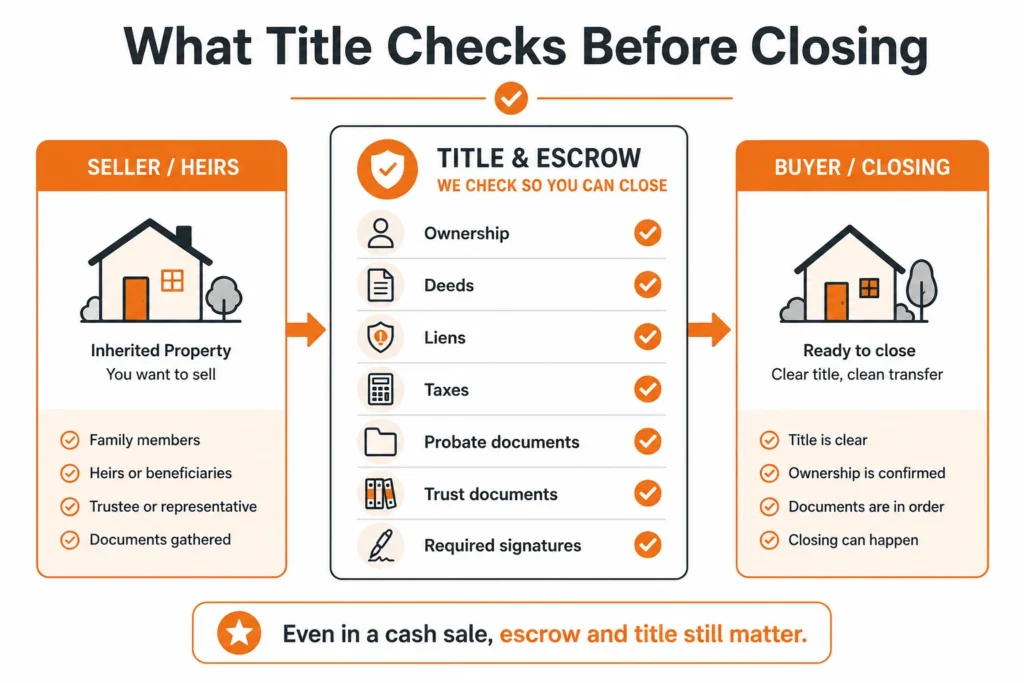
The Title Company Is the Gatekeeper
Title shows what the record says.
The title company is not there to take sides. They are not there to make the buyer happy or the seller happy.
They check the record. They are not there to take anybody’s word for it. They need documents they can rely on. If they cannot insure the transfer, escrow cannot close.
They review ownership, deeds, liens, mortgages, unpaid taxes, probate documents, trust paperwork, payoff demands, and required signatures.
That protects both sides.
It protects the buyer from receiving bad title. It protects the seller by making sure the money, documents, and payoffs are handled through a neutral escrow process.
This is important in a cash sale.
Some sellers think cash means shortcuts. It should not.
Even in a cash sale, escrow and title still matter.
If a buyer is serious, they should be willing to go through escrow and let title do its job.
I have seen title find old liens. I have seen title find unpaid taxes. I have seen title find a deceased owner still on record.
Those things do not always kill a sale.
But they have to be handled before closing.
That is usually where the real problem shows up.
Property Taxes Can Surprise Families With Inherited Property in the Bay Area
Taxes keep moving.
Inherited houses can come with property tax questions. There may be current taxes, delinquent taxes, supplemental bills, or reassessment issues.
In California, Proposition 19 can also affect inherited property taxes.
That does not mean every family gets the same result.
It may depend on who inherited the property, whether it was a primary residence, what the heir does with it, and whether required forms are filed.
Do not guess here.
Talk with the county assessor or a tax professional if taxes are unclear.
This matters in the Bay Area because property values can be high. A family may inherit a house with an old tax basis. Then they find out the future tax bill may change.
That can affect the decision.
Keeping the house, renting it, listing it, or selling privately can all look different once taxes are understood.
The California State Board of Equalization keeps general Proposition 19 information here: California Proposition 19 information.
The tax question should be handled before the family commits.
What If the Paperwork Is Not Clean?
Paperwork problems must be fixed.
Sometimes the house itself is not the first problem. The paperwork is.
Missing trust documents can delay escrow. A deceased owner on title can delay escrow. Missing signatures can delay escrow. A bad deed can delay escrow.
Probate papers may be needed. Court orders may be needed. Letters Testamentary or Letters of Administration may be needed.
Sometimes the fix is simple.
Sometimes it takes an attorney.
Sometimes the family has to slow down before any buyer can close.
This is why I do not like fake promises.
If title has not been reviewed, nobody should promise a clean closing date. They can estimate. They can prepare. But title decides what must happen before closing.
I have seen sellers get excited because someone promised a fast close. Then the title company found a problem nobody asked about.
That creates frustration.
A good buyer asks hard questions early.
That saves time later.
Would Listing With a Realtor Make Sense?
Sometimes listing is better.
I will say that plainly.
If title is clean, the house is presentable, the heirs agree, and the family wants full market exposure, a realtor may be the better route.
That can bring more buyers.
A clean house in a strong Bay Area neighborhood may do well on the MLS. Retail buyers may compete. The family may get a higher gross price.
Before the family chooses a realtor, buyer, or private sale, they should get clear on title, probate, taxes, and who has authority to sign. That decision should come before anyone argues about the final price.
A private cash sale does not always produce the highest price. It usually trades price for speed, privacy, and fewer moving parts.
That trade-off should be said clearly.
If the family has time, cooperation, and money to prepare the house, listing may make sense.
If the house can pass inspections and buyer financing, listing may make sense.
If everyone agrees and title is clean, listing may make sense.
The right answer depends on the real situation.
When a Cash Sale May Not Be the Best Fit
A cash sale is not always the right answer.
If the house is clean, updated, vacant, title is clear, the heirs agree, and the family has time, a traditional listing may bring stronger open-market exposure.
A realtor may be the better first call when:
- The house is presentable and does not need major work
- Title is clear
- All heirs or decision makers agree
- There is no urgent timeline
- The family is willing to handle showings, inspections, repairs, buyer financing, and possible delays
- The main goal is full market exposure instead of speed, privacy, or certainty
That is the honest trade-off. A private sale usually trades some price for speed, privacy, certainty, and fewer moving parts. The family should understand that before deciding.
When Listing Starts Creating Problems
Some houses are not ready.
A traditional listing can get complicated when authority is unclear, probate is unresolved, siblings disagree, or the house needs major work.
The same is true when the family lives out of the area.
Someone has to clean the house. Someone has to meet contractors. Someone has to sort belongings. Someone has to decide what stays and what goes.
Then come showings, inspections, repair requests, credits, buyer delays, and lender questions.
That may be fine for some families.
For others, it is too much.
I have walked through houses where the family had decades of belongings inside. I have seen old plumbing, roof leaks, foundation issues, electrical problems, dry rot, sewer issues, and unpermitted work.
With years of construction and redevelopment experience in the Bay Area, I know how fast repair numbers can move.
One contractor says one number. Another says something else. Then the buyer’s inspector finds more.
That can change the deal.
A listing can still work. But the family should understand what it takes.
Do not choose a listing just because it sounds like the highest price.
Look at the work, time, risk, and family agreement behind that price.
When a Private Sale May Make Sense
Privacy has value too.
A private sale may make sense when the family does not want open houses, repairs, cleanout, or months of back-and-forth.
It may also make sense when the house has title issues, probate questions, old liens, tax concerns, or major repairs.
That does not mean a private sale is always better.
It means it may fit the situation.
Twin Home Buyer can look at the property from a buyer’s perspective. That means looking at the house, repairs, belongings, timeline, title path, and what the seller is trying to solve.
The offer has to make sense for both sides.
That is the honest part.
If you want top open-market exposure, talk with a realtor. If you need legal authority clarified, talk with an attorney. If you want to know what a private sale could look like, then talk with a buyer.
Those are different conversations.
Do them in the right order.
A private sale of inherited property in the Bay Area may make sense when the family wants fewer repairs, less cleanout, and a more private process.
If You Are Stuck, You Can Ask Early
You do not need every answer.
Some families wait because they think they need everything figured out before calling anyone. You do not.
You may not know if the house is in a trust. You may not know if probate is needed. You may not know if all siblings must sign.
That is common.
Twin Home Buyer cannot give legal advice. But we can look at the situation privately and tell you what a buyer and title company will likely need before escrow can close.
That alone can help you know the next step.
Sometimes the next step is calling an attorney.
Sometimes it is finding the trust.
Sometimes it is checking the deed.
Sometimes it is getting all heirs on the same page.
Sometimes it is looking at the property and deciding whether listing or a private sale makes more sense.
A straight conversation early can save a lot of guessing.
How Twin Home Buyer Helps Once Authority Is Clear
Clarity comes before closing.
Once the authority to sell is clear, Twin Home Buyer can look at the property privately and explain what is realistic.
That may mean a private sale without repair work, open houses, or realtor commissions.
It may also mean waiting until probate, title, or signatures are handled.
We work with inherited houses across the Bay Area.
That includes Oakland, Fruitvale, Jingletown, Hayward, Daly City, San Mateo, Fremont, San Jose, Redwood City, Walnut Creek, Burlingame, and nearby cities.
These situations are not all the same. An older East Bay house with deferred maintenance, an out-of-area heir trying to manage a California property, a tenant who does not want to move, or a San Mateo County house with high repair costs can all require a different plan.
We can look at homes with repairs, belongings, old liens, tax issues, tenant problems, or family timing pressure.
But I will say this again.
No buyer can close around bad title.
If title is not ready, the first job is getting the paperwork clear.
Then the family can decide what sale path makes sense.
A Simple Order to Follow Before Selling Inherited Property in the Bay Area
Use this order first.
If you just inherited a house, do not let relatives, buyers, or agents rush you into the wrong first step.
Start here:
- Find out who is on title.
- Look for the trust, will, or deed.
- Ask whether probate is needed.
- Confirm who can legally sign.
- Check taxes, liens, and mortgage balances.
- Talk with siblings or co-heirs early.
- Decide whether listing or private sale fits.
- Open escrow when authority is clear.
That order protects the family.
It also keeps people from fighting over price before they know who can sign.
Start with authority.
Then talk about options.
FAQ
Can I sell a house I just inherited?
Maybe. The first question is whether you have legal authority to sell. If the house is in a trust, the trustee may have authority. If the house is still in the deceased owner’s name, probate or another legal step may be needed. Ask a title company or probate attorney before assuming you can sign.
What if the house is still in my parent’s name?
That usually needs review before a sale can close. The family may need probate, trust documents, or another legal transfer. A cash buyer cannot erase that issue. Title will need proof showing who has authority to sell.
What if there is no will?
No will can mean more court involvement. The property may need probate so the court can appoint someone to handle the estate. That person may be called an administrator. If there is no will and no trust, talk with a probate attorney before signing sale documents.
What if the house is in a trust?
The trust may make the sale easier. But the title company still needs to review the trust and recorded deed. The key question is whether the house was actually transferred into the trust. If it was not, the family may still need legal help.
Do I need probate to sell an inherited house in California?
It depends on title and documents. Probate may be needed if the deceased owner is still on title, there is no trust, or authority is unclear. Some transfers avoid probate, and some California estates may qualify for simplified or summary procedures. For real property, the right path may depend on value, date of death, whether the property was the deceased owner’s primary residence, whether a probate case is already open, and who must sign. Do not guess. A probate attorney or title company can tell you what applies.
Can one sibling sell the house without the others?
Sometimes yes. Often no. It depends on title, trust documents, probate authority, and ownership shares. One sibling may have authority as trustee or court representative. But if multiple heirs or owners must sign, one person cannot force a clean closing alone.
What does a title company check before closing?
They check ownership, deeds, liens, mortgages, unpaid taxes, payoff demands, probate documents, trust paperwork, and required signatures. They also confirm that the seller can legally transfer the house. If they cannot insure title, escrow cannot close.
Do I still have to pay property taxes after inheriting a house?
Property taxes still matter after inheritance. There may be current taxes, delinquent taxes, supplemental bills, or reassessment questions. Proposition 19 may also affect some inherited properties in California. Talk with the county assessor or a tax professional before assuming the old tax bill stays the same.
What if I do not know whether I can sell?
That is common. Start by checking the deed, trust, will, and county records. Then speak with a title company or probate attorney. You can also talk with a buyer early to understand what escrow may ask for, but legal authority should be confirmed by the proper professional.
Can Twin Home Buyer buy a house in probate?
Yes, in some cases. Twin Home Buyer can buy probate properties when the proper authority and court requirements are in place. A private cash sale may be simpler than listing, but it may not bring the same market exposure. If the family wants the highest open-market price, a realtor may be the better first call.
Final Word
An inherited house carries a lot.
It carries family history, old bills, repairs, tax questions, title records, and decisions nobody wanted to make too early.
That does not mean you are behind.
It means you need the right order.
After 27 years in this business, I have learned that the first issue is not always price. Sometimes it is title. Sometimes it is probate. Sometimes it is family agreement. Sometimes it is the house itself.
Before you decide what to do, understand your options.
If you inherited a Bay Area property and you are not sure whether it is in a trust, probate, your name, your sibling’s name, or still in your parent’s name, get clarity first.
Once authority is clear, Twin Home Buyer can look at the property privately.
That may mean a private sale without repairs, cleanout, open houses, or realtor commissions.
Before you call, gather what you can: the property address, the most recent deed, any trust or probate papers, mortgage information, tax bills, and the names of the decision makers. If you do not have everything, that is fine. We can still look at the situation and tell you what a buyer and title company will likely need next.
Call or text Twin Home Buyer at (415) 415-TWIN.
No pressure. We will look at the property, the paperwork situation, the repairs, and the timeline. Then we can tell you what is realistic.
What Our Clients Say
⭐ Trusted by Homeowners Everywhere
We’re proud that 92% of our customers rate their experience with us as excellent.
Rafael P.

Stress free process, paid all the closing costs and didn’t have to do any cleaning or repairs. Juan Diaz and team are men of their word. Very professional and respectful. The escrow process was a piece of cake. The best part is they close faster than any realtor listing the house ever could. If you’re looking for a no hassle way to sell your house quickly then I definitely recommend Twin home buyer and team.
Robert R.
I can’t speak highly enough about Juan Diaz and his team at Twin Home Buyer. I'm truly honored to be able to work with them and learn from them. Their professionalism, knowledge, honesty, integrity, and hard work ethics are very much admired and respected. They are highly experienced, detail oriented, honest, and truly care about their clients' needs. They deliver on their promises and go above and beyond to get the job done. I look forward to continuing to work with them. I recommend them 100%!
Edgar R.
Called Twin Home Buyer with questions about my property. They listened, offered honest advice, and followed up just like they said they would. Super kind and no pressure. I haven’t sold yet, but I’d definitely recommend giving them a call. Great people!
Jose J.
The twin home buyer was awesome to deal with although they did not buy my house. They recommended me over to an amazing realtor that was able to get top dollar for my property. They let me know upfront that it was not the right match that they could not help me, but it didn’t stop there this company generally cares
Gabriela G.
I've had the opportunity to work with Twin Home Buyer on a few occasions. And everytime has been a great experience. They do excellent work! Juan Diaz is Honest, trustworthy and very easy to work with. I always recommend him to my clients when they want a cash, quick close. I look forward to keep working with them in the future.
Tewfik H
I met with Juan Diaz on Saturday April 2nd and after showing him my property we sat down and discussed price. We finally agreed on a price that was not far off my asking. I felt strongly that Juan was genuine. He sent me a sale and purchase agreement that afternoon. I reviewed and had an advisor from HomeLight review it. The advisor said it was a "good agreement" and that it was "solid". I proceeded with the agreement on April 4th with up to 60 days to close. I may close sooner if I wish. Before meeting Juan I was dealing with two RE agents. One was great bit she overpromised the selling price, even when I presented her with contradictory comps. The other RE agent was pushy and persistent. Both agents wanted me to pour more money into the property. I felt that repairs and improvements were constantly draining my energy. What Juan gave me was a solution to my endless repairs and freedom from dealing with agents. He also alleviated my concerns by offering an Earnest Money Deposit of $50K. That's more than the standard $19.5K. He will also pay all the closing costs. All I would be responsible for is paying off the loan. I was almost immediately notified by the Title Company that the money was in Escrow. To sweeten the deal he also offered to have his guys move our stuff. I told him that I did not expect that but I definitely welcome it. Today someone dropped off 10 heavy duty boxes as I had requested. What more, there's is no need to clear out all of the junk that we accumulated over the years. That's a big help along with the 60 days. Moving is a stressful period in life and Juan made it that much easier. Now I will sit back and wait for an opportunity to buy again.
Tewfik H
Twin Home Buyer made selling my house simple and hassle-free. Their offer was fair, and they handled everything efficiently. I couldn’t have asked for a smoother experience!..
Abbas M.
Very seamless and professional. They do exactly what they say they would do. We work with a lot of sellers and I continue to refer to Juan and team for those who want to sell quickly and with the least hassle.
Suzanne P.
I had the pleasure of being contacted by one of the team members with Twin Homes. She was very pleasant to speak with and asked me to assist with the sale of one of their homes. She was prompt and available when I needed her. I later spoke with Juan Diaz who exemplified the values I stand for as a real estate professional. I have had such pleasant interactions with the entire team that I would always pick up the phone for them. If you have the opportunity to work on the buy or sale side I am sure you will be surprised with the communication and attention to detail they show. They have done the big and little things very well.
Gabriela G.
I've had the opportunity to work with Twin Home Buyer on a few occasions. And everytime has been a great experience. They do excellent work! Juan Diaz is Honest, trustworthy and very easy to work with. I always recommend him to my clients when they want a cash, quick close. I look forward to keep working with them in the future.
Bianca C.
What sets Twin Home Buyer apart is their personalized approach to customer service. The team took the time to understand my unique needs and provided tailored support and guidance every step of the way, ensuring a seamless selling experience. Overall, I couldn't be more satisfied with my experience with Twin Home Buyer. If you're considering selling your home and want a hassle-free, fair, and transparent process, I highly recommend reaching out to Twin Home Buyer.
