A cash buyer can be ready to close, but that does not mean escrow can close.
That is the part many sellers do not realize until they are already in the middle of a sale.
The buyer may have the money.
The seller may have signed the contract.
Everyone may want the deal to move fast.
But if title shows an old loan, lien, deceased owner, missing signature, probate issue, trust problem, judgment, unpaid taxes, or ownership dispute, the money is only one part of the deal.
The property still has to be legally and practically transferable.
That is why sellers sometimes get stuck. They think the hard part is finding a buyer. Then escrow opens, the title company reviews the records, and suddenly everyone is waiting on paperwork, signatures, payoff information, court documents, releases, or clarification.
A cash buyer can help remove lender delays.
Cash does not automatically remove title problems.
Direct Answer: Can a Cash Buyer Close If There Are Title Problems?
Yes, a cash buyer can sometimes close if there are title problems, but only if the issue can be reviewed, cleared, paid, released, corrected, insured, or accepted by escrow and the title company.
Cash can remove buyer-financing problems like loan approval, appraisal delays, lender-required repairs, and underwriting.
But cash does not remove the need for:
- Clear ownership
- Proper seller authority
- Required signatures
- Payoff information
- Lien releases
- Trust or probate documents
- Title company review
- Escrow instructions
- Recording requirements
A cash buyer may be ready. The seller may be ready. But the title still has to be ready enough for escrow to close.
Important note: Twin Home Buyer is not a law firm and does not provide legal services, legal advice, probate services, title services, tax advice, or court representation. This article is for general seller education only. If your situation involves probate, a trust, liens, judgments, tax issues, ownership disputes, missing signatures, or unclear authority, speak with the right professional. That may include an attorney, escrow officer, title company, tax professional, lender, court representative, trustee, executor, administrator, or county office.
Cash Solves the Buyer Problem, Not the Title Problem
A cash buyer can be helpful because they may not need:
- Mortgage approval
- Appraisal approval
- Loan underwriting
- Lender-required repairs
- Financing contingency delays
- Bank review of the property condition
That can make a big difference, especially if the property needs repairs, has tenants, has been inherited, or would not qualify easily for a traditional financed buyer.
But escrow still has to answer a different question:
Can this property transfer from the current legal owner to the buyer?
That question has nothing to do with whether the buyer has cash in the bank.
It has to do with the property records.
For example, a seller in Oakland, the East Bay, San Mateo County, or anywhere in California may have a buyer ready to close, but the sale can still slow down if:
- An old mortgage still appears on title
- A deceased parent is still listed as the owner
- The house is in a trust and the trustee documents are missing
- A sibling or co-owner refuses to sign
- A tax lien or judgment needs to be reviewed
- A payoff amount is unclear
- A previous loan was paid off but never properly released
- Escrow needs court documents, probate documents, or authority documents
In those situations, the buyer’s cash helps, but it does not skip the title process.
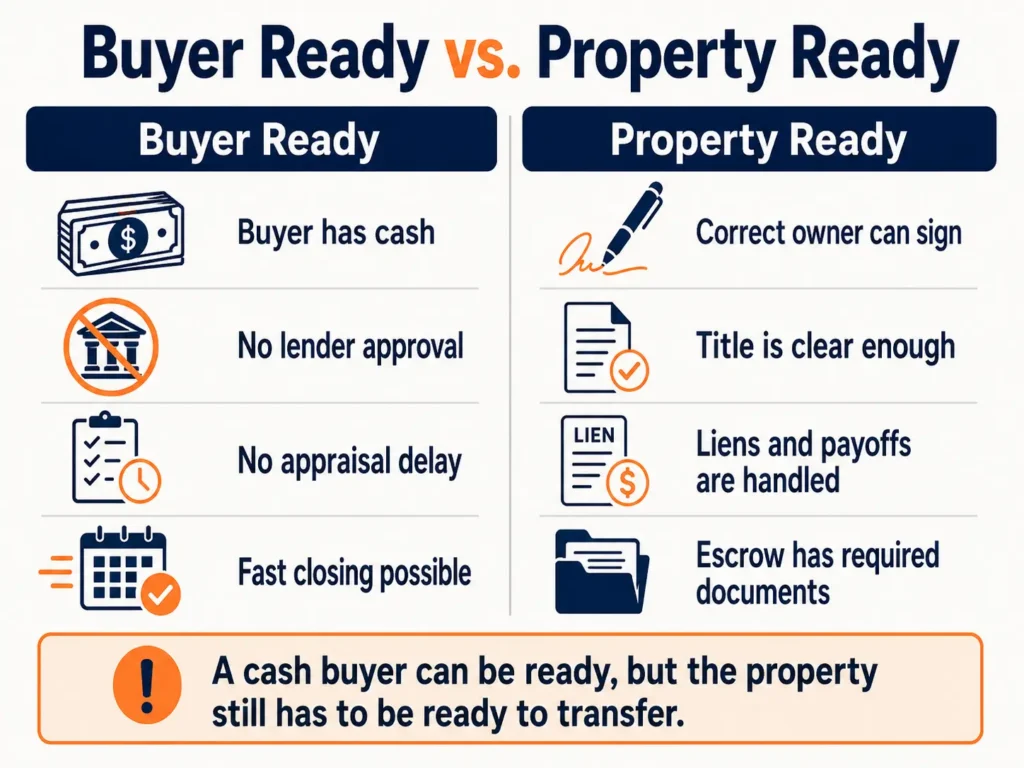
Buyer Ready vs. Property Ready
There are two different questions in a real estate sale:
- Is the buyer ready?
- Is the property ready to transfer?
Those are not the same thing.
A buyer may be ready if they have the money, understand the price, and want to close.
But the property may not be ready if title shows an issue that escrow has to handle first.
This is where many sellers get frustrated.
They may say, “The buyer has cash, so why are we waiting?”
The answer is usually simple: escrow is not just checking the buyer. Escrow and title are checking whether the property can be transferred correctly.
A cash buyer may remove lender problems.
Title problems are different.
The Four Types of Title Problems That Usually Slow Down a Sale
Not every title problem is the same. Some are simple. Some are serious. Some can be handled during escrow. Some need more time.
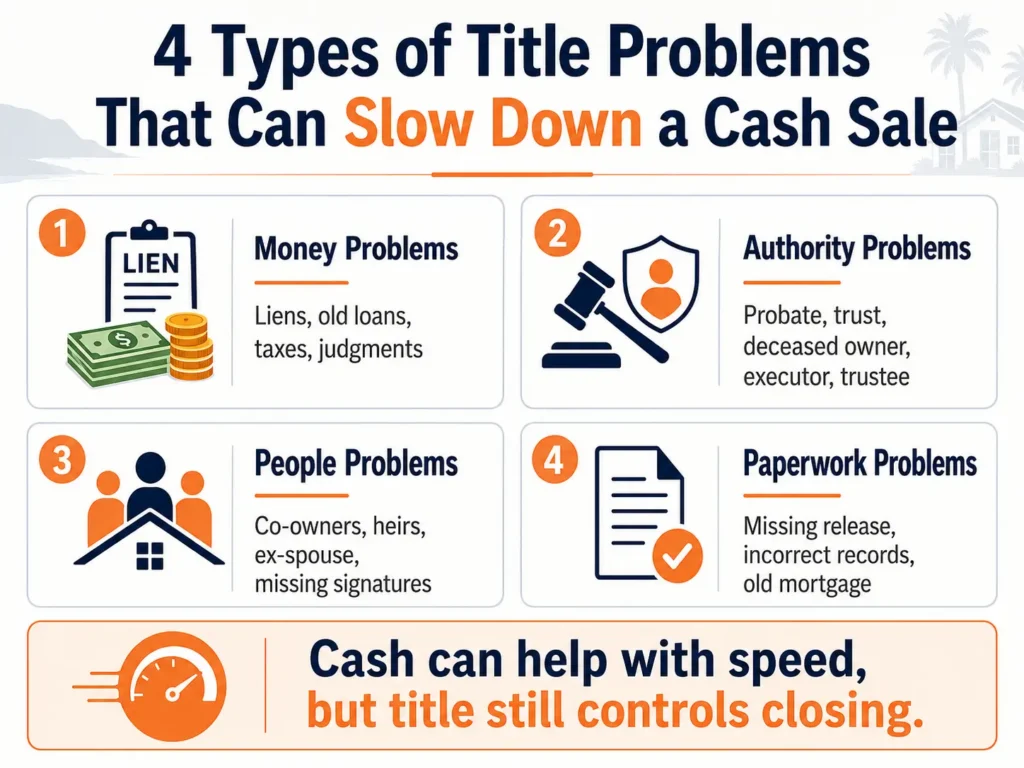
A practical way to understand title problems is to put them into four buckets:
- Money problems
- Authority problems
- People problems
- Paperwork problems
Once you know which type of problem you are dealing with, it is easier to understand what may be holding up the closing.
1. Money Problems: Liens, Old Loans, Judgments, and Taxes
Some title problems are really money problems.
That may include:
- Old mortgages
- Tax liens
- Judgment liens
- Mechanic’s liens
- HOA balances
- Code fines
- Back property taxes
- Unpaid property-related debts
- Recorded claims against the property
These issues can matter because escrow may need to know what must be paid before the seller receives money.
A seller may accept a cash offer and think:
“That is the amount I am walking away with.”
But title may show old loans, liens, taxes, or recorded debts that have to be handled first.
That means the offer price and the final walk-away amount may not be the same.
Sometimes these items can be paid through escrow from the seller’s proceeds. Sometimes they need more review. Sometimes the seller may need a payoff, release, correction, or professional help before escrow can move forward.
This is why sellers should not only ask, “What is the offer?”
They should also ask:
“What does title show, and what has to be paid or cleared before closing?”
2. Authority Problems: Deceased Owners, Probate, Trusts, and Estates
Some title problems are not about money. They are about authority.
That means escrow needs to know who has the legal right to sign.
This comes up often with inherited houses in California.
A family may believe they can sell the house because the property belonged to a parent, grandparent, spouse, or relative. But if the person who passed away is still on title, escrow may need to see who has authority to sell.
That may involve:
- A trust
- A trustee
- Probate
- An executor
- An administrator
- Court documents
- Estate documents
- A surviving spouse
- Other legal authority
A cash buyer cannot skip that step.
If the person signing does not have the authority to sell, escrow may not be able to close.
This is one of the biggest misunderstandings with inherited properties. The problem is not always the house. The problem may be that the family has not confirmed who can legally sign.
A seller may clean out the property, find a buyer, agree on price, and still be stuck because authority has not been confirmed.
That does not always mean the sale is dead. But it does mean the right documents or professional guidance may be needed before the sale can close.
3. People Problems: Co-Owners, Heirs, Ex-Spouses, and Family Disagreement
Some title problems are really people problems.
This happens when more than one person has a legal interest in the property or when more than one person may need to sign.
Examples include:
- Multiple siblings inherited the property
- One owner lives out of state
- One owner does not agree to sell
- An ex-spouse is still connected to title
- A family member cannot be reached
- One person thinks they can sell alone but cannot
- The title company needs signatures from additional people
A cash buyer may be ready to close, but the sale can stop if the required people do not sign.
This is not a cash problem.
It is a people and authority problem.
This happens often with long-time family homes in the Bay Area. A parent may have owned the house for decades. After they pass away, multiple children or relatives may become involved. One person may be handling the sale, but escrow may still need to confirm who has the right to sign and whether everyone required is in agreement.
That is why sellers should find out early who is on title and who escrow needs involved.
4. Paperwork Problems: Missing Releases, Old Loans, and Incorrect Records
Some title problems are paperwork problems.
The issue may not be that money is owed or that anyone is fighting. The problem may be that the records are incomplete, old, or unclear.
Examples include:
- A loan was paid off years ago but still appears on title
- A release was never recorded correctly
- A deed is missing or incorrect
- A trust document is incomplete
- A legal description needs review
- A lender needs to confirm a payoff
- A county record needs correction
- Title needs more documentation before insuring the sale
This can happen with older California homes that have been refinanced, transferred, inherited, or owned by the same family for many years.
The seller may honestly believe everything is clean. Then the preliminary title report shows an old item that nobody expected.
That does not automatically mean the sale cannot happen. But escrow may need proof, clarification, a release, or review before closing.
Why the Preliminary Title Report Matters
In many sales, title problems show up after escrow opens and the title company reviews the property records.
That is usually when the seller first hears that something needs to be cleared, explained, corrected, or paid.
A preliminary title report may show:
- Who appears to own the property
- Loans recorded against the property
- Liens or judgments
- Property tax issues
- Easements or recorded restrictions
- Requirements before closing
- Documents the title company needs
- Exceptions that may need explanation
A seller may think the house is ready to close because they found a buyer.
But the preliminary title report may show something that still needs attention.
That can be frustrating because the seller may have already made plans. The family may be waiting on the money. The house may be vacant. Repairs may be getting worse. A tenant may still be inside. Or another buyer may have already backed out.
That is why the title report matters.
It tells everyone what has to be handled before the property can transfer.
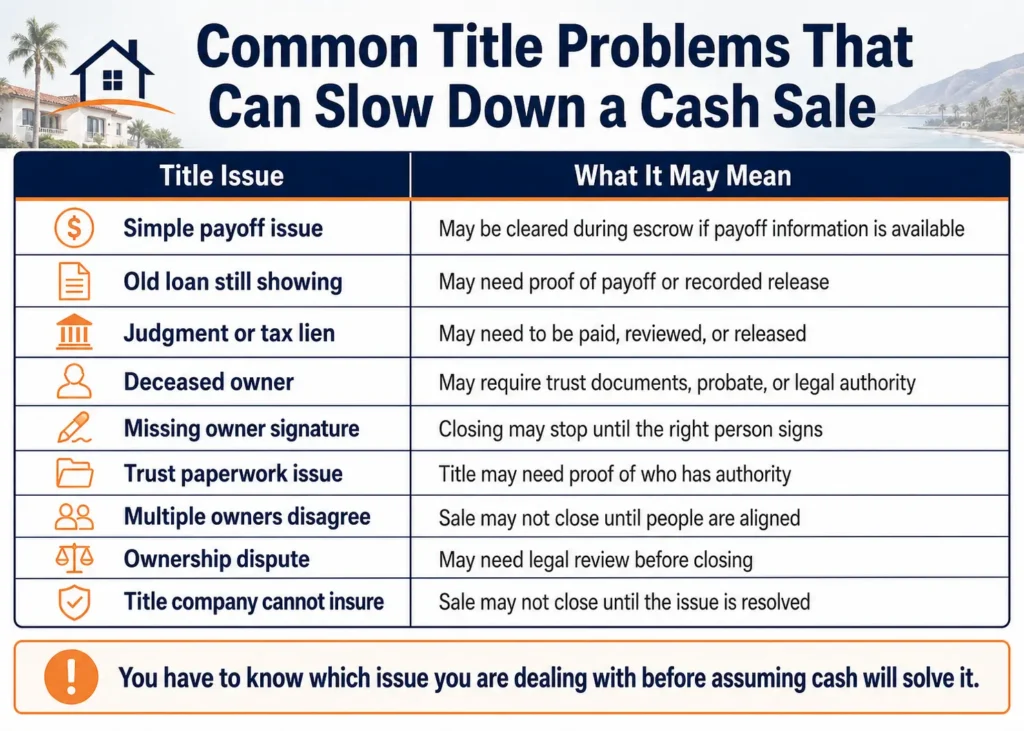
Common Title Problems That Can Slow Down a Cash Sale
Here are some of the most common issues that can slow down a cash sale.
An Old Mortgage Still Shows on Title
Sometimes a loan was paid off years ago, but the release was not recorded correctly.
The seller may believe the loan is gone, but the title report still shows it.
Escrow may need proof that the loan was satisfied. In some cases, the lender, title company, or another professional may need to help verify or clear the issue.
This can happen with Bay Area homes that have been owned for decades or refinanced multiple times. A parent or grandparent may have handled the loan years ago, and the current seller may not have the paperwork.
The buyer may have cash, but escrow still needs to know whether that old loan affects the transfer.
There Are Liens or Judgments Against the Property
Liens and judgments can create problems because they may need to be paid, negotiated, released, or reviewed before closing.
Examples may include:
- Tax liens
- Judgment liens
- Mechanic’s liens
- HOA balances
- Code fines
- Unpaid property-related debts
- Recorded claims against the property
Sometimes these issues can be handled through escrow. Sometimes they affect the seller’s net proceeds. Sometimes they require more review before the title company can move forward.
This is where sellers need to understand the difference between the offer price and the amount they may actually receive after payoffs or title-related debts are handled.
The Owner on Title Has Passed Away
This is common with inherited homes.
If the property is still in the name of someone who passed away, the family may need to show who has authority to sell.
That may involve a trust, probate, an executor, an administrator, a surviving spouse, court documents, estate documents, or another form of legal authority.
A cash buyer cannot simply ignore that.
If the right person cannot legally sign, escrow may not be able to close.
Multiple People Are on Title
If more than one person owns the property, escrow may need signatures from all required owners.
That can become difficult if one owner is out of state, one owner disagrees, an ex-spouse is still connected to title, or a family member cannot be reached.
A seller may think the house is “basically mine,” but escrow has to follow the records and required documents.
If the title company says another person needs to sign, the buyer having cash does not remove that requirement.
Trust or Estate Paperwork Is Missing
If the house is in a trust or estate, escrow may need documents showing who has authority to act.
The title company may need to confirm:
- Who the trustee is
- Whether the trustee has authority to sell
- Whether the trust documents are complete
- Whether probate is required
- Whether the estate representative can sign
- Whether heirs or beneficiaries need to be involved
The seller may not know the answer immediately. That is normal.
But the issue still has to be reviewed before closing.
Back Taxes or Unpaid Property Bills Exist
Unpaid property taxes or recorded debts may need to be addressed before the sale can close.
This does not always mean the sale is impossible.
But it may affect:
- The closing timeline
- The payoff process
- The seller’s net proceeds
- What escrow needs before closing
- Whether the buyer still wants to move forward
A cash buyer may be more flexible than a traditional buyer, but escrow still needs clear instructions on what must be paid or resolved.
Do Not Assume Cash Means the Title Issue Is Minor
Do not assume a title issue is minor just because the buyer has cash.
Also, do not assume the sale is impossible just because title found something.
The real question is:
What does escrow or the title company need before closing can move forward?
Some problems can be handled during escrow. Others need more time. Some require an attorney, court, lender, trustee, executor, administrator, county office, or another professional before the sale can close.
Guessing is where sellers lose time.
They either panic and think the deal is dead, or they assume everything is fine because the buyer has cash.
Neither one helps.
The better move is to find out exactly what is stopping the closing.
Questions Sellers Should Ask Escrow or the Title Company
If escrow or the title company says there is a title issue, ask direct questions.
You do not need to become a title expert. But you should understand what is holding up the sale.
Helpful questions include:
- What exact issue is stopping or delaying closing?
- Is this a money issue, authority issue, people issue, or paperwork issue?
- What document is missing?
- Who needs to sign?
- Can this be handled during escrow?
- Will this affect my net proceeds?
- Does this require an attorney, court, lender, trustee, executor, administrator, or county office?
- What is the next step escrow or title needs from me?
- Is the issue likely to affect closing instructions?
- Can the buyer move forward while the issue is being reviewed?
These questions keep the conversation practical.
The goal is not to solve everything yourself.
The goal is to understand what is actually slowing the sale down.
What Should You Gather If a Title Problem Comes Up?
If a title issue has already come up, try to gather whatever paperwork you have.
You may not have everything. That is normal.
Helpful items may include:
- Preliminary title report
- Escrow notice or title company message
- Old loan information
- Mortgage payoff letters
- Lien or judgment notices
- Trust documents
- Probate documents
- Death certificate, if applicable
- Names of all owners on title
- Contact information for escrow or title
- Letters from a lender, county, court, or attorney
You do not need to solve the problem before reaching out.
But if you have paperwork, bring it into the conversation. It helps the buyer, escrow, title company, or professional ask better questions.
Can a Cash Buyer Still Buy a House With Title Problems?
Sometimes, yes.
A cash buyer may still buy a house with title problems if the issue can be reviewed, cleared, paid, corrected, released, insured, or accepted by escrow and the title company.
But it depends on the issue.
Some title problems can be handled during escrow.
Others take longer.
Some may require help from a title company, escrow officer, attorney, lender, court, trustee, executor, administrator, county office, or another professional.
A cash buyer may be more patient, flexible, and experienced than a traditional retail buyer. That can help when the property has title issues plus other problems, such as repairs, tenants, family disagreement, or timeline pressure.
But the cash buyer still needs escrow to close correctly.
Not Every Cash Buyer Handles Title Problems the Same Way
A seller may hear “cash buyer” and think every buyer is the same.
They are not.
Some buyers understand complicated escrow situations. Some do not.
Some buyers are patient when title needs more time. Others walk away as soon as the deal gets complicated.
Some buyers understand old loans, liens, inherited homes, tenants, probate, trusts, and multiple-owner situations. Others only understand simple deals.
That does not mean every buyer is bad.
It means sellers should understand who they are dealing with.
A seller should ask:
- Does the buyer understand escrow delays?
- Has the buyer handled title issues before?
- Is the buyer willing to work through the problem?
- Is the buyer actually buying the property, or assigning the contract?
- Will the buyer stay in communication if closing takes longer?
- Does the buyer understand as-is properties and complicated seller situations?
The question is not just whether the buyer says they have cash.
The question is whether they understand the situation well enough to help the transaction move toward closing.
When a Cash Buyer May Be Helpful
A cash buyer may be helpful when the title issue is only one part of a bigger seller problem.
For example, the seller may also be dealing with:
- A house that needs repairs
- A vacant property
- A tenant-occupied house
- Family disagreement
- Probate or trust questions
- An inherited property
- A property that would struggle with traditional financing
- A buyer who already backed out
- A sale that needs flexibility
- A seller who wants privacy and fewer showings
In the Bay Area and Northern California, title issues often come with other real-life problems.
A house may be older, inherited, tenant-occupied, behind on repairs, or owned by multiple family members. The seller may not want open houses, repeated inspections, repair negotiations, lender conditions, or months of uncertainty.
In those situations, a cash buyer may help because the issue is not just the title.
The issue is the whole situation.
A good cash buyer is not just bringing money. They are looking at the property, the people involved, the paperwork, the condition, the timeline, and what needs to happen for the sale to make sense.
When a Cash Buyer May Not Be Enough
A cash buyer may not be enough if the title issue prevents the property from legally transferring.
That can happen if:
- Nobody has legal authority to sell
- Required owners refuse to sign
- Probate has not been handled
- A court order is needed
- A lien cannot be released
- A payoff cannot be confirmed
- There is an ownership dispute
- The title company cannot insure the transaction
- The seller needs legal advice before moving forward
This is important.
No buyer should promise that every title problem can be fixed overnight.
Some issues need the right professional involved first.
That may mean escrow, title, an attorney, a lender, a court, a trustee, an executor, an administrator, a tax professional, or a county office.
It is better to understand the issue early than to push a sale that cannot close.
Should You List the House or Sell to a Cash Buyer If There Are Title Problems?
There is no one right answer for every seller.
The best choice depends on the house, the paperwork, the people involved, the timeline, and what the seller actually needs.
Option 1: Listing With an Agent
Listing with an agent may make sense if:
- The title issue is already being cleared
- The house is in good condition
- The seller has time
- The ownership paperwork is clean enough
- The seller wants to test the open market
- The property can handle showings and inspections
- The seller is comfortable with a traditional sale process
If the house is clean, marketable, and the seller has time, listing may help the seller reach more buyers.
But if the house has title issues plus major repairs, tenants, family disagreement, or timeline pressure, the process can become more complicated.
Option 2: Working With a Cash Buyer
A cash buyer may make sense if:
- The house needs repairs
- The seller wants speed after title is cleared
- The seller does not want repeated showings
- The property has tenants or occupancy issues
- The seller needs a buyer who understands complicated situations
- The seller wants a direct as-is sale
- The seller values certainty and privacy more than testing the market
- The seller does not want repair negotiations or lender issues
A cash buyer may not remove the title problem, but they may remove other problems from the sale.
That can matter when the seller is already dealing with enough.
Option 3: Slowing Down and Getting Professional Help First
Sometimes the best move is not to list or sell immediately.
Sometimes the seller needs to slow down and get the right help first.
That may be the best option if:
- Authority is unclear
- Probate may be needed
- A trust issue exists
- There is a serious dispute
- A title company or attorney needs to review documents
- The seller does not know who can legally sign
- The title company cannot move forward yet
This is not a failure.
It is better to understand the issue early than to push a sale that cannot close.
A serious buyer should understand that.
How Twin Home Buyer Looks at Title Problems
At Twin Home Buyer, we do not look only at the house.
We look at the whole situation.
That can include:
- Who owns the property
- Who can sign
- Whether there are liens or old loans
- Whether the house is vacant or occupied
- Whether repairs are needed
- Whether tenants are involved
- Whether there are family or probate issues
- What escrow may need before closing
- What timeline the seller is trying to meet
- Whether a direct as-is sale makes sense once the issue is reviewed
We cannot promise that every title issue can be fixed.
We cannot give legal advice.
We cannot force other owners, heirs, lenders, lienholders, courts, or county offices to move faster.
But we can look at the property situation, ask practical questions, talk through what may be slowing the sale down, and work with escrow if a direct sale makes sense.
Sometimes the seller needs an attorney first.
Sometimes the seller needs title or escrow to explain what is missing.
Sometimes the issue can be handled during escrow.
Sometimes the timeline has to change.
The goal is not to pretend every situation is easy.
The goal is to understand the problem clearly so the seller can make a better decision.
Title Problem Slowing Down Your Sale?
If escrow found an old loan, lien, deceased owner, missing signature, probate issue, trust issue, tax problem, ownership dispute, or other title problem, do not guess.
Start by finding out what escrow or the title company needs.
Then look at the full situation:
- Who can sign?
- What needs to be cleared?
- What paperwork is missing?
- What will affect your net proceeds?
- Is the house also dealing with repairs, tenants, vacancy, or family pressure?
- Does a direct as-is sale still make sense once the title issue is reviewed?
Twin Home Buyer can help you look at the property situation and ask practical questions. If a direct as-is sale makes sense after the title issue is reviewed by the right professional, we can talk through that option with you.
Call Twin Home Buyer at (415) 415-8496 or fill out the form on this page to start the conversation.
Twin Home Buyer does not provide legal services, legal advice, probate services, title services, tax advice, or court representation. If your title issue involves probate, a trust, liens, ownership disputes, missing signatures, tax problems, or unclear authority, you may need to speak with an attorney, title company, escrow officer, tax professional, lender, court representative, trustee, executor, administrator, or the appropriate county office before closing can move forward.
Final Thoughts: Cash Helps, But Title Still Controls the Closing
A cash buyer can make a sale simpler in many situations.
Cash can remove lender delays, appraisal issues, financing problems, and repair conditions from the buyer side of the deal.
But cash does not automatically clear title.
If there are title problems, old loans, liens, deceased owners, missing signatures, trust issues, probate questions, or unclear authority, escrow still needs the issue handled before the property can transfer.
Before deciding what to do, understand the problem clearly.
Then you can decide whether listing, waiting, getting professional help, or selling directly makes the most sense.
The real lesson is simple:
Cash helps with the buyer side of the deal. Title still controls whether the property can close.
Frequently Asked Questions
Can a cash buyer buy a house with title problems?
Sometimes, yes. A cash buyer may be able to buy a house with title problems, but the issue usually has to be reviewed, cleared, paid, released, corrected, insured, or accepted by escrow and the title company before closing.
Does cash fix title problems?
No. Cash can remove financing delays, but it does not automatically fix title problems, ownership issues, liens, probate problems, missing signatures, missing documents, or unclear authority.
Can title problems stop a cash sale?
Yes. Even if the buyer has cash, escrow may not be able to close if the title issue prevents the property from transferring properly.
What title problems can delay closing?
Common title problems that can delay closing include old mortgages, liens, judgments, deceased owners, probate issues, trust paperwork problems, unpaid taxes, missing signatures, unreleased loans, incorrect records, or ownership disputes.
Can a cash buyer close if the owner on title passed away?
It depends. If someone on title passed away, the family may need to show who has authority to sell. That may involve a trust, probate, executor, administrator, surviving spouse, court document, or another legal process.
Twin Home Buyer does not provide probate services or legal advice, so sellers should speak with the right professional if authority is unclear.
Can liens be paid from the sale proceeds?
Sometimes, yes. Some liens or debts may be paid through escrow from the sale proceeds. It depends on the type of lien, payoff amount, available equity, title company requirements, and the seller’s situation.
Should I talk to a title company before selling?
If you already know there may be title issues, it is smart to involve escrow, a title company, or the right professional early so you understand what may need to be handled before closing.
Is selling to a cash buyer better than listing if there are title problems?
It depends on the situation. Listing may make sense if the house is in good condition, the seller has time, and the title issue is already being cleared. A cash buyer may make sense if the house needs repairs, the seller wants privacy, the seller wants fewer showings, or the seller needs a buyer who understands complicated escrow situations.
Can Twin Home Buyer help if my house has title problems?
Twin Home Buyer can review the property situation and talk through whether a direct as-is sale may make sense once the title issue is reviewed by the right professional.
Some issues may still need help from escrow, a title company, attorney, lender, court, county office, trustee, executor, administrator, tax professional, or another appropriate professional before closing.
Twin Home Buyer does not provide legal services, legal advice, title services, probate services, tax advice, or court representation.
What should I do if escrow found a title problem?
Start by asking escrow or the title company what issue was found, what document or action is needed, and whether the issue affects closing, timing, or net proceeds.
Ask whether it is a money issue, authority issue, people issue, or paperwork issue.
If you are unsure what to do next, you may need help from escrow, title, an attorney, lender, court, trustee, executor, administrator, tax professional, county office, or another professional depending on the issue.
What Our Clients Say
⭐ Trusted by Homeowners Everywhere
We’re proud that 92% of our customers rate their experience with us as excellent.
Rafael P.

Stress free process, paid all the closing costs and didn’t have to do any cleaning or repairs. Juan Diaz and team are men of their word. Very professional and respectful. The escrow process was a piece of cake. The best part is they close faster than any realtor listing the house ever could. If you’re looking for a no hassle way to sell your house quickly then I definitely recommend Twin home buyer and team.
Robert R.
I can’t speak highly enough about Juan Diaz and his team at Twin Home Buyer. I'm truly honored to be able to work with them and learn from them. Their professionalism, knowledge, honesty, integrity, and hard work ethics are very much admired and respected. They are highly experienced, detail oriented, honest, and truly care about their clients' needs. They deliver on their promises and go above and beyond to get the job done. I look forward to continuing to work with them. I recommend them 100%!
Edgar R.
Called Twin Home Buyer with questions about my property. They listened, offered honest advice, and followed up just like they said they would. Super kind and no pressure. I haven’t sold yet, but I’d definitely recommend giving them a call. Great people!
Jose J.
The twin home buyer was awesome to deal with although they did not buy my house. They recommended me over to an amazing realtor that was able to get top dollar for my property. They let me know upfront that it was not the right match that they could not help me, but it didn’t stop there this company generally cares
Gabriela G.
I've had the opportunity to work with Twin Home Buyer on a few occasions. And everytime has been a great experience. They do excellent work! Juan Diaz is Honest, trustworthy and very easy to work with. I always recommend him to my clients when they want a cash, quick close. I look forward to keep working with them in the future.
Tewfik H
I met with Juan Diaz on Saturday April 2nd and after showing him my property we sat down and discussed price. We finally agreed on a price that was not far off my asking. I felt strongly that Juan was genuine. He sent me a sale and purchase agreement that afternoon. I reviewed and had an advisor from HomeLight review it. The advisor said it was a "good agreement" and that it was "solid". I proceeded with the agreement on April 4th with up to 60 days to close. I may close sooner if I wish. Before meeting Juan I was dealing with two RE agents. One was great bit she overpromised the selling price, even when I presented her with contradictory comps. The other RE agent was pushy and persistent. Both agents wanted me to pour more money into the property. I felt that repairs and improvements were constantly draining my energy. What Juan gave me was a solution to my endless repairs and freedom from dealing with agents. He also alleviated my concerns by offering an Earnest Money Deposit of $50K. That's more than the standard $19.5K. He will also pay all the closing costs. All I would be responsible for is paying off the loan. I was almost immediately notified by the Title Company that the money was in Escrow. To sweeten the deal he also offered to have his guys move our stuff. I told him that I did not expect that but I definitely welcome it. Today someone dropped off 10 heavy duty boxes as I had requested. What more, there's is no need to clear out all of the junk that we accumulated over the years. That's a big help along with the 60 days. Moving is a stressful period in life and Juan made it that much easier. Now I will sit back and wait for an opportunity to buy again.
Tewfik H
Twin Home Buyer made selling my house simple and hassle-free. Their offer was fair, and they handled everything efficiently. I couldn’t have asked for a smoother experience!..
Abbas M.
Very seamless and professional. They do exactly what they say they would do. We work with a lot of sellers and I continue to refer to Juan and team for those who want to sell quickly and with the least hassle.
Suzanne P.
I had the pleasure of being contacted by one of the team members with Twin Homes. She was very pleasant to speak with and asked me to assist with the sale of one of their homes. She was prompt and available when I needed her. I later spoke with Juan Diaz who exemplified the values I stand for as a real estate professional. I have had such pleasant interactions with the entire team that I would always pick up the phone for them. If you have the opportunity to work on the buy or sale side I am sure you will be surprised with the communication and attention to detail they show. They have done the big and little things very well.
Gabriela G.
I've had the opportunity to work with Twin Home Buyer on a few occasions. And everytime has been a great experience. They do excellent work! Juan Diaz is Honest, trustworthy and very easy to work with. I always recommend him to my clients when they want a cash, quick close. I look forward to keep working with them in the future.
Bianca C.
What sets Twin Home Buyer apart is their personalized approach to customer service. The team took the time to understand my unique needs and provided tailored support and guidance every step of the way, ensuring a seamless selling experience. Overall, I couldn't be more satisfied with my experience with Twin Home Buyer. If you're considering selling your home and want a hassle-free, fair, and transparent process, I highly recommend reaching out to Twin Home Buyer.
