
A Bay Area inherited house can be worth a lot on paper and still not be ready to sell.
That surprises families.
They think the first question is, “What is the house worth?”
But when someone passes away and the property needs to be sold, the first question is often more important:
Who has the authority to sign?
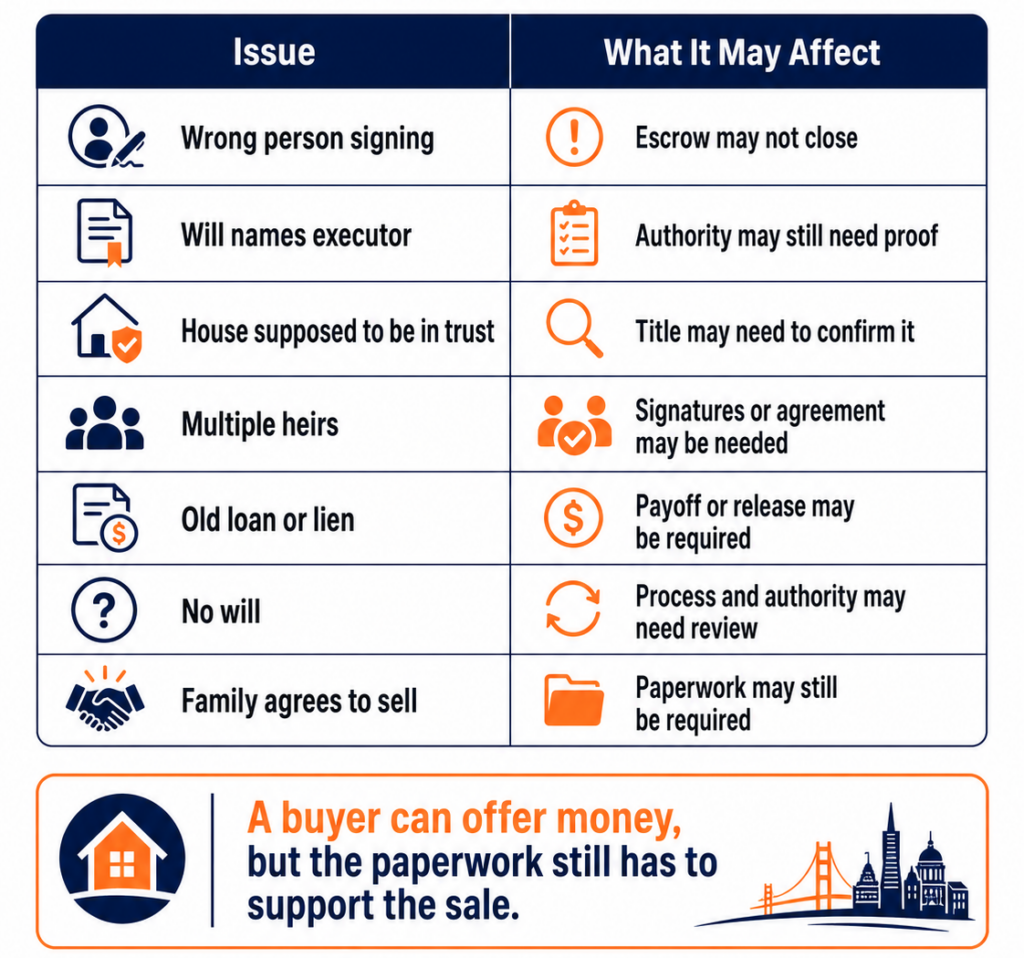
A buyer can offer money. A realtor can list the house. A cash buyer can agree to buy it as-is. The family can all say they want to sell.
But if escrow and title cannot confirm the right person is signing, the sale can still stop.
That is where administrator vs executor matters.
The issue is not only what the family wants to do. The issue is whether the paperwork supports the sale.
Inherited-house sales usually have two problems.
The first problem is the house itself. Maybe it needs repairs. Maybe it is full of belongings. Maybe there are tenants, relatives, old systems, safety issues, or years of deferred maintenance.
The second problem is the paperwork. Who is on title? Is there a will? Is there a trust? Was the house actually transferred into the trust? Are there multiple heirs? Are there loans, liens, back taxes, or unpaid bills?
A direct as-is buyer may help with the house problem.
Escrow and title still have to clear the paperwork problem.
That is the part many families do not see until they are already trying to close.
Why Authority Matters Before Selling an Inherited House
A house cannot always be sold just because the family agrees.
Before the family spends money on repairs, accepts an offer, signs listing paperwork, or starts planning a closing date, they need to know who can sign.
That person may be an executor, administrator, trustee, personal representative, surviving spouse, or another person with proper authority.
The title does not close based on family conversations. It closes based on documents.
That is why the family needs to confirm:
- Who is on title?
- Who has authority to act?
- What documents prove that authority?
- Does escrow or title need anything else?
- Are all required people involved?
- Are there loans, liens, taxes, or unpaid bills that affect closing?
This is not about making the process harder. It is about avoiding a bigger problem later.
A family may have a buyer ready, but if the wrong person signs, the file can stall. The buyer may lose patience. The family may lose time. The house may keep costing money while everyone tries to figure out what paperwork is missing.
A high offer does not matter if escrow cannot close.
For sellers who want to understand the basic probate process in California, the California Courts probate guide is a good official starting point.
Administrator vs Executor: The Simple Difference
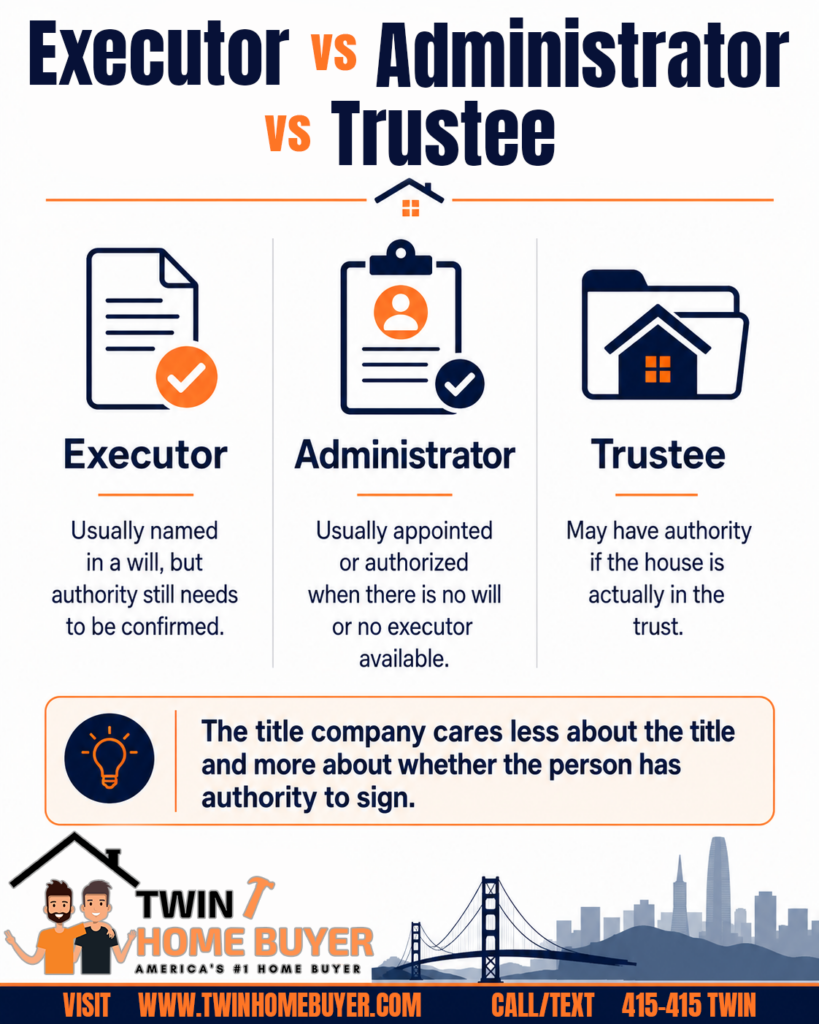
The words administrator and executor are often used like they mean the same thing.
They are related, but they are not exactly the same.
For a home sale, the practical question is not what the family calls the person.
The practical question is whether that person has authority to sign.
Executor
An executor is usually the person named in a will to help handle the estate after someone passes away.
But being named in a will does not always mean the person can automatically sell the house right away.
That is where families sometimes make a bad assumption.
They may say, “The will names me as executor, so I can sell the house.”
Maybe. Maybe not yet.
The seller still needs to confirm what the estate documents, title, escrow, and any required process allow.
Being named in a will and having paperwork that escrow or title will accept are not always the same thing.
Administrator
An administrator is usually appointed or authorized when there is no will, no executor is available, or the named executor cannot or will not serve.
The administrator may not have been chosen by the person who passed away. Instead, the court or required process may determine who can handle the estate.
For the family, the role may feel similar because someone is handling the estate.
For escrow, the question is more specific:
Does this person have authority to sign for the sale?
Personal Representative
In California, people may also hear the term personal representative.
In simple language, this usually refers to the person who has authority to act for the estate, depending on the situation.
That person may be an executor or an administrator.
The family may not use that phrase in everyday conversation, but escrow, title, court paperwork, or estate documents may use it.
Trustee
If the house is in a trust, the trustee may be the key person instead of an executor or administrator.
This is different from a house that is only in the deceased owner’s individual name.
A trust can make things cleaner, but only if the paperwork and title line up.
The simple takeaway is this:
The title company does not care what the family casually calls the person. They care whether that person has authority to act.
Being Named in a Will Is Not Always Enough
This is one of the most common inherited-house mistakes.
A family member sees their name in the will and assumes the sale can move forward.
But a will by itself may not answer every closing question.
The house may still be titled in the deceased owner’s name. Escrow or title may need proof that the person signing has authority. There may be additional paperwork or required steps before the property can be transferred.
This matters before the family spends money.
Do not spend repair money before you know who can sign.
Do not clean out the whole house just because someone thinks they are in charge.
Do not accept an offer without knowing whether the seller side can actually close.
That does not mean the family cannot sell. It means the family should confirm the authority side before moving like everything is clear.
The mistake is not asking questions.
The mistake is moving forward like the paperwork does not matter.
In many probate situations, escrow or title may need documents showing the person has been officially appointed or authorized, such as Letters showing appointment as personal representative.
Confirm What the Paperwork Actually Allows
It is not enough to ask, “Who is handling the estate?”
The better question is:
What does the paperwork actually allow?
Some documents may clearly support a sale. Other documents may show that someone has authority to handle certain estate matters, but more steps may still be needed before real estate can be sold.
That is an important difference.
A person may be helping with the estate, talking to family members, paying bills, or managing the property. That does not automatically mean escrow can accept their signature for a real estate sale.
This is why the seller should not only ask who is handling the estate. They should confirm what the paperwork actually allows. The California probate Letters form shows why the details of authority can matter when real property is involved.
Before assuming the house can close, the family should ask:
- Who has authority to sign?
- What documents prove that authority?
- Does title match what the family believes?
- Does escrow need anything else?
- Are there heirs, trustees, or other parties who need to be involved?
- Are there loans, liens, taxes, or title issues that affect closing?
- Does the paperwork allow the person to sell the real estate, or are more steps needed first?
In some probate situations, there may also be additional court steps or confirmation needed before the property can transfer.
Not every sale has the same process. That is why guessing is risky.
The family does not need to become a legal expert. They need to know whether the person signing has authority that escrow and title can rely on.
For legal authority, probate, trust, title, tax, lien, or court paperwork questions, the seller should confirm the details with the right professional.
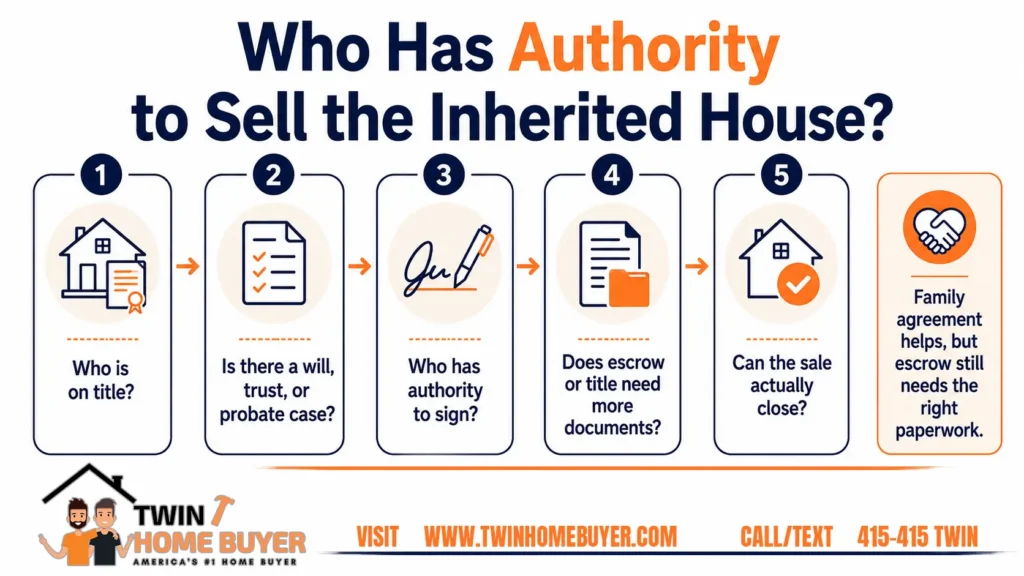
A Real Bay Area Example: The Family Has a Buyer, But Escrow Still Cannot Close
Here is how this happens.
A family inherits an older house in Oakland or the East Bay. The parents owned it for decades. It is not a polished retail property. It has old electrical, worn flooring, deferred maintenance, and a garage full of belongings. Maybe there is a relative living there. Maybe the house is vacant, but the bills are still coming in every month.
One sibling lives nearby and is doing most of the work.
Another sibling is out of state.
One person wants to list because the house might be worth a lot.
Another person does not want to spend money on repairs or cleanout.
Another person just wants the property sold because the family is tired of dealing with it.
Everyone says they agree to sell.
One person believes they are the executor because their name is in the will. Another family member says the house was supposed to be in a trust. The family finds a buyer willing to purchase the property as-is.
At first, it feels like the hard part is done.
There is a buyer.
The buyer understands the house needs work.
The family thinks everyone is on the same page.
Then escrow starts asking questions.
- Who is actually on title?
- Was the property really transferred into the trust?
- Who has authority to sign?
- Is the person named in the will officially able to act for the sale?
- Does the paperwork give enough authority to sell the real estate?
- Are all required parties involved?
- Are there loans, taxes, liens, or unpaid bills?
- Is there proof that the person signing has authority?
Now the family realizes the sale is not only about price.
It is about whether the property, people, title, and paperwork line up.
Cash can help with repairs, timing, and cleanout.
Cash does not replace authority.
Why This Happens Often With Bay Area Inherited Homes
Inherited-house sales in the Bay Area can get complicated because the house problem is usually not the only problem.
Many Bay Area inherited homes are older family homes. Some have been owned for decades. Some need major repairs. Some have tenants, relatives, or occupants. Some are vacant and becoming expensive to maintain. Some have title questions nobody noticed until the family tried to sell.
This comes up in places like Oakland, Alameda County, Hayward, San Leandro, Richmond, Vallejo, San Mateo, San Jose, and other parts of the Bay Area.
For local inherited-property and probate information, sellers in Oakland or the East Bay can also review Alameda County probate court information.
The local reality matters.
A house in the Bay Area may be worth a lot even if it needs work. That can create pressure. The family sees the value and wants to move. But a high property value does not clean up title. It does not fix family disagreement. It does not prove who can sign.
Older homes may need major repairs. Labor costs can be high. Holding costs add up. Utilities, insurance, property taxes, code issues, and vacancy risk can become a burden. If tenants or relatives are living in the property, the sale may become harder.
Family members may also be spread across different cities or states. One person may be making calls. Another may be questioning price. Another may not want strangers walking through the home. Another may not want to spend money getting the property ready.
That is why inherited-house sales need more than a price estimate.
The family needs to understand ownership, authority, property condition, people, money, timing, and risk.
What If Everyone in the Family Agrees to Sell?
Family agreement helps.
It can reduce conflict. It can make decisions easier. It can help the sale move faster.
But agreement is not the same as authority.
From the family’s point of view, the decision may feel simple:
Everyone agrees.
We found a buyer.
Let’s sell.
Escrow is looking at something different.
Escrow needs the correct signatures, clear title, and enough paperwork to support the transfer.
Even if all heirs agree, the sale may still need:
- Proper authority
- Clear title
- Correct signatures
- Trust, estate, or probate paperwork
- Escrow and title approval
- Payoff information for loans, liens, taxes, or unpaid bills
- Confirmation that the person signing has the right to sign
Agreement matters.
But title still needs the right paperwork.
What If There Is No Will?
If there is no will, the family may not have a named executor.
That can change who has authority and what process may be needed before the house can be sold.
The family may need to figure out:
- Who has priority to act
- Whether someone needs to be appointed
- Whether all heirs are known
- Whether the heirs agree
- Whether there are debts, taxes, liens, or unpaid bills
- Whether the house can be sold now or more steps are needed first
No will does not automatically mean the house cannot be sold.
But it can change the process.
One family member may be organized. They may be responsible. They may be the oldest child. They may live closest to the property. They may be the one paying the bills and talking to buyers.
That still does not automatically mean escrow can accept their signature.
If there is no will, the family should confirm the situation with a probate attorney, title company, escrow officer, or the right professional before moving too far forward.
What If the House Is in a Trust?
A trust can make things cleaner.
But only if the paperwork and title line up.
This is where families get surprised.
They may say, “My parents had a trust.”
That may be true.
But escrow and title still need to confirm whether the house was actually placed into the trust.
If title still shows the deceased owner individually, the family may have a problem to solve before closing.
The trustee may need to show:
- Trust documents
- Authority to act
- Identification
- Required signatures
- Title company requirements
- Any supporting documents escrow asks for
A trust does not automatically fix every issue.
There may still be questions about who the trustee is, whether the successor trustee has authority, whether the property was properly titled, whether there are loans or liens, and whether title will insure the sale.
Do not assume the trust solves everything until title and escrow confirm what they need.
A trust only helps if the paperwork and title line up.
What the Title Company and Escrow May Need to See
Depending on the situation, escrow or the title company may ask for documents showing who has authority to sell.
This may include items such as:
- Death certificate
- Will or estate documents
- Trust documents
- Court paperwork
- Documents showing appointment or authority
- Identification of the person signing
- Loan payoff information
- Lien or tax information
- Confirmation that all required parties are involved
The exact documents depend on the property, title, estate situation, county, escrow company, title company, and legal requirements.
Escrow and title are not asking for paperwork just to slow the family down.
They need the file to support the transfer.
They need to know the buyer is receiving valid title and that the right person is signing for the seller side.
That is why one inherited-house sale can be simple and another can get stuck.
One family may have a clean trust situation.
Another family may have a will but still need more steps.
Another family may have no will, multiple heirs, and no clear person authorized yet.
Another family may have the right person ready to sign, but title finds an old loan, lien, unpaid tax issue, or missing document.
The seller does not need to know every legal detail before making a decision.
But the seller should know what escrow and title need before assuming the sale can close.
How Authority Affects Selling As-Is
Selling as-is can help with the property problem.
It does not automatically solve the paperwork problem.
That distinction matters.
Many inherited homes in the Bay Area are older, outdated, vacant, tenant-occupied, or in need of repairs. The family may not want to make repairs. They may not want to clean out the property. They may not want months of showings. The house may not be a good fit for a traditional financed buyer.
Those are property-side problems.
An as-is buyer may be able to help with those.
But escrow still needs the right person to sign. Title still needs enough paperwork to support closing.
So the seller needs to separate the two issues:
The house problem:
- Repairs
- Cleanout
- Tenants or occupants
- Old systems
- Unsafe areas
- Deferred maintenance
- Showings
- Financing concerns
The paperwork problem:
- Who owns the house
- Who can sign
- Whether there is a will
- Whether there is a trust
- Whether probate is involved
- Whether all required people are involved
- Whether there are liens, loans, taxes, or unpaid bills
- Whether title matches what the family believes
As-is solves the repair conversation.
It does not automatically solve the authority conversation.
When Listing With an Agent May Make Sense
Listing with an agent may make sense in some situations.
There is nothing wrong with wanting to test the open market. If the house is in good condition, the family is aligned, authority is clear, and the seller has time, listing may produce a strong result.
Listing may make sense if:
- Authority is clear
- The family is aligned
- The home is in good enough condition for showings
- The seller has time
- The property can attract financed buyers
- Repairs or cleaning can improve the net result
- The seller wants to test the open market
- The property is not blocked by major title, paperwork, probate, or occupancy issues
This is especially true if the property is clean, vacant, financeable, and ready for normal buyer traffic.
But listing can become harder when the inherited house has major repairs, family disagreement, unclear authority, tenants, occupants, title issues, or a timeline problem.
An agent can help market the property.
The seller still needs authority to sign.
A buyer can offer a high price.
The sale still needs to close.
Listing can work when the property, paperwork, timeline, and family situation support it.
When Selling Directly to Twin Home Buyer May Make Sense
Selling directly to Twin Home Buyer may make sense when the house itself has become the problem.
That does not mean Twin Home Buyer replaces escrow, title, a probate attorney, or the right professional when legal authority or court paperwork is involved.
It means Twin Home Buyer may help with the property side of the situation.
That includes repairs, cleanout, tenants, occupants, timing pressure, privacy, and the uncertainty that comes with trying to make an inherited property retail-ready.
A direct sale may be worth comparing if:
- The house needs major repairs
- The family does not want to clean it out
- The property is vacant and becoming a burden
- There are tenants, occupants, or relatives in the home
- The seller wants fewer showings
- The family needs more certainty
- The seller wants to compare an as-is offer before spending money
- The house may not be a good fit for a traditional financed buyer
- The family wants to avoid making the property retail-ready
- The family is tired of carrying the property while trying to figure out the next step
This is where a direct as-is offer can be useful.
Not because it magically fixes every title or authority issue.
It does not.
But it can give the family a real number to compare before spending money on repairs, cleanout, staging, or listing preparation.
That matters.
If the property needs work, the seller should know what a direct as-is sale could look like before they put money into the house.
Then the family can compare:
- Keep the house
- Fix it and list
- Clean it out and list
- Sell as-is directly
- Handle authority/title issues first, then decide
Twin Home Buyer may be a good option when the property side is the burden: repairs, cleanout, tenants, timing, privacy, or uncertainty.
The paperwork still has to support the closing.
That is the honest answer.
Questions to Ask Before Trying to Sell an Inherited House in the Bay Area
Before trying to sell an inherited house in the Bay Area, ask these questions:
- Who is currently on title?
- Is there a will?
- Was an executor named?
- Has anyone been officially given authority to act?
- Is there an administrator?
- Is there a trustee?
- Is the house actually in a trust, or does title still show the deceased owner individually?
- Are there multiple heirs?
- Does everyone agree to sell?
- Who is supposed to sign the sale documents?
- What documents prove that person has authority?
- Does the paperwork allow the person to sell the real estate, or are more steps needed first?
- Are there tenants, occupants, or family members living in the house?
- Are there back taxes, liens, loans, or unpaid bills?
- Does the house need major repairs?
- Is the property vacant, occupied, damaged, or unsafe?
- Does the family want the highest price, speed, certainty, privacy, or fewer problems?
- Has escrow or a title company reviewed the situation?
- Do you need a probate attorney or another professional before moving forward?
- Should you compare a direct as-is offer before spending money on repairs, cleanout, or listing prep?
These questions are not meant to slow the seller down.
They are meant to prevent the family from spending money or accepting an offer before they know whether the sale path is clear.
A Simple Order of Operations Before You Spend Money
Before spending serious money on repairs, cleanout, staging, or listing preparation, get the order right.
A practical sequence looks like this:
- Check who is currently on title.
- Confirm who has authority to act.
- Ask escrow or title what documents may be needed.
- Identify the property-side problems: repairs, tenants, cleanout, safety issues, or vacancy.
- Understand the money issues: loans, liens, taxes, unpaid bills, insurance, utilities, and holding costs.
- Compare the realistic options: keep it, list it, fix it, sell directly, or get professional help first.
- Avoid spending repair money before knowing whether the sale path is actually clear.
If the authority side is unclear, handle that first.
If the authority side is clear but the house itself is the burden, compare your selling options before spending money.
That is the better order.
Common Mistakes Families Make
Inherited-house sales can go sideways when the family moves too fast without confirming the basics.
Common mistakes include:
- Assuming the oldest child can automatically sell the house
- Assuming being named in a will is enough by itself
- Assuming family agreement replaces authority
- Accepting an offer before knowing who can sign
- Spending money on repairs before understanding title and authority
- Waiting too long while the house sits vacant
- Ignoring loans, liens, taxes, or unpaid bills
- Thinking a cash buyer can close without proper paperwork
- Assuming a trust solves everything without confirming title
- Listing the house before knowing whether the seller can sign
- Focusing only on value instead of closing ability
- Not asking escrow or title what documents are needed
- Assuming the paperwork gives full authority without confirming what it actually allows
- Treating the property problem and the paperwork problem like they are the same thing
The mistake is not asking questions.
The mistake is moving forward like the paperwork does not matter.
A family may be trying to do the right thing. They may be trying to move quickly, avoid conflict, or stop the property from becoming a bigger burden.
But if the authority issue is not clear, speed can create more problems.
The smarter move is to understand the house, the people, the paperwork, and the timeline before deciding what to do next.
Final Answer: Why Administrator vs Executor Matters
Administrator vs executor matters because the person handling the sale needs authority to act.
If there is a will, there may be an executor.
If there is no will or no executor available, there may be an administrator.
If the house is in a trust, the trustee may be the key person.
If the court or estate process is involved, the paperwork matters.
But the main point is simple:
Before focusing on price, repairs, listing, or buyer type, find out who has authority to sell.
That is what escrow, title, and the closing process will care about.
The house value matters.
The paperwork decides whether the sale can actually close.
Thinking About Selling an Inherited House in the Bay Area?
If you inherited a house in the Bay Area and you are not sure who has authority to sell, start by confirming the paperwork side with escrow, title, a probate attorney, or the right professional.
That part matters.
But if the house itself is also becoming a burden, Twin Home Buyer can help you look at the property side of the decision.
We can review the house as-is and talk through repairs, cleanout, tenants, timing, privacy, and what a direct sale could look like.
Listing with an agent may make sense in some situations.
Keeping the house may make sense in others.
And if the issue involves probate, title, taxes, liens, court paperwork, or legal authority, those details should be confirmed before assuming the sale can close.
But before you spend money fixing the house, cleaning it out, staging it, listing it, or accepting an offer that may not close, compare what an as-is direct sale to Twin Home Buyer could look like.
That gives you a clearer picture before you commit to repairs, cleanout, showings, or a traditional listing plan.
If the property is in the Bay Area and the house itself is becoming the problem, fill out the form on this page or contact Twin Home Buyer to compare your options.
Call: (415) 415-TWIN
Text:(415) 415-TWIN
Frequently Asked Questions
What is the difference between an administrator and an executor?
An executor is usually named in a will. An administrator is usually appointed or authorized when there is no will, no executor is available, or the named executor cannot serve. For a home sale, the key issue is whether the person has authority to act and sign.
Can an executor sell an inherited house in the Bay Area?
An executor may be able to help sell an inherited house, but the exact authority depends on the estate documents, title, escrow requirements, and any required process. The seller should confirm authority before assuming the sale can close.
Can an administrator sell an inherited house?
An administrator may be able to help sell estate property if properly authorized. The family should confirm what the paperwork allows before accepting an offer or assuming escrow can close.
Is being named in a will enough to sell an inherited house?
Not always. Being named in a will and having authority that escrow or title will accept are not always the same thing. The seller should confirm what documents are needed before assuming the sale can move forward.
Can heirs sell a house without an executor or administrator?
Sometimes heirs believe they can sell because everyone agrees, but agreement is not always the same as authority. The family may need to confirm title, signatures, trust documents, court paperwork, or other requirements first.
What if the inherited house is in a trust?
If the house is in a trust, the trustee may be the person with authority. But the seller should confirm that the house was actually placed into the trust and that title matches the paperwork. A trust only helps if the paperwork and title line up.
Can a cash buyer close if authority is unclear?
Cash can help with repairs, timing, cleanout, and property condition. It does not replace authority. Escrow still needs the right person to sign and the right paperwork to support closing.
Should I fix the inherited house before confirming authority?
Usually, it is smarter to understand ownership, authority, title, and family agreement before spending money on repairs. Repairs may help in some cases, but they do not solve authority, title, or paperwork issues.
Is selling as-is still possible if the inherited house needs repairs?
Selling as-is may be possible if the buyer understands the condition of the house. But the seller still needs authority to sign, and escrow and title still need enough paperwork to close.
Should I list the inherited house or sell it directly?
Listing may make sense if authority is clear, the family is aligned, the house is showable, and the seller has time. Selling directly may make sense if the house needs repairs, has tenants or occupants, needs cleanout, or the family wants more certainty and fewer steps.
Real People. Real Results.
What Our Clients Say
Rafael P.

Stress free process, paid all the closing costs and didn’t have to do any cleaning or repairs. Juan Diaz and team are men of their word. They close faster than any realtor listing ever could.
Robert R.
Juan Diaz and his team deliver on their promises and go above and beyond. Their professionalism, honesty, and hard work are very much respected. I recommend them 100%!
Edgar R.
Called Twin Home Buyer with questions. They listened, offered honest advice, and followed up just like they said they would. Super kind and no pressure. Great people!
Jose J.
Awesome to deal with. They let me know upfront if it wasn't the right match and even recommended a great realtor. This company genuinely cares about homeowners.
