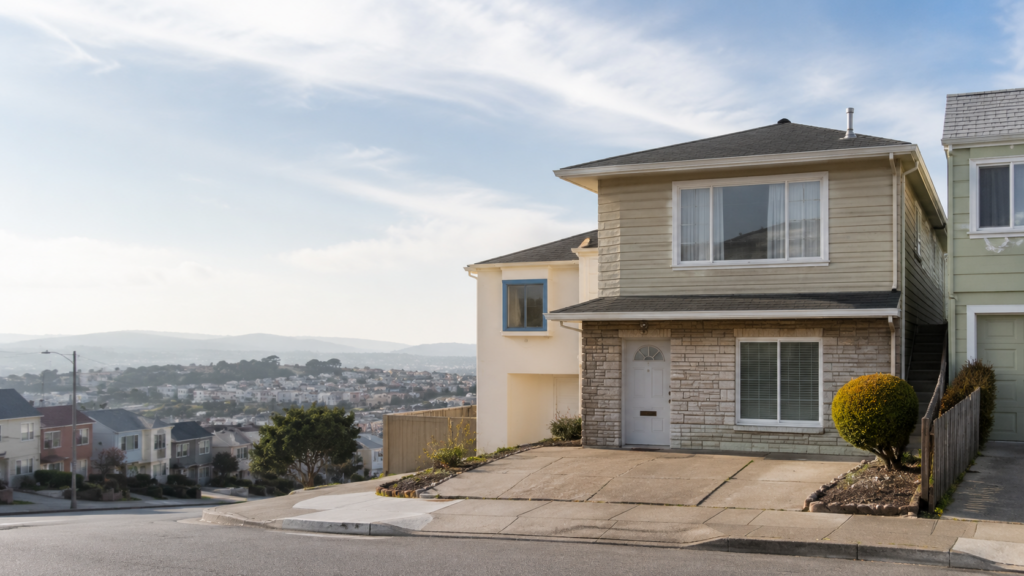
The garage looks normal from outside.
That is how a lot of Daly City houses start. From the street, nothing looks unusual.
Then someone walks downstairs.
There may be a bedroom where the garage used to be. There may be a bathroom, laundry area, storage room, separate entrance, or small living setup.
Maybe your parents used it that way for years.
Maybe a prior owner did the work.
Maybe a tenant used the space differently.
Maybe you inherited the house and nobody knows what was permitted.
For a long time, the house may have worked fine. The family used the space. Nobody asked many questions.
Then the sale starts.
The buyer walks through. The inspector looks closer. The appraiser studies the layout. The lender starts asking questions.
That is when the issue changes.
The real question is not only, “Was this permitted?”
The better question is this:
Can this deal actually close once everyone looks at the house?
That is where sellers need to slow down.
Daly City houses often have these stories
Older homes carry family history.
In Daly City, a lot of homes have lower-level space that families used however they needed. A garage might have become storage, then a bedroom, then a rental-style setup.
On the Peninsula, space is expensive. Repairs cost real money. Families often make houses work before they worry about how the records look.
That does not mean every converted garage is a problem.
It also does not mean the issue should be ignored.
The problem starts when the house goes from family use to buyer, lender, inspector, and escrow review.
That is when a normal family setup can become a sale issue.
I have seen this many times
I’m Juan Diaz, CEO of Twin Home Buyer
I grew up in East Oakland, around Jingletown and Fruitvale. Those are neighborhoods where families made houses work however they could.
People converted garages. They added rooms. They fixed things themselves. They rented space to relatives. They used every part of the house.
I understand that.
After 27 years in Bay Area real estate, I have walked through hundreds of homes with old repairs, converted spaces, added bathrooms, tenant setups, and work that may not match the records.
I also look at these houses as a contractor. Through Matrix Group One Inc., CSLB License #1066892, I have seen what happens when plumbing, electrical, drainage, framing, or old garage conversions create problems during a sale.
That does not mean every house is bad.
It means I look at the real deal question:
What can stop this sale from closing?
That question matters more than most sellers realize.
The house and records may disagree
Many Bay Area houses changed over time.
Families added rooms. Garages became living areas. Bathrooms were added downstairs. Storage areas became bedrooms.
A temporary setup became part of daily life.
The issue is not always the work itself.
The issue is what happens when the sale starts and different people look at the same house from different angles.
A seller may see useful space.
A buyer may see risk.
An inspector may see safety concerns.
An appraiser may question value.
A lender may ask whether the layout matches the loan file.
That is the part many sellers do not see coming.
The house did not change when escrow opened. What changed is that everyone started looking at the risk.
That is why an old garage conversion can sit quietly for years, then become the main issue during a sale.
A converted garage is different
A small repair is one thing.
A loose handrail, broken window, or old water heater is usually easier to understand. A converted garage can touch more parts of the deal.
It may affect how the property is used.
It may affect value.
It may affect parking.
It may affect safety.
It may affect financing.
It may affect how buyers understand the house.
When I walk a house like this, I am looking at more than paint and flooring.
- Who is using the space
- Whether someone sleeps there
- Whether plumbing was added
- Whether electrical was changed
- Whether there is a bathroom
- Whether there is a separate entrance
- Whether the space was rented
- Whether parking was affected
- Whether the layout matches records
- Whether the work looks safe
- Whether the numbers still work
That is the practical side.
A serious buyer is not just looking at extra square footage. They are looking at the risk attached to that square footage.
Extra space can help a house feel bigger.
But if the buyer’s lender, appraiser, or inspector has concerns, that same space can create problems.
Useful space is not the same thing as clean closing risk.
The seller may not have caused it
Sometimes the seller did nothing wrong.
Maybe a parent changed the garage years ago. Maybe a prior owner did the work. Maybe a tenant used the space differently.
Maybe nobody kept records.
That happens often.
I do not look at that and think the seller is careless. Most people are just trying to understand what they own.
That is especially true with inherited houses.
A son or daughter may walk into a Daly City house after a parent passes away and find rooms, wiring, plumbing, storage, old repairs, and paperwork they never saw before.
They may not know who did the work.
They may not know when it was done.
They may not know whether records match the house.
That does not make them naive.
It means they need to get clear before choosing a sale path.
You may not have created the issue. But you still need to understand how it affects the sale.
That is not blame. That is preparation.
The problem may appear after you accept
The offer is not the finish line.
A seller can accept an offer and still lose the deal later. That is one of the biggest lessons in real estate.
This is how it can happen.
A buyer walks through the house and likes the downstairs space. They see an extra bedroom, office, guest room, or possible rental area.
The seller feels good.
The offer comes in.
Then escrow starts.
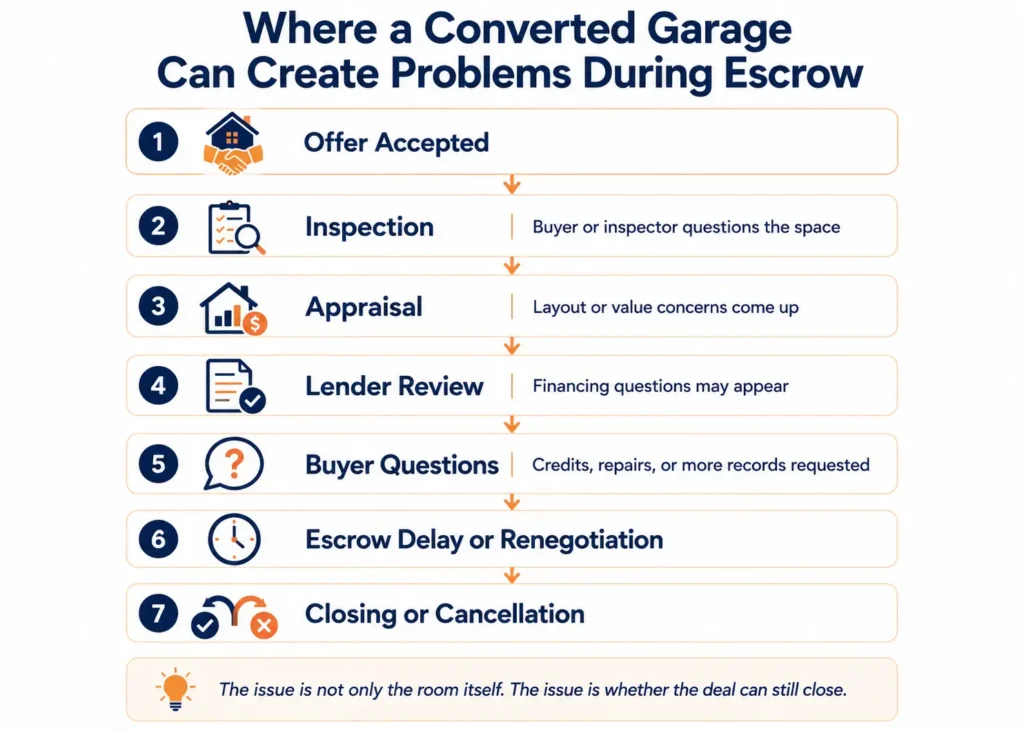
The buyer orders inspections. The inspector questions the converted space. The buyer asks for records, credits, or repairs.
Then the appraiser reviews the layout.
Then the lender may ask more questions.
Then the buyer gets nervous.
That is where sellers get frustrated.
The seller may say, “This room has always been here.”
The buyer may say, “Can I safely use this room?”
The lender may say, “Are we financing the property as described?”
Those are different questions.
A deal can look strong at first and still fall apart later.
That is why I tell sellers not to judge an offer by price alone.
The buyer may see it differently later
Buyers can change their mind.
That does not always mean they were dishonest. Sometimes they simply did not understand the risk yet.
On the first showing, a converted garage can feel like a bonus.
The buyer may see more usable space.
The buyer may imagine family staying there.
The buyer may like having a separate entrance.
The buyer may think the room adds value.
Then the reports come back.
Now the buyer starts asking different questions.
- Was the work documented?
- Can the space be counted?
- Will the lender accept it?
- Will insurance be affected?
- Will repairs be needed?
- Can the space be used the way they expected?
Those are not small questions.
That is why the seller needs to understand the buyer type, not just the offer number.
Some buyers can handle risk.
Some buyers cannot.
Some buyers say they can handle risk until the paperwork starts.
That is where the deal can break.
Unpermitted work may not stop the sale
The house may still be sellable.
Unpermitted work does not automatically mean the sale is impossible. Many homes with old work, additions, or changed layouts still sell.
But it can change the sale.
It may affect:
- Buyer confidence
- Inspection results
- Appraisal value
- Financing approval
- Insurance questions
- Repair requests
- Credits
- Renegotiation
- Closing timeline
- Whether the buyer cancels
That is the real issue.
It is not only whether someone will make an offer. It is whether that buyer still wants the house after they understand everything.
A high offer with a nervous buyer may not be better than a lower offer with fewer problems.
Top price matters.
Closing certainty matters too.
The best offer is not always the biggest number on paper.
Selling without repairs still requires honesty
Current condition still comes with responsibility.
A seller may choose not to repair the converted garage before selling. That is one thing.
Hiding known issues is different.
If you know about a converted garage, added bathroom, old wiring, plumbing, tenant use, notices, or unsafe conditions, be careful.
Talk to the right people.
That may mean a Realtor, attorney, escrow officer, title company, or disclosure professional.
Twin Home Buyer is not a law firm. We do not give legal, tax, title, permit, code, or disclosure advice.
If you have questions in those areas, speak with the right professional before making final decisions.
The California real estate disclosure guide can help sellers understand where disclosure questions may start.
That is not a scare tactic.
That is just being clean about the sale.
Selling in current condition means understanding the problem, pricing the problem, and finding a buyer who can handle it.
It does not mean pretending the problem is not there.
A permit search may help
Checking records can help.
If you are trying to sell a Daly City house with a converted garage, permit records may give you useful information.
The Daly City permit information page is one place where a homeowner can start looking into permit questions.
But records do not always tell the whole story.
The actual condition still matters.
The way the space is used still matters.
Buyer expectations still matter.
Financing still matters.
A record search may answer one question and raise three more.
That is why I do not like guessing.
Before you make promises to a buyer, understand what you know and what you do not know.
If something is legal, title, disclosure, tax, or code-related, get the right professional involved.
A clean sale starts with clear information.
Fixing first can open another door
Fixing first sounds like the safe move.
Sometimes it is. Other times, it creates more cost, delay, and confusion than the seller expected.
A converted garage may involve framing, plumbing, electrical, drywall, windows, drainage, sewer lines, or old work behind walls.
One contractor may see a small repair.
Another may see a bigger problem.
Bay Area repair costs can move fast.
That is why I do not tell sellers to spend money blindly.
Sometimes repairs help.
Sometimes they do not.
Sometimes opening a wall reveals something worse.
Sometimes the money spent does not come back in the sale price.
That does not mean you should never fix anything.
It means you should know what problem you are trying to solve before spending money.
Are you trying to get a higher price?
Are you trying to pass inspection?
Are you trying to reduce lender concerns?
Are you trying to make the space safer?
Are you trying to avoid renegotiation?
Those are different goals.
Before you spend money, make sure the money improves the sale.
If the repairs are too large, or the house has years of deferred maintenance, it may help to read more about selling a house with major repairs.
Highest offer does not mean strongest
The highest offer is not always strongest.
Sellers sometimes chase the cleanest-looking offer. I understand why. Nobody wants to leave money on the table.
But the highest offer is not always the best offer.
A buyer may offer more because they like the extra downstairs space.
Then inspections happen.
Then the lender gets involved.
Then the appraiser reviews the layout.
Now the buyer may ask for a credit.
Or they may want repairs.
Or they may cancel.
That is how weeks get lost.
A lower offer with fewer risks may sometimes be stronger than a higher offer that depends on financing, appraisal, and a nervous buyer.
That does not mean you should always take less.
It means you should compare the whole deal.
Look at price, buyer type, contingencies, timeline, repair requests, financing risk, and closing certainty.
The MLS can get you more money.
But only if the buyer, lender, appraiser, inspector, and paperwork can survive the problem.
That is the part sellers need to understand before choosing an offer.
Listing with a Realtor may still work
Sometimes listing is the right move.
I am not going to tell every seller that a direct sale is better. That is not true.
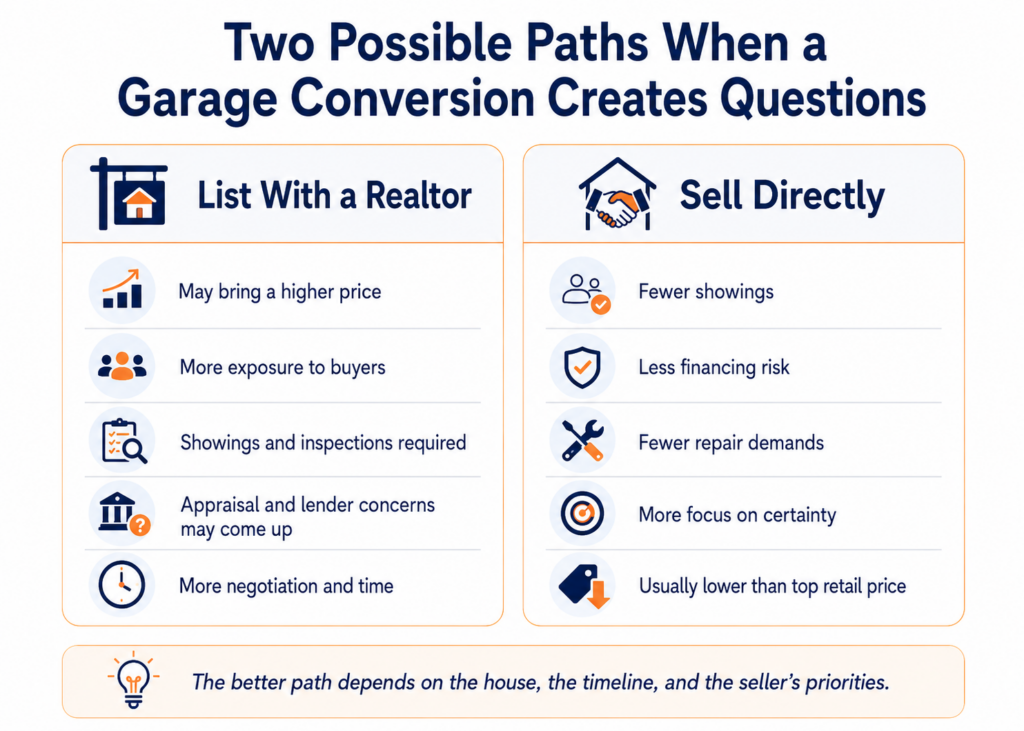
A good Realtor may help you get more exposure and a higher retail price.
Listing may make sense if:
- You have time
- The house is clean and accessible
- The layout issue is minor
- You can handle showings
- The home can likely qualify for financing
- You can negotiate repairs or credits
- Your Realtor understands layout concerns
- You want to test the open market
That path can work.
The mistake is listing before you understand how the converted space may affect buyers, lenders, inspections, and appraisal.
Some Realtors know how to handle these issues.
Some do not.
That matters.
If you list, ask direct questions before going live.
- How will the converted space be described?
- What will be shared with buyers?
- What buyer type is most likely?
- Will financing be a concern?
- How will repair requests be handled?
- What happens if appraisal questions come up?
A good listing strategy starts with the truth about the house.
Selling directly may make more sense
A direct sale can reduce moving parts.
That may matter when the house has old repairs, belongings, tenants, deferred maintenance, or a garage conversion that makes regular buyers nervous.
A direct sale may fit when:
- You do not want repairs
- The house needs major work
- The family inherited the property
- The layout may not match records
- You do not want open houses
- Tenants or relatives are involved
- You want privacy
- You value certainty
- You want fewer lender issues
This is not magic.
A serious buyer still needs to understand the property, condition, cost, title, and closing path.
A real buyer does not make the problem disappear with a slogan.
They understand the problem, price the problem, and take responsibility for the risk they agree to buy.
That is the difference between a real conversation and a pitch.
A direct sale may not bring the highest retail price.
That needs to be said clearly.
The trade-off is usually price, time, repairs, showings, financing risk, and certainty.
For some sellers, the open market is worth the extra work.
For others, a cleaner path matters more.
The right answer depends on the seller’s situation.
If speed, privacy, and fewer moving parts matter, you can also learn more about how a direct sale works on our page about how to sell your house fast.
Inherited homes need extra care
Inherited houses bring more questions.
A converted garage is one issue. Ownership can be another issue. Those two problems can meet in the same house.
If a parent passed away, the family may not know who can sign.
The property may be in a trust.
The property may still be in the deceased owner’s name.
There may be multiple heirs.
One sibling may live nearby.
Another may live out of state.
Someone may want to list.
Someone else may want to sell directly.
Someone may think the garage conversion adds value.
Someone else may fear it creates risk.
This is where sellers need to slow down.
A buyer can offer money, but escrow cannot close if the wrong person is signing.
If legal authority is unclear, speak with an attorney.
If title is unclear, the title company may need more information.
If heirs disagree, the sale may slow down.
This is normal in inherited property situations.
The key is not to guess your way through it.
For parcel-related information, you can start with San Mateo County parcel information.
If you are dealing with a family property, you can also read more about how we approach an inherited house in California.
Tenants can make it harder
Some houses have people living there.
That can change the sale too. A converted garage may be used by a tenant, relative, roommate, or family member.
That creates more questions.
- Is there a lease?
- Is anyone paying rent?
- Is the space separate?
- Will the person cooperate with showings?
- Will the buyer want the tenant to stay?
- Will the buyer want the space vacant?
I do not give legal advice about tenants.
If a seller has tenant questions, they should speak with the right attorney or local professional.
But from a deal standpoint, tenants can affect timing, access, buyer confidence, and closing certainty.
Some buyers do not want tenant-occupied properties.
Other buyers understand them.
That difference matters.
If someone is living in the converted garage, do not treat it like a minor detail.
That can become one of the biggest issues in the sale.
If the property has tenants, this page on selling a tenant-occupied house may help you understand the sale path better.
Open houses may not help
Showings can create pressure.
If the house has a converted garage, old repairs, or belongings everywhere, open houses may not be simple.
Some sellers do not want strangers walking through.
Some families are dealing with grief.
Some tenants do not cooperate.
Some homes are not ready for retail buyers.
Some sellers do not want repeated questions about the same issue.
A traditional listing can still work.
But the seller needs to be honest about what that path requires.
The house may need cleaning.
The house may need access.
The house may need explanation.
The house may need buyers who understand the risk.
That does not make listing wrong.
It means listing is not only about putting photos online.
It is about preparing the buyer pool for the real property.
Escrow protects both sides
Escrow is not just paperwork.
In a real sale, escrow and the title company act as neutral parties. They help handle funds, documents, title, payoff items, and closing instructions.
That matters in a cash sale too.
A seller should not hand over a deed casually. A seller should not rely on a handshake.
A proper closing through escrow and title helps protect both sides.
This is especially important when the property has old work, inherited ownership, liens, taxes, tenants, or family decision-makers.
The cleaner the closing path, the less room there is for confusion.
A straight deal still needs a proper closing.
Gather what you can first
You do not need everything perfect.
Before you choose a sale path, gather what you already have. Do not turn this into months of homework.
Helpful items may include:
- Photos of the converted space
- Old records you already have
- Notes about who did the work
- Information about current use
- Tenant details, if rented
- Any notices or reports
- Tax, lien, or loan information
- Trust, probate, or ownership documents
- Questions already raised by a buyer or agent
If you do not have these items, that does not mean you cannot sell.
It means the buyer, Realtor, title company, or attorney may need to help sort through the situation.
The goal is not perfection.
The goal is to avoid walking into escrow blind.
Ask better questions before selling
The right question is not only price.
Most sellers ask, “What can I get for the house?”
That matters.
But with a converted garage, the better questions are deeper.
- Who can legally sign?
- Does the house match records?
- Is someone living in the converted space?
- Are there tenants or relatives involved?
- Is there old plumbing or electrical work?
- Are there liens, taxes, or title issues?
- Can a regular buyer get financing?
- Will the buyer ask for credits?
- Will inspections create problems?
- Is time more important than top price?
- Is privacy important?
- Can the seller handle delays?
Those questions change the decision.
A seller who has time, money, and a clean house may choose the open market.
A seller with repairs, tenants, uncertain records, and family pressure may need a different path.
That is not about fear.
That is about choosing based on reality.
Before you decide, slow down
The garage is not the whole story.
The real story is the house, records, buyer, lender, timeline, and seller’s tolerance for risk.
Some sellers should list.
Some should repair first.
Some should talk to an attorney.
Some should sell directly and avoid months of uncertainty.
There is no single answer for every Daly City house.
After 27 years around Bay Area properties, I have learned that the first question is not always, “What can I get?”
Sometimes the better question is, “What can actually close?”
That question saves people time.
Before you decide what to do, understand your options. If the house has a converted garage, old repairs, tenants, probate, or title issues, Twin Home Buyer can look at the layout, condition, records you have, and the kind of buyer who may realistically close.
Call or text Twin Home Buyer at (415) 415-TWIN. No pressure. We can talk privately and look at what is realistic.
No one needs to pretend the house is simpler than it is.
FAQ
Can I sell a Daly City house if the garage was converted?
Yes, it may still be sellable. A converted garage can affect inspections, financing, appraisal, buyer confidence, price, and closing certainty. The issue is not only whether a buyer likes the space. The issue is whether the sale can close after everyone reviews the property.
Does unpermitted work always stop a sale?
No. Unpermitted work does not automatically stop every sale. But it can change the buyer pool and create questions during escrow. Some buyers may continue. Others may ask for credits, repairs, or more information before closing.
Can I sell the house without fixing the garage?
Possibly. Selling in current condition usually means the seller is not agreeing to make repairs before closing. It does not mean hiding known issues. If you have disclosure, permit, legal, or title questions, speak with the right professional before making final decisions.
Should I fix the converted garage before selling?
Not always. Sometimes fixing helps the sale. Sometimes it creates more cost, delay, and new questions. The right answer depends on the property, records, budget, timeline, and buyer type.
Will a regular buyer buy a house with a converted garage?
Some regular buyers may still want it. Others may get nervous after inspections, lender questions, appraisal concerns, or disclosure review. A traditional listing may bring more exposure and possibly a higher price. It may also bring more uncertainty if the buyer needs financing.
Can a cash buyer buy a house with layout or permit issues?
A cash buyer may have fewer lender obstacles. That can help when the layout or permit history creates financing concerns. But a cash sale may not produce the highest retail price compared to a strong traditional listing. The trade-off is usually price, time, privacy, repairs, and certainty.
What if I inherited the house and do not know what was permitted?
That is common. Many heirs do not know the full property history. You may need to review ownership, trust documents, probate status, title, taxes, and known property conditions. If legal authority or title is unclear, talk to an attorney before trying to close any sale.
Should I talk to a Realtor before selling directly?
Sometimes, yes. If the house is clean, accessible, financeable, and the layout issue is manageable, a Realtor may help you test the retail market. That may bring a higher price. It may also bring showings, inspections, repair requests, lender questions, and more time.
Is selling directly always better than listing?
No. Listing may be better if you have time, the house is marketable, and the issue is manageable. Selling directly may make more sense if you want fewer repairs, fewer showings, and less financing risk. A direct sale usually gives up some open-market competition in exchange for a cleaner path.
What should I gather before talking to a buyer?
Gather photos, old records, repair notes, tenant information, title documents, trust papers, loan information, tax details, and any reports you already have. You do not need everything perfect before having a conversation. The goal is to understand what may affect price, timing, and closing risk.
What if a buyer already backed out?
That happens. Try to understand why they backed out before accepting another offer. If the issue was financing, appraisal, inspections, records, or fear about the converted space, the next buyer may raise similar questions. The better move is to understand the risk before going back into escrow.
What Our Clients Say
⭐ Trusted by Homeowners Everywhere
We’re proud that 92% of our customers rate their experience with us as excellent.
Rafael P.

Stress free process, paid all the closing costs and didn’t have to do any cleaning or repairs. Juan Diaz and team are men of their word. Very professional and respectful. The escrow process was a piece of cake. The best part is they close faster than any realtor listing the house ever could. If you’re looking for a no hassle way to sell your house quickly then I definitely recommend Twin home buyer and team.
Robert R.
I can’t speak highly enough about Juan Diaz and his team at Twin Home Buyer. I'm truly honored to be able to work with them and learn from them. Their professionalism, knowledge, honesty, integrity, and hard work ethics are very much admired and respected. They are highly experienced, detail oriented, honest, and truly care about their clients' needs. They deliver on their promises and go above and beyond to get the job done. I look forward to continuing to work with them. I recommend them 100%!
Edgar R.
Called Twin Home Buyer with questions about my property. They listened, offered honest advice, and followed up just like they said they would. Super kind and no pressure. I haven’t sold yet, but I’d definitely recommend giving them a call. Great people!
Jose J.
The twin home buyer was awesome to deal with although they did not buy my house. They recommended me over to an amazing realtor that was able to get top dollar for my property. They let me know upfront that it was not the right match that they could not help me, but it didn’t stop there this company generally cares
Gabriela G.
I've had the opportunity to work with Twin Home Buyer on a few occasions. And everytime has been a great experience. They do excellent work! Juan Diaz is Honest, trustworthy and very easy to work with. I always recommend him to my clients when they want a cash, quick close. I look forward to keep working with them in the future.
Tewfik H
I met with Juan Diaz on Saturday April 2nd and after showing him my property we sat down and discussed price. We finally agreed on a price that was not far off my asking. I felt strongly that Juan was genuine. He sent me a sale and purchase agreement that afternoon. I reviewed and had an advisor from HomeLight review it. The advisor said it was a "good agreement" and that it was "solid". I proceeded with the agreement on April 4th with up to 60 days to close. I may close sooner if I wish. Before meeting Juan I was dealing with two RE agents. One was great bit she overpromised the selling price, even when I presented her with contradictory comps. The other RE agent was pushy and persistent. Both agents wanted me to pour more money into the property. I felt that repairs and improvements were constantly draining my energy. What Juan gave me was a solution to my endless repairs and freedom from dealing with agents. He also alleviated my concerns by offering an Earnest Money Deposit of $50K. That's more than the standard $19.5K. He will also pay all the closing costs. All I would be responsible for is paying off the loan. I was almost immediately notified by the Title Company that the money was in Escrow. To sweeten the deal he also offered to have his guys move our stuff. I told him that I did not expect that but I definitely welcome it. Today someone dropped off 10 heavy duty boxes as I had requested. What more, there's is no need to clear out all of the junk that we accumulated over the years. That's a big help along with the 60 days. Moving is a stressful period in life and Juan made it that much easier. Now I will sit back and wait for an opportunity to buy again.
Tewfik H
Twin Home Buyer made selling my house simple and hassle-free. Their offer was fair, and they handled everything efficiently. I couldn’t have asked for a smoother experience!..
Abbas M.
Very seamless and professional. They do exactly what they say they would do. We work with a lot of sellers and I continue to refer to Juan and team for those who want to sell quickly and with the least hassle.
Suzanne P.
I had the pleasure of being contacted by one of the team members with Twin Homes. She was very pleasant to speak with and asked me to assist with the sale of one of their homes. She was prompt and available when I needed her. I later spoke with Juan Diaz who exemplified the values I stand for as a real estate professional. I have had such pleasant interactions with the entire team that I would always pick up the phone for them. If you have the opportunity to work on the buy or sale side I am sure you will be surprised with the communication and attention to detail they show. They have done the big and little things very well.
Gabriela G.
I've had the opportunity to work with Twin Home Buyer on a few occasions. And everytime has been a great experience. They do excellent work! Juan Diaz is Honest, trustworthy and very easy to work with. I always recommend him to my clients when they want a cash, quick close. I look forward to keep working with them in the future.
Bianca C.
What sets Twin Home Buyer apart is their personalized approach to customer service. The team took the time to understand my unique needs and provided tailored support and guidance every step of the way, ensuring a seamless selling experience. Overall, I couldn't be more satisfied with my experience with Twin Home Buyer. If you're considering selling your home and want a hassle-free, fair, and transparent process, I highly recommend reaching out to Twin Home Buyer.
