Why Cash Was King in 1990s Oakland — And Why It Still Wins Today
Juan Diaz here from Twin Home Buyer. Back in 1985, I started with my Uncle George clipping foreclosure notices from the Inner City Express in a very different Oakland. This page is about more than one company story. It is about how the Oakland housing market worked before the tech-fueled run-up, why distressed properties behaved differently back then, and why cash buyers had a clear edge in the 1990s that still matters in 2026.
If you look at Oakland housing market history closely, one theme shows up again and again: when financing gets expensive, uncertainty rises, or homes need too much work, sellers lean toward certainty. That is where cash becomes powerful. In the 1990s, that advantage was obvious. Today, even in a much more expensive Bay Area market, the same principle still helps owners dealing with repairs, title issues, probate, inherited homes, liens, tenants, or fast-moving timelines.
What Oakland Looked Like Before the Modern Boom
Oakland in the late 1980s and early 1990s was not the same market people picture today. The city had strong neighborhoods, active families, long-time owners, and major upside, but it did not yet have the same level of institutional attention, high-end renovation pressure, or tech-driven demand that would later reshape so much of the East Bay. For many working homeowners, equity was present, but liquidity was not. People could own a valuable piece of Oakland and still struggle to solve a property problem quickly.
That matters when talking about market history. A housing market is not only about prices going up or down. It is about how fast homes sell, how buyers evaluate risk, how lenders behave, and how much repair burden sellers must absorb before a deal can close. In 1990s Oakland, many homes needing work sat longer because traditional financed buyers were cautious. They worried about condition, rate pressure, and whether a property would pass appraisal or inspection standards without major changes first.
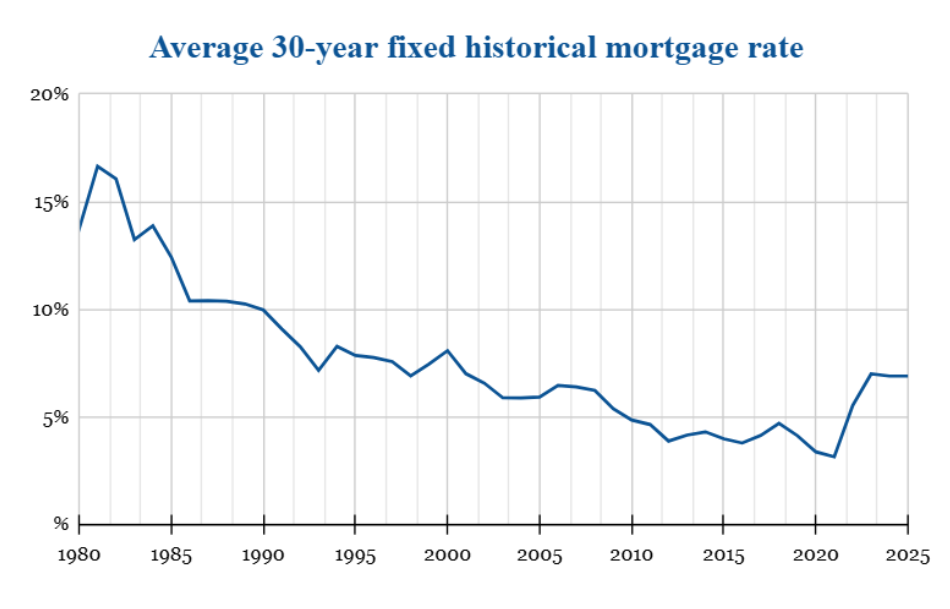
The Economics of 1990: 10% Interest Rates Changed Everything
In 1990, the average 30-year fixed mortgage rate was around 10.13%. That number shaped the market more than many sellers realize. Even if a home price looked modest by today’s standards, the monthly payment burden was heavy. Buyers had less room for error, lenders were less forgiving, and deals could collapse when payments, repairs, and closing costs all stacked together.
That is one of the biggest reasons cash had real power in the 1990s Oakland market. A cash buyer could remove financing delays, appraisal pressure, and lender-driven condition requirements. Sellers who needed certainty often preferred a direct cash offer over a higher but fragile financed contract. When a property needed repairs or the seller needed speed, reliability became just as important as headline price.
That lesson still applies in 2026. Rates may move differently from one cycle to another, but the same truth remains: when borrowed money becomes more expensive or harder to secure, cash becomes more attractive. It gives sellers a simpler path through a more complicated market.
Why Distressed Properties Traded Differently Back Then
Older Oakland homes often came with deferred maintenance, outdated plumbing, old roofs, worn electrical systems, foundation concerns, garage conversions, or unpermitted additions. In the 1990s, these problems could reduce the buyer pool quickly because financing standards and buyer budgets left less room for major surprises. A house needing serious work was not just inconvenient. It could become unsellable through the standard retail path unless the seller fixed it first or priced it aggressively.
That created opportunity for experienced cash buyers who understood repairs and could move without lender approval. The real value was not only in buying below retail. It was in solving a problem other buyers could not comfortably absorb. If you knew construction, understood title issues, and could close without waiting for a bank, you could help sellers who otherwise had very limited options.
Local Shops, Local Trades, and Why Margins Worked
Before big-box stores dominated the Bay Area, we relied heavily on family-owned plumbing houses, local hardware stores, and neighborhood supplier relationships. That ecosystem mattered. Materials moved faster through trusted channels, pricing was often more negotiable, and repeat operators who showed up consistently could get help when timing was tight. In a property business built on speed and problem-solving, that local network made a real difference.
Labor economics mattered too. Skilled trades such as plumbers and electricians cost far less by 1990s standards than they do now. That meant an experienced investor or contractor could step into a distressed property, make meaningful improvements, and still preserve room for a profitable exit. Lower repair costs widened the gap between what the average retail buyer feared and what a capable cash buyer could confidently handle.
How That Advantage Evolved
Today, labor is more expensive, permits can be more complex, and the cost of mistakes is much higher. But the principle has not changed. If a buyer can evaluate repairs accurately and control execution better than the average market participant, that buyer can still move on properties that scare off traditional purchasers. That is one reason experienced direct buyers still matter in Oakland.
Oakland Before the Tech Explosion
Before the dot-com era and long before AI became a market force, Oakland moved at a different speed. There was demand, but not the same speculative heat or aggressive wave of buyers chasing proximity to San Francisco and the broader Bay tech economy. For homes in rough condition, that meant longer timelines and fewer clean exits. Properties that needed work did not always attract eager bidding wars. Many simply sat until the right cash operator stepped in.
When later waves of Bay Area growth pushed more buyers into Oakland, the city’s market changed dramatically. Demand deepened, prices rose, and neighborhoods that once felt overlooked became highly competitive. But even as values climbed, one thing stayed constant: the hardest homes to sell were still the ones with complexity. Deferred maintenance, title problems, probate, code issues, and problem occupancy continued to separate easy retail deals from situations where cash still offered a superior path.
What Oakland Housing Market History Teaches Sellers in 2026
Looking backward helps sellers make better decisions today. Oakland’s housing history shows that markets reward convenience and punish uncertainty. When a house is clean, updated, financeable, and easy to understand, the retail market usually responds well. When a property is complicated, the cost of delay grows quickly. Owners start spending money on cleanout, repairs, carrying costs, disclosures, inspections, and contractor coordination before they even know whether the final deal will stay together.
That is where the older market lessons still matter. In the 1990s, cash won because it removed friction. In 2026, cash still wins for many sellers because it removes a different version of that same friction: lender overlays, insurance concerns, renovation inflation, title delays, buyer hesitation, and the fatigue that comes from trying to prepare a difficult house for a polished retail audience.
Why Cash Still Wins Today
Cash does not win because every seller wants the same thing. It wins because certain sellers value certainty more than maximized retail presentation. If the property needs major repairs, has tenants, carries old liens, involves probate, or belongs to an owner who simply does not want to manage months of prep work, a direct cash sale can create a cleaner outcome. That was true decades ago, and it is still true now.
In today’s Oakland market, the financial stakes are larger, which makes certainty even more valuable. A bad repair decision can cost far more than it used to. A delayed closing can carry larger holding costs. A failed retail deal can drain both time and momentum. For the right property, a serious cash offer can reduce risk, shorten the timeline, and let the seller move on without funding a full renovation first.
The Twin Home Buyer Advantage Today
As a licensed General Contractor and C-36 plumber, I still apply the same core principles that mattered decades ago. We understand repair costs from the inside, not just from a spreadsheet. That helps us evaluate older homes realistically, move faster on distressed situations, and avoid the inflated assumptions that often make retail preparation so frustrating for sellers.
Because we know the work, we can often make stronger as-is offers than buyers who must outsource every decision. Sellers do not need to pour money into a property just to see whether the market will cooperate. Instead, they can compare a direct, no-obligation cash option against the cost and uncertainty of fixing everything first.
The Real Question for Sellers
The most useful question is not whether Oakland is more expensive now than it was in 1990. Of course it is. The better question is whether your specific property benefits more from full retail preparation or from a direct sale that trades a longer process for immediate certainty. Oakland housing market history shows that when financing is tight, repairs are heavy, or timelines are urgent, certainty becomes a premium feature.
If your house is clean, updated, and easy to finance, the open market may be a strong fit. If it is older, inherited, tenant-occupied, damaged, or carrying a long list of unresolved issues, the historical lesson is simple: the buyer who can close cleanly and solve complexity often creates the best real-world outcome.
Real People. Real Results.
What Our Clients Say
Rafael P.

Stress free process, paid all the closing costs and didn’t have to do any cleaning or repairs. Juan Diaz and team are men of their word.
Robert R.
Juan Diaz and his team deliver on their promises and go above and beyond. Their professionalism and honesty are respected.
Edgar R.
Called Twin Home Buyer with questions. They listened, offered honest advice, and followed up just like they said they would.
Jose J.
Awesome to deal with. They let me know upfront if it wasn't the right match and even recommended a great realtor.
