Title issues and liens can stop a traditional home sale completely — but they do not have to stop your sale. From Oakland's Dimond District to San Francisco's Sunset, these title clouds scare off conventional lenders and make financed buyers walk away. A direct cash buyer who understands title resolution can often move forward where the traditional market cannot.
The Bay Area's high property values, aging housing stock, and complex ownership histories create a disproportionate number of title complications compared to most other markets. Many homeowners discover a lien or title cloud for the first time when they are already trying to sell — and at that point, the surprise can derail months of planning and force a choice between resolving expensive legal issues out of pocket or abandoning the sale entirely.
The good news is that title issues do not necessarily prevent a sale. They create complications for traditional buyers who depend on lender approval — but a cash buyer who works with title companies experienced in lien resolution can often structure a transaction that clears the issue at closing, pays off the obligation from the proceeds, and delivers the seller a clean exit without requiring them to fund the resolution before the sale even begins.
Common Title and Lien Challenges in the Bay Area
Not all title issues are equally serious or equally complicated to resolve. Some can be cleared in days with the right title company. Others require court involvement, creditor negotiation, or probate proceedings that add weeks or months to the timeline. Understanding what type of issue you are dealing with is the essential first step before any sale strategy can be evaluated.
Tax Liens — IRS, FTB, and Property Tax Delinquencies
Federal IRS liens, California Franchise Tax Board liens, and delinquent property tax obligations are among the most common title clouds on Bay Area properties. These liens attach to the property automatically when the underlying tax obligation goes unpaid, and they must be satisfied before or at closing for title to transfer cleanly. A financed buyer's lender will not approve a loan on a property with an active federal tax lien until it is fully resolved — which means the seller must either pay it off before listing or find a buyer who can structure the payoff at closing.
We recently helped an Oakland homeowner settle over $15,400 in combined IRS and property tax liens at closing, allowing the sale to proceed on a fast timeline without the seller needing to fund the payoff out of pocket before the transaction could begin.
Mechanic's Liens — Unpaid Contractor Claims
When a contractor, subcontractor, or materials supplier is not paid for work performed on a Bay Area property, California law allows them to file a mechanic's lien against the property itself as security for the debt. These liens can be filed even if the homeowner believed the work was completed or paid for through a general contractor — because subcontractors and suppliers have independent lien rights that the property owner may not have known were at risk. A mechanic's lien stays attached to title until it is formally resolved through payment and a lien release, or through legal proceedings if the original claim is disputed.
For sellers, a mechanic's lien discovered during a title search creates immediate complications. A financed buyer's lender will typically not proceed, and even cash buyers who do not understand construction law may pull out. Working with a buyer and title company that regularly handles mechanic's lien resolution is essential to keeping the transaction on track once the issue is identified.
Judgment Liens — Court Judgments Against the Owner
When a court enters a money judgment against a property owner — from a lawsuit, a debt collection action, a personal injury case, or a business dispute — California law allows the judgment creditor to record an abstract of judgment that automatically creates a lien on all real property the debtor owns in that county. The judgment creditor does not need to take any separate action against the property specifically. The lien simply attaches to the title when the abstract is recorded, and it stays there until the judgment is paid, settled, or discharged through bankruptcy.
Judgment liens on Bay Area properties can range from a few thousand dollars to hundreds of thousands depending on the underlying case, and they can appear on a title search even when the original lawsuit is years old. A cash buyer who understands judgment lien resolution can often negotiate a payoff from proceeds at closing, allowing the sale to proceed without the seller funding the resolution in advance.
Boundary Disputes and Easement Conflicts
In densely built Bay Area neighborhoods, unclear property lines, encroachments from neighboring structures, and disputed easements create title complications that conventional lenders treat as disqualifying conditions. A fence built on the wrong side of a survey line, a garage addition that crosses a property boundary, or a shared driveway with no recorded easement agreement can all generate title clouds that prevent a financed buyer from closing — even when the physical situation is stable and has existed without conflict for decades.
Resolving these issues formally requires a licensed surveyor, often a title attorney, and sometimes a court proceeding if the neighboring party disputes the resolution. For sellers who do not want to fund that process before selling, a cash buyer who can work around the boundary issue or structure a transaction that handles it at closing is often the most practical path forward.
Probate Clouds and Ownership Disputes
When a Bay Area property passes through an estate and the transfer of ownership is not properly documented, recorded, or court-approved, the resulting title cloud can prevent any sale until the ownership question is formally resolved. This happens regularly with inherited properties where the original owner passed away without a will, where multiple heirs have conflicting claims, where a deed was never properly recorded after a transfer, or where a trust or estate has not been properly administered. Lenders will not approve financing for a property with an unresolved ownership question — and even many cash buyers will not proceed until the title is clear.
A buyer who works with probate attorneys and experienced title companies regularly can often navigate these situations more efficiently than the open market allows, identifying the fastest legal path to a clean title and structuring a transaction that accommodates the estate's timeline rather than forcing the heirs to fully resolve every issue before a sale can even begin.
HOA Liens and Assessment Delinquencies
In Bay Area condominiums, planned developments, and HOA-governed communities, unpaid assessments, special assessment charges, and fines can generate HOA liens that attach to the property and block a clean title transfer. HOA liens in California have priority rules that can make them especially difficult to ignore — and in some circumstances, an HOA can actually foreclose on a property for delinquent assessments even when the mortgage is current. For sellers with outstanding HOA obligations, a direct buyer who can pay off the delinquency at closing removes a complication that would otherwise prevent any financed buyer from proceeding.
Why Traditional Sales Fail When Title Issues Exist
Conventional mortgage lenders require clean, insurable title as a condition of loan approval. When a title search reveals an active lien, a boundary dispute, an ownership cloud, or any other encumbrance that the title insurance company cannot insure over, the lender's underwriting department will either require the issue to be fully resolved before proceeding or decline the loan entirely. That requirement puts the entire burden of resolution on the seller — who typically must fund the payoff or legal costs out of pocket, wait for the resolution process to complete, and then re-enter the market hoping the buyer has not moved on during the delay.
In practice, many traditional sales with title complications die in escrow. The buyer goes under contract, the title search surfaces the problem, and then a weeks-long resolution attempt begins while the buyer's financing approval window starts to expire. If the resolution takes longer than expected — or if the cost of clearing the lien turns out to be higher than the seller anticipated — the buyer may walk and the seller is left starting over from scratch, having already invested months of preparation, staging, and showing time into a transaction that could not close.
That cycle is exactly what a cash buyer sidesteps. Because there is no lender requiring clear title before funds can be released, a cash buyer and a competent title company can often structure a transaction where liens are identified, payoff amounts are confirmed, the sale proceeds cover the obligations, and the title transfers cleanly — all within a single closing process that does not require the seller to fund anything in advance or wait for a separate resolution to complete before the sale can restart.
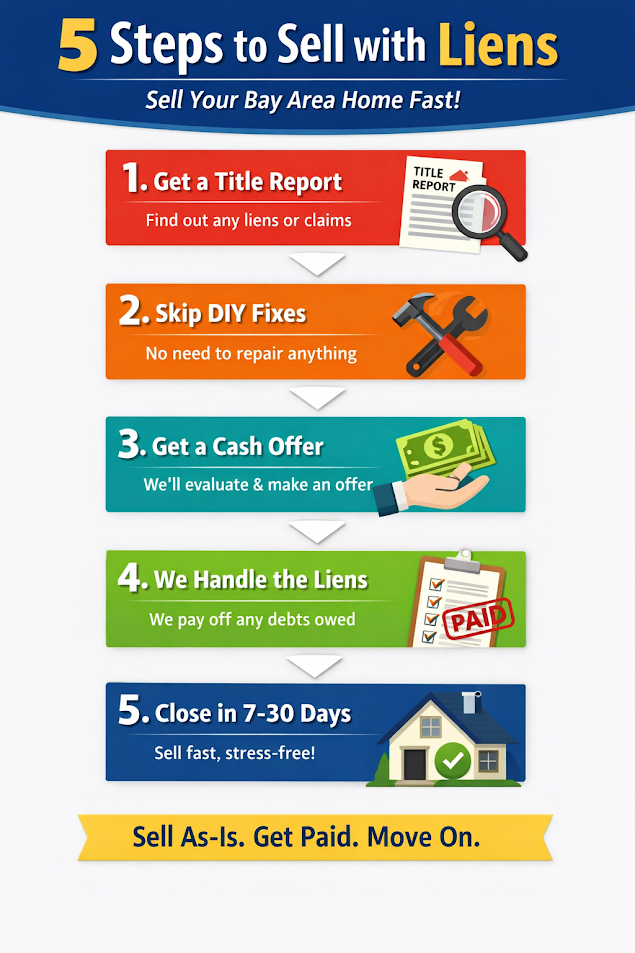
Step-by-Step: How We Buy Homes with Title Issues
The process for selling a property with known or suspected title issues is more straightforward than most sellers expect when they are working with a buyer who regularly handles these situations. Each step below is designed to keep the transaction moving forward while the title issues are being identified and resolved in parallel — rather than stopping the process entirely until every issue is cleared.
- Step 1 — Property and Situation Review We start with the property address and a description of what you know about any existing liens, legal issues, or ownership questions. You do not need a complete legal inventory before reaching out — we will help identify what needs to be looked at more closely once we understand the basic situation.
- Step 2 — Preliminary Title Report We order a preliminary title report through a licensed Bay Area title company. This report identifies all active liens, encumbrances, easements, boundary issues, and ownership questions currently recorded against the property. Most preliminary reports are available within two to 7 business days and give us a clear picture of what needs to be resolved before or at closing.
- Step 3 — Cash Offer That Accounts for the Issues Once we understand the title situation, we make a direct cash offer that factors in the lien payoffs, resolution costs, and any other title-related obligations. The offer is built around the property's net equity after those obligations are satisfied — not a vague range that gets revised downward once the title report comes back with findings you were not expecting.
- Step 4 — Lien Payoff and Title Resolution at Closing For liens that can be paid off at closing — tax liens, mechanic's liens, judgment liens, HOA delinquencies — the title company processes the payoffs directly from the sale proceeds. The seller does not need to fund these obligations out of pocket before closing. For more complex issues like boundary disputes or probate clouds, we work with the title company and appropriate legal professionals to determine the fastest resolution path and build the timeline around that process.
- Step 5 — Clean Title Transfer and Proceeds to Seller Once all liens are paid and the title company confirms insurable title, the deed transfers and the seller receives the remaining net proceeds. The transaction is complete, the obligations are resolved, and the property is no longer the seller's legal or financial responsibility from that point forward.
What Sellers Need to Know About Lien Payoffs at Closing
One of the most common misconceptions about selling a property with liens is that the seller must pay off all obligations before the sale can proceed. In most cases involving standard liens — IRS taxes, property tax delinquencies, mechanic's liens, judgment liens, and HOA assessments — the payoff can be structured to happen at closing from the sale proceeds, not before. The title company acts as an escrow holder, confirms the payoff amounts with each lien holder, and disburses the required funds directly from the closing transaction before releasing the remaining net proceeds to the seller.
This means a seller with a $20,000 tax lien on a property with $300,000 in equity does not need to come up with $20,000 before listing or before accepting an offer. The lien gets paid at closing, and the seller receives the net equity after the payoff and closing costs are deducted. Working with a buyer and title company who understand this process — and who have done it before in the Bay Area market specifically — is what makes this straightforward rather than complicated.
Where advance resolution is required — typically for boundary disputes, probate ownership questions, or contested lien claims — we work with the seller to identify the fastest legal path and structure a purchase agreement that accommodates that timeline rather than forcing an artificial deadline that creates pressure for everyone involved.
Frequently Asked Questions
Can I sell a house with an IRS lien on it?
Yes — in most cases. IRS liens can often be satisfied at closing from the sale proceeds if there is sufficient equity. The title company coordinates the payoff directly with the IRS, which issues a lien release once the obligation is confirmed paid. The process typically takes two to four weeks once the payoff amount is formally requested, which is factored into the closing timeline from the beginning.
What if I do not know what liens are on my property?
That is normal. Most sellers do not have a complete inventory of their title status until a preliminary report is ordered. We can initiate the title search as part of the evaluation process and walk you through every finding on the report so you understand what exists, what the resolution path looks like, and how each obligation will be handled at or before closing.
Do I need to hire an attorney to sell with title issues?
It depends on the type of issue. Straightforward lien payoffs — taxes, mechanics, HOA — are typically handled entirely by the title company without requiring separate legal representation. More complex issues like boundary disputes, contested liens, or probate clouds may require an attorney's involvement. When legal help is warranted, we can connect you with Bay Area title attorneys experienced in the specific type of issue your property has.
How long does it take to close with title issues?
Straightforward lien payoffs can often close in 14 to 30 days once the payoff amounts are confirmed. More complex issues like boundary disputes or ownership clouds can take longer depending on whether court involvement is required. We provide a realistic timeline estimate once the preliminary title report is back — not a generic range that does not account for what is actually on your title.
Will a title issue reduce my offer price?
The offer is based on the property's equity after lien payoffs — not a penalty for having a lien. If the property is worth $500,000 and has $30,000 in liens, the offer reflects the net equity position after those obligations are cleared. The liens do not reduce your equity; they reduce what gets paid to you after they are satisfied. A transparent buyer should explain this calculation clearly before you accept any offer.
Can you buy a house with both liens and repairs needed?
Yes. Many of the properties we purchase in the Bay Area have both title complications and physical condition issues. Because we are a licensed general contractor and licensed plumbing contractor, we can assess the repair scope accurately at the same time the title report is being reviewed — which means both the legal and physical condition are factored into the offer together, without requiring the seller to resolve either one before the sale can proceed.
Clear Your Title and Close on Your Terms
Do not let a lien or title cloud prevent you from moving forward. Twin Home Buyer has helped Bay Area homeowners sell properties with IRS tax liens, mechanic's liens, judgment debts, boundary disputes, probate complications, and HOA delinquencies — closing cleanly by resolving obligations at closing rather than requiring the seller to fund them in advance.
Get a no-obligation cash offer and a clear explanation of how the title issues on your property would be handled. The conversation is free, there is no pressure to accept, and you will leave knowing exactly what your options are regardless of what the title report shows.
Call (415) 415-TWINReal People. Real Results.
What Our Clients Say
Rafael P.

Stress free process, paid all the closing costs and didn’t have to do any cleaning or repairs. Juan Diaz and team are men of their word. They close faster than any realtor listing ever could.
Robert R.
Juan Diaz and his team deliver on their promises and go above and beyond. Their professionalism, honesty, and hard work are very much respected. I recommend them 100%!
Edgar R.
Called Twin Home Buyer with questions. They listened, offered honest advice, and followed up just like they said they would. Super kind and no pressure. Great people!
Jose J.
Awesome to deal with. They let me know upfront if it wasn't the right match and even recommended a great realtor. This company genuinely cares about homeowners.
