Selling an Inherited House Fast in the Bay Area
Inheriting a home in the Bay Area can be emotionally complicated and financially stressful at the same time. While the property may carry significant equity, the probate process, maintenance burden, family coordination, and ongoing holding costs can quickly turn an inheritance into a difficult responsibility — especially when the heirs live out of state, the property needs work, or family members have different ideas about what should happen next.
Many heirs in Oakland, San Francisco, San Jose, and throughout the Bay Area want to sell quickly so they can avoid extra taxes, insurance, utility bills, deferred maintenance, and months of uncertainty tied to a property they never planned to own. In the right situation, a direct as-is sale can significantly reduce that pressure, distribute proceeds to the family faster, and allow everyone involved to move forward without the property continuing to absorb time, money, and emotional energy that could be going elsewhere.
The most important question is usually not just whether the inherited house has value. The real question is what type of sale actually makes sense given the probate status, title condition, number of heirs involved, physical condition of the property, and the timeline priorities of the people who need to make a decision together. Getting those details clear before choosing a selling strategy can save months of wasted effort and prevent the family from committing to a process that does not fit their situation.
Why Probate Matters for California Sellers
Probate matters because it directly affects who has legal authority to sign sale documents, how long the process may take before a sale can close, and what type of transaction structure is even legally possible given the estate's status. In California, estates above certain asset thresholds typically require formal probate administration unless the estate qualifies for a simplified procedure — and that requirement can create significant delays for families who are already trying to manage a Bay Area property from a distance or coordinate decisions among multiple beneficiaries who may not agree on timing or strategy.
For Bay Area families, those delays are expensive in a way that would not be true in most other housing markets. Mortgage payments, property taxes, insurance premiums, basic landscaping, utility maintenance, and periodic repairs do not pause because the house is tied up in a probate proceeding. If the property is vacant, older, or has known maintenance issues, those costs compound faster than most heirs anticipate when they first take on responsibility for the estate. The carrying cost of waiting three to nine months through a full probate process on a Bay Area property can easily reach tens of thousands of dollars before the estate is even in a position to close a sale.
Understanding the estate's specific probate pathway — whether through the Independent Administration of Estates Act, a simplified affidavit procedure, or a full court-supervised process — is essential before any sale strategy can be evaluated. That determination affects everything from who can negotiate the price to how quickly a contract can be executed and whether court confirmation of the sale price will be required before closing can proceed.
Common Challenges of Inherited Homes
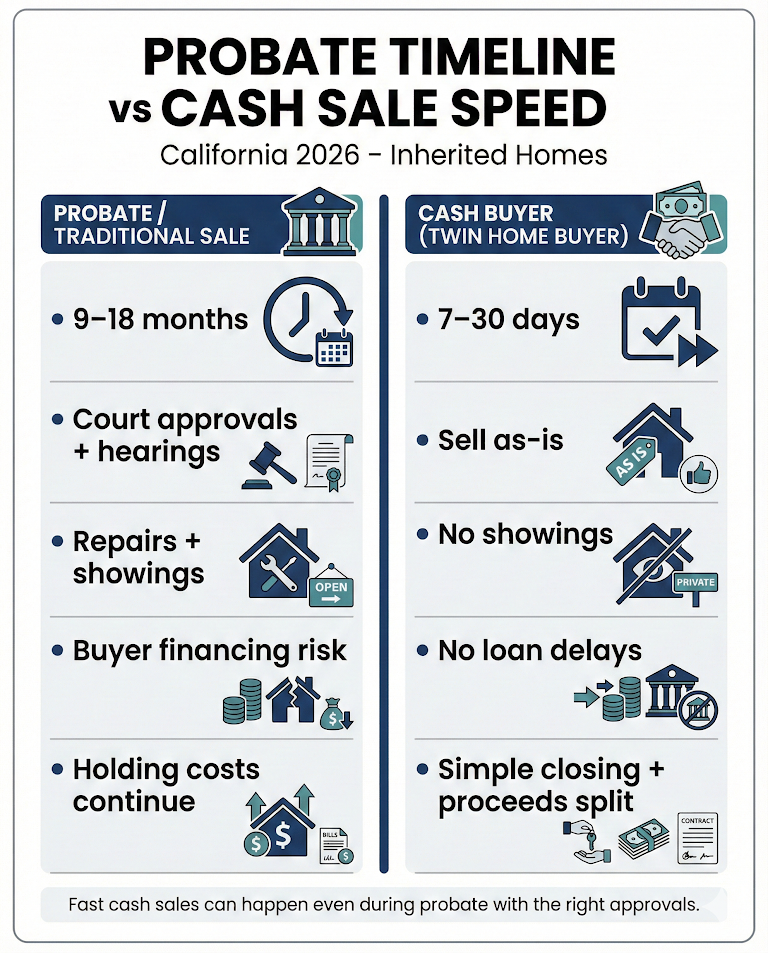
Inherited homes often come with far more than paperwork. Many have deferred maintenance that accumulated over years of owner-occupancy by someone who was no longer physically or financially able to keep up with repairs. Some still contain decades of personal belongings that need to be sorted, donated, stored, or disposed of before any showing or inspection can take place. Some involve genuine family disagreement about pricing strategy, acceptable timelines, or whether selling is even the right decision — and those disagreements can slow the process as much as any legal complication.
Traditional listings can work in some inherited property cases — particularly when the home is in good condition, the probate status is clear, the executor has full independent authority, and the heirs are aligned on strategy. But for many inherited properties, the retail listing path requires repairs, professional inspections, staging, cleanout, and significant lead time before the property is ready for market exposure. If the buyer depends on conventional financing, the transaction can still slow down or collapse during underwriting or after inspection — which is especially demoralizing when the family committed to a long preparation process specifically to achieve a clean, final sale.
The key issue for most heirs: the longer an inherited property sits unresolved, the more money, time, and emotional energy it tends to consume — and the harder it becomes to make clear decisions about it as fatigue and family tension accumulate. That is why many families start looking for a simpler and more certain path well before the probate process has fully run its course, and why a direct offer that can be evaluated and accepted quickly often provides more real value than a retail listing that promises a higher gross number but delivers it months later after significant additional investment.
Step-by-Step: How to Sell Your Inherited Home Fast
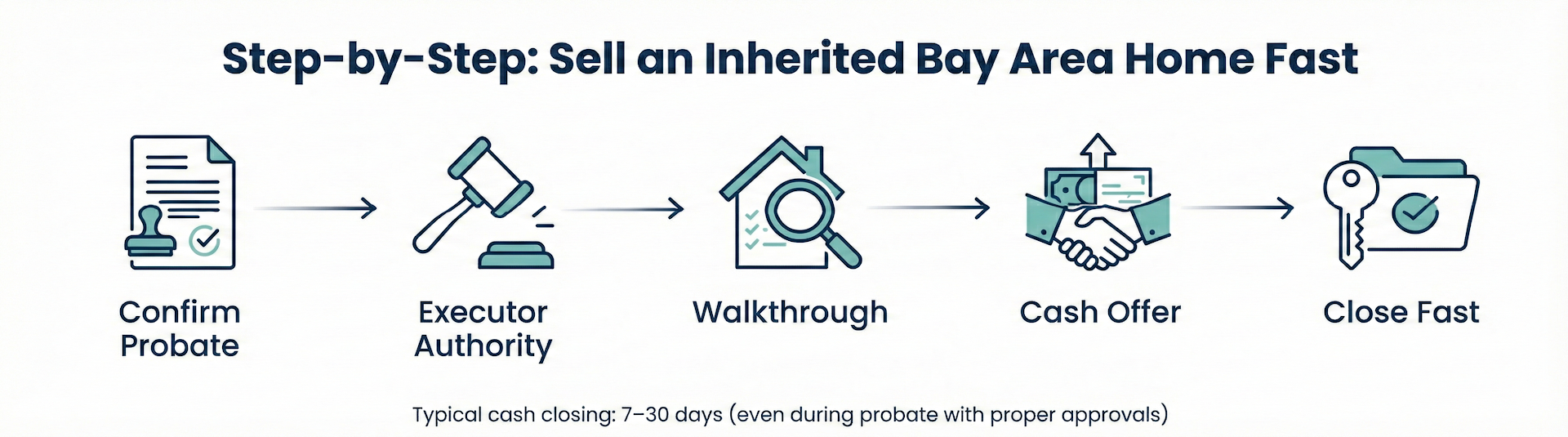
The first step is confirming the legal status of the estate before any sale strategy is discussed. Before a Bay Area inherited property can be sold, the family needs to know exactly who has signing authority, whether a probate proceeding has been opened and how far it has progressed, whether the executor or administrator has been granted full independent administration power, and whether there are any title complications — liens, co-ownership disputes, deed errors, or unresolved encumbrances — that would need to be addressed before a clean transfer of ownership is possible. This foundation work is not optional. Every subsequent decision about timing, pricing, and sale structure depends on getting this picture clear first.
The second step is deciding what kind of sale actually fits the property's condition and the family's priorities. If the home is in good condition, the estate is legally straightforward, the family has the bandwidth to prepare the property, and everyone agrees on a timeline, a traditional listing may produce the highest gross number. But if the property needs significant work, contains personal belongings, has title complications, involves multiple heirs with different schedules, or if the family's top priority is speed and certainty over maximum price, an as-is direct sale is almost always the more practical path — and frequently results in a comparable or better net outcome once carrying costs, repair expenses, and agent commissions are removed from the traditional sale calculation.
The third step is evaluating buyers and sale options based on more than just the offered price. Families should also assess how clear and transparent the process will be from contract to closing, whether the buyer has a genuine track record of closing inherited and probate properties in the Bay Area, whether repairs or preparations are required before closing can proceed, and how much certainty the family will actually have once the contract is signed. A buyer who offers more but requires repairs, financing contingencies, and a 60-day escrow may ultimately deliver less certainty and less net proceeds than a direct buyer who offers slightly less but closes in two weeks with no conditions attached.
The Fast Cash Advantage for Inherited Properties
Selling as-is to a direct buyer can simplify the inherited property process significantly because it removes most of the usual obstacles that make estate sales complicated and slow. There is no repair list to negotiate, no staging to fund, no financing contingency that can fall apart during underwriting, and no need to spend weeks preparing the property just to discover that the market is not responding the way the family hoped. That simplification is especially valuable when the heirs are already managing probate paperwork, family dynamics, out-of-state logistics, and the emotional weight of a recent loss simultaneously.
A direct sale is also particularly well-suited to the physical reality of most inherited Bay Area homes. These properties frequently have outdated systems, years of accumulated personal property, cosmetic wear from long occupancy, deferred maintenance that the original owner was no longer able to address, and general cleanup needs that would require significant time and money before a retail listing could realistically compete in the market. Instead of solving every one of those problems before the sale, the family can transfer the property in its current condition, receive proceeds sooner, and redirect that energy toward completing the estate settlement rather than managing a pre-sale renovation project.
When an As-Is Sale Makes the Most Sense
An as-is sale is most clearly the right choice when the property needs significant repairs that the estate does not have the cash to fund upfront, when the executor lives far from the Bay Area and cannot practically coordinate contractors, inspectors, and agent visits from a distance, when multiple heirs want a faster resolution and cannot agree on how much to invest in pre-sale preparation, or when the family is experiencing the kind of emotional fatigue that makes a drawn-out listing process feel like an unreasonable additional burden on top of everything else the estate demands. In any of those situations, a direct sale is not a compromise — it is the most sensible business decision available given the real constraints the family is working within.
That does not mean every inherited house should be sold the same way, or that a direct sale is automatically the right answer regardless of the property's condition and the family's situation. The decision should be grounded in what the family actually values most once all the real costs and constraints are on the table. If maximum gross price is the top priority and the family has the resources and time to pursue it, a traditional listing may still be worth considering. But if speed, certainty, simplicity, and lower out-of-pocket pre-sale cost are the priorities — which they are for most heirs managing a Bay Area inherited property — a direct as-is sale almost always produces a better total outcome when the full picture is honestly evaluated.
The carrying cost calculation is often the deciding factor. For every month a Bay Area inherited property sits unsold, the estate absorbs property taxes, insurance, utilities, basic maintenance, and any mortgage obligation that was part of the original ownership. On a typical Bay Area single-family home, that monthly carrying cost can easily exceed $3,000 to $6,000. Over a six-month listing and escrow cycle, that number can reach $18,000 to $36,000 — all of which comes directly out of the proceeds the heirs were hoping to receive. A direct sale that closes in two to four weeks eliminates the vast majority of that carrying cost exposure, and that savings frequently closes or eliminates the gap between the direct offer and the theoretical retail listing price.
What Heirs Should Confirm Before Moving Forward
Before any sale strategy is committed to, every heir involved in the decision should be clear on the following points. Missing any of these creates risk that can derail the transaction or create legal complications after the sale has already been initiated.
- Confirm exactly who has legal signing authority for the estate — executor, administrator, or trustee — and verify that their authority covers real property sales without additional court approval
- Understand clearly whether probate is required, already in progress, or can be bypassed through a simplified California procedure such as IAEA or a small estate affidavit
- Review the title condition carefully for liens, judgments, co-ownership complications, deed errors, or unresolved encumbrances that need to be cleared before a clean transfer can close
- Decide as a family whether the property will be sold as-is or prepared for the open market — and make that decision based on real cost estimates, not optimistic assumptions about what repairs will cost or how long a listing will take
- Compare competing sale options not just on gross price but on certainty, timeline, repair burden, carrying costs during the escrow period, and total net after all selling expenses
- Make sure all key family decision-makers are aligned on the sale plan before any contract is signed — undisclosed disagreement among heirs is one of the most common reasons inherited property sales fall apart after they have already started
Why Bay Area Families Often Choose Speed and Certainty
Bay Area real estate carries holding costs that are higher than almost anywhere else in the country, which means the financial math on an inherited property sale looks different here than it would in most other markets. Even when a house has strong equity and a favorable market position, waiting three, six, or nine months while paying taxes, insurance, cleanup, utilities, maintenance, and potentially a continuing mortgage can erode a meaningful portion of the benefit the family was expecting from the inheritance. That erosion is not hypothetical — it is a real, month-by-month cost that compounds the longer the property sits unresolved.
Inheriting a property in the Bay Area can already feel overwhelming, particularly for heirs who did not expect to be managing real estate, coordinating with attorneys and title companies, and making major financial decisions during a period of grief and family transition. A simpler sale structure reduces one significant layer of that complexity. It allows the family to focus energy on resolving the estate, honoring the process, and making decisions about what comes next — instead of managing a lengthy list of property tasks that no one signed up for and that continue generating costs and stress until the sale finally closes.
The families who ultimately feel best about their inherited property decisions are almost always the ones who were honest with themselves early about what the process would actually require and chose a path that fit their real situation — not the one that looked best on paper under ideal conditions that never fully materialized. For most Bay Area heirs, that means a direct sale that closes cleanly, distributes proceeds promptly, and removes the property from the equation so the estate can be resolved and the family can move forward.
Frequently Asked Questions
Can I sell an inherited house before probate is fully completed?
It depends on the estate's specific structure and what authority the executor or administrator has been granted. Under California's Independent Administration of Estates Act, some estates can proceed with a sale without full court confirmation, while others require a court-supervised process with notice to heirs and a confirmation hearing before the sale can close. The probate status needs to be reviewed by a probate attorney before any sale timeline can be committed to — but a direct buyer experienced with Bay Area inherited properties can often work within these timelines more efficiently than the retail market allows.
Do I need to repair the inherited property first?
No. Many heirs choose to sell as-is specifically to avoid repair costs, cleanup, staging expenses, and the time burden of preparing a property for open-market listing while simultaneously managing probate. A direct sale accounts for the property's current condition in the offer itself — which means there are no repair demands after the contract is signed and no pre-sale investment required from the estate before the transaction can close.
Why do families often choose a direct cash sale?
Because it reduces the delays, carrying costs, repair burdens, and financing uncertainty that make traditional listings difficult for inherited properties — and because it allows the family to distribute proceeds and resolve the estate faster once the legal authority to sell is confirmed. For heirs who are managing a Bay Area property from out of state, dealing with family coordination challenges, or simply exhausted by the demands of the probate process, a direct sale often provides the combination of speed, certainty, and simplicity that makes the entire experience more manageable.
Secure Your Inheritance Today
Do not let probate delays, mounting holding costs, and ongoing property stress keep draining time and equity from the estate. Twin Home Buyer can provide a no-obligation cash offer on your inherited Bay Area property based on its current condition — no repairs required, no agent commissions, and no pressure to accept.
Whether the estate is in early probate, mid-process, or approaching resolution, the first step is simply understanding what the property is worth as-is and what a direct sale would look like for your specific situation. That conversation costs nothing and comes with no obligation to move forward.
Get My Probate Offer →Real People. Real Results.
What Our Clients Say
Rafael P.

Stress free process, paid all the closing costs and didn’t have to do any cleaning or repairs. Juan Diaz and team are men of their word. They close faster than any realtor listing ever could.
Robert R.
Juan Diaz and his team deliver on their promises and go above and beyond. Their professionalism, honesty, and hard work are very much respected. I recommend them 100%!
Edgar R.
Called Twin Home Buyer with questions. They listened, offered honest advice, and followed up just like they said they would. Super kind and no pressure. Great people!
Jose J.
Awesome to deal with. They let me know upfront if it wasn't the right match and even recommended a great realtor. This company genuinely cares about homeowners.
