I’m Juan Diaz, CEO of Twin Home Buyer. I’ve spent 27 years buying, repairing, and rebuilding houses across the Bay Area, and this is exactly the kind of decision I walk landlords through when the fatigue is real but the numbers haven’t been checked yet.
It’s the 2 a.m. call about a burst water heater. It’s a tenant who stopped paying and won’t return your texts. It’s rent that used to cover the mortgage and now barely covers half of it. At some point, you stop thinking of yourself as an investor and start thinking of yourself as a tired landlord.
That feeling is real. But it isn’t the same thing as an answer.
Being a tired landlord doesn’t automatically mean you should sell. It also doesn’t mean you should keep the property just to prove the fatigue wasn’t its fault. The real question is what the rental actually nets, once repairs, vacancy, and your own time are counted honestly. Fatigue is a signal. It’s not a number.
This comes up often with inherited rentals, too. If you inherited the property, you and any co-owners may not agree on whether the fatigue justifies selling. That ownership and authority question is its own topic — this article is about the numbers, once you’re ready to look at them.
Quick Answer
Landlord fatigue by itself isn’t a reason to sell. But if repairs, vacancy, management time, and the next big expense are eating more than the rental actually nets, selling may make more financial sense than continuing to hold it. The tired landlord label fits a lot of Bay Area owners right now — the question is whether the property or the management is actually the problem.
If you’re not sure which one it is for you, Twin Home Buyer can look at the numbers with you before you decide anything. Get a cash offer today.
Is It the Property Wearing You Out, or the Management?
These are two different problems, and they call for two different fixes.
The property itself might be the issue: rent capped well below market, a roof or water heater that’s overdue, a floor plan that can’t compete with newer units. If so, no amount of better management changes those numbers. The property was always going to be a tough hold.
If the management is the issue — turnover, late-night calls, chasing rent, coordinating repairs — the property itself might still be a solid investment. The fix there might be a property manager, not a sale.
Most tired landlords are dealing with some mix of both. Separating the two is the first real step, before you decide anything else.
What Does This Rental Actually Net — After Repairs, Vacancy, and Your Time?
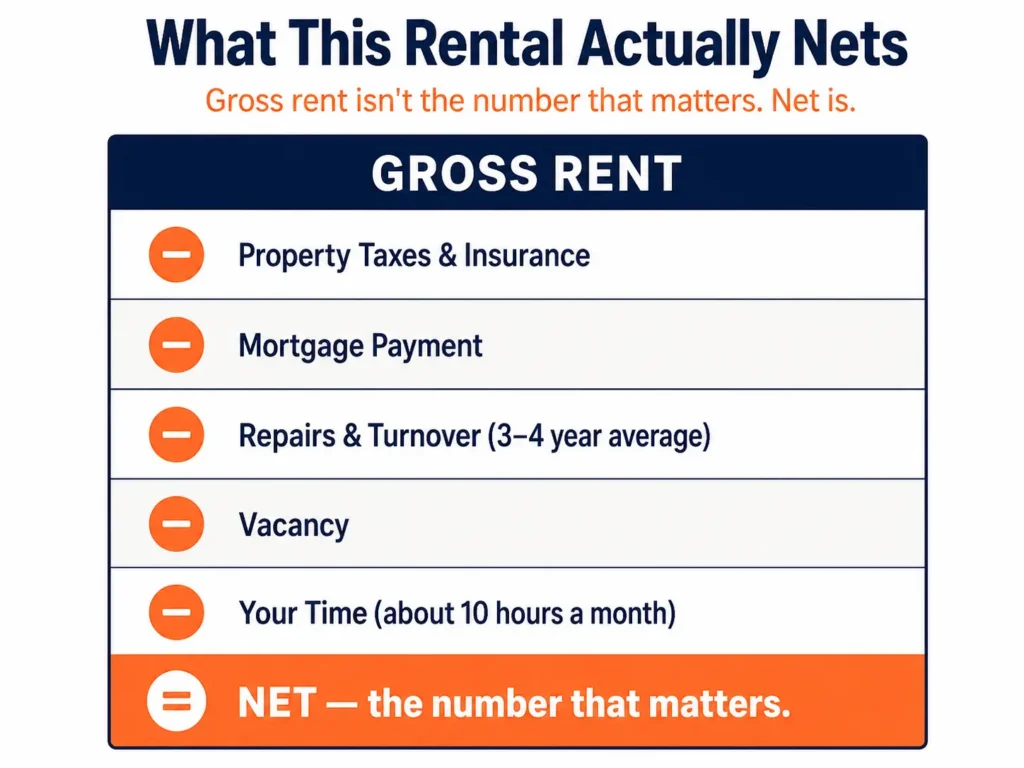
Gross rent isn’t the number that matters. Net is.
Start with what actually lands in your pocket each year. Then subtract property taxes, insurance, and any mortgage payment. Repairs and turnover costs come out next — not just this year’s, but the average over the last three or four years. So does vacancy, even if it’s only a few weeks between tenants. Then be honest about your own time. Ten hours a month managing a property isn’t free, even if no check gets written for it.
Once all of that is counted, some rentals still net a healthy return. Others are barely breaking even, or losing money once your time is priced in. You can’t tell which one you have from gross rent alone.
How Bay Area Rent Control and Tenant Protections Change the Math
Local rent control rules vary by city, and they can affect how much rent you’re able to raise and how a sale gets handled. Oakland, Berkeley, San Francisco, and San Jose all have their own local ordinances, and the details depend on the property and the specific city.
Twin Home Buyer does not provide legal, tax, title, tenant, bankruptcy, divorce, probate, or code-compliance services. Specific lease, notice, or rent-increase questions may need to be reviewed with the local rent board or a qualified professional — not decided from a blog post.
What matters for this article is simpler: if your rent has been capped well below market for years because of tenure or local rules, that’s not bad luck. That’s the actual ceiling on what the property can produce, and it belongs in your keep-or-sell math.
A Real Bay Area Example: When the Numbers Said Sell (and When They Didn’t)
The following is an illustrative, anonymized example based on situations that come up regularly — not a specific transaction record.
Take an older duplex in Hayward, owned for over a decade. The long-term tenant pays well under market rent. The roof is original to the building and due for replacement within a year or two.
Run the numbers honestly, and the picture changes fast. Rent comes in every month, but it barely covers the mortgage, taxes, and insurance combined. The roof replacement alone would cost more than a full year of net income. Add turnover risk and ordinary repairs, and this property was quietly losing money before the owner ever felt “tired” of it.
Now take a similar-looking rental a few blocks away. The rent is closer to market, and the systems are newer. This owner is worn down by tenant turnover, not by the numbers. In that case, the math still works — the real fix might be hiring a property manager, not selling.
Same fatigue. Two different properties. Two different right answers. Every situation is different — this example is here to show how the math can point in either direction, not to predict yours.
What a Big Repair Bill Really Tells You About Keeping vs. Selling
A major repair bill feels like the final straw for any tired landlord. It’s also one of the most useful pieces of information you’ll get.
Say the property has been running close to breakeven for years. Now a $20,000 roof or a $15,000 electrical upgrade is due. That bill often reveals a property that was never going to pencil out long-term. The fatigue wasn’t bad luck — it was the deferred cost of an aging asset finally coming due.
If the property has otherwise been solid, and the repair is a one-time expense on an asset that still performs well, that’s a different situation. It might be worth absorbing, especially if financing or reserves make it manageable.
Either way, the bill is a decision point. Don’t let it force a rushed choice — use it to finally run the real numbers.
If a big repair bill has you wondering whether this rental is still worth keeping, Twin Home Buyer can look at the property as-is — tenant in place or vacant — and help you compare selling against absorbing that cost. Get a cash offer today.
Selling Occupied vs. Selling Vacant: Why It Changes Your Buyer Pool and Price
Selling a rental with a tenant in place isn’t the same process as selling it empty, and it doesn’t always attract the same buyers.
An occupied property tends to draw investors who want the income to continue, or a direct buyer comfortable managing the transition. A vacant property opens the door to owner-occupant buyers too, which can widen the buyer pool and sometimes support a higher price — but it also means covering the property during the vacancy and managing move-out logistics.
Neither path is automatically better. It depends on your timeline, your tenant relationship, and how much certainty you want. Already decided to sell, with the tenant staying through closing? A tenant-occupied sale has its own mechanics worth understanding. Selling with a tenant still in the property covers those specifics in more depth than this article does.
Would a Property Manager Actually Fix the Fatigue Without Selling?
Sometimes, yes. Sometimes, no. This is worth answering honestly instead of assuming either way.
A property manager typically costs eight to ten percent of collected rent, plus leasing fees when a unit turns over. If your numbers have real room in them, that cost can buy back your time and your sanity without changing the underlying investment. Many landlords who are fatigued by day-to-day management, not by the economics, find this is exactly the fix they needed.
But a property manager can’t fix a property that doesn’t pencil out. Maybe rent control has capped your income well below what the property costs to run. Maybe a major repair is unavoidable regardless of who’s managing it. Either way, hiring help just adds a new expense on top of a property that was already thin. Be honest about which situation you’re in before you spend money finding out the hard way.
Questions to Ask Yourself Before Deciding
- Are repairs costing more than expected, more often than they used to?
- Is your rent capped well below market because of tenure or local rent control?
- Is tenant turnover frequent, or is there a difficult tenant situation right now?
- How much of your own time goes into managing this property in a typical month?
- Is a major expense — roof, water heater, electrical panel, foundation — likely in the next one to three years?
- If you sold and invested the proceeds elsewhere, would that likely outperform continuing to hold?
If most of your answers point the same direction, that’s real information — not just a mood.
Not sure how to weigh your own answers? Twin Home Buyer can walk through them with you and help you see what the numbers actually say before you commit to a direction. Get a cash offer today.
Honest Options: Keep It, Hire Help, List It, or Sell Directly
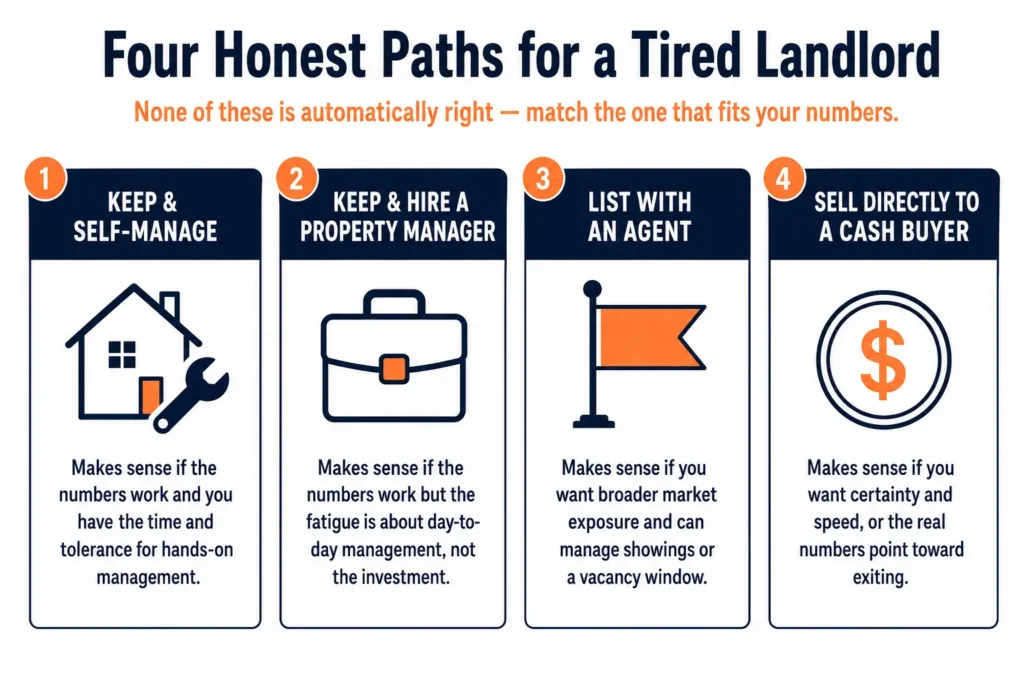
There are four real paths here for a tired landlord, not two.
Keep it and self-manage can make sense if the numbers still work and you have the time and tolerance for hands-on management.
Keep it and hire a property manager can make sense if the numbers work, but the fatigue is really about day-to-day management rather than the investment itself.
List it with an agent, occupied or vacant, can make sense if you want broader market exposure and can manage tenant cooperation, showings, or a vacancy window during the process.
Sell directly to a cash buyer can make sense if you want certainty and speed. It also fits if you don’t want to manage a tenant transition or deferred repairs before selling, or the real numbers point toward exiting rather than continuing to hold.
None of these is automatically right for every landlord. The point is picking the one that actually matches your numbers, not just your mood on a bad week.
What Twin Home Buyer Looks At on a Tired-Landlord or Tenant-Occupied Property
When we look at a rental like this, we look at current rent versus market rent, the condition and age of major systems, whether a tenant is in place and the terms of that tenancy, and what repairs are realistically coming due. That’s a different lens than pricing a vacant, move-in-ready home.
This doesn’t mean selling directly is automatically your best option. Self-managing might still work. A property manager might solve the real problem. Listing traditionally might get you a better price if you have the time for it. A tired landlord has real options — the goal is picking the one that fits your actual numbers.
A Word on Taxes and Legal Details
Selling an investment property can trigger capital gains tax, and the details depend on your basis, how long you’ve owned it, and your specific situation. This is worth discussing with a tax professional before you decide anything — not something to guess at from an article. The California Franchise Tax Board publishes general information on reporting property sales if you want a starting point.
Twin Home Buyer does not provide legal, tax, title, tenant, bankruptcy, divorce, probate, or code-compliance services. Twin Home Buyer cannot resolve lease terms, notice requirements, or tenant disputes on your behalf. A cash buyer may offer flexibility on timing and condition, but that flexibility doesn’t replace confirming your specific lease and tax situation with the right professional first.
Keeping, Hiring Help, Listing, or Selling — Get the Real Numbers First
Keeping it may be the right call. Hiring a property manager may be the right call. Listing it or selling directly may be the right call. The part worth getting right first is knowing what the property actually nets, not just how tired you are of running it.
If the property is in the Bay Area, you can call or text (415)-415-TWIN, or get a cash offer today, and talk through the real numbers with someone who’s done this before.
FAQs
Is landlord burnout a good reason to sell a rental property?
Not by itself. Burnout is a real signal, but the decision should come from what the property actually nets after repairs, vacancy, and your time — not from exhaustion alone.
How do I know if my rental is actually losing money?
Subtract taxes, insurance, repairs, vacancy, and the value of your own time from what you collect in rent. If that number is thin or negative, the property may be underperforming even if it feels “fine” month to month.
Does rent control affect what I can sell my property for?
It can. Rent capped well below market limits the income a buyer is pricing against, which can affect value — especially for an occupied sale. Details vary by city and property.
Can I sell my rental if a tenant is still living there?
Yes. It’s a different process than selling vacant, with its own rules around notice and cooperation. A tenant-occupied sale covers those mechanics in more depth.
Would a property manager solve the problem instead of selling?
Sometimes. If the numbers work and the fatigue is about day-to-day management, a manager can help. If the property itself doesn’t pencil out, hiring help just adds a new cost on top of a thin investment.
What should I do before a big repair bill forces the decision for me?
Run the real numbers now — net income, upcoming repairs, and rent-control limits — instead of waiting for a five-figure bill to make the decision for you under pressure.
Real People. Real Results.
What Our Clients Say
Rafael P.

Stress free process, paid all the closing costs and didn’t have to do any cleaning or repairs. Juan Diaz and team are men of their word. They close faster than any realtor listing ever could.
Robert R.
Juan Diaz and his team deliver on their promises and go above and beyond. Their professionalism, honesty, and hard work are very much respected. I recommend them 100%!
Edgar R.
Called Twin Home Buyer with questions. They listened, offered honest advice, and followed up just like they said they would. Super kind and no pressure. Great people!
Jose J.
Awesome to deal with. They let me know upfront if it wasn't the right match and even recommended a great realtor. This company genuinely cares about homeowners.
