
Foundation cracks make sellers panic, and I get why — but a General Contractor License means I don’t have to guess what I’m actually looking at, and neither should you. My name’s Juan Diaz. Twenty-seven years buying, repairing, and rebuilding houses across the Bay Area, as CEO of Twin Home Buyer, is exactly why I evaluate these myself instead of taking someone else’s word for it.
This guide covers foundation repair Bay Area costs, financing risk, and disclosure. A foundation problem sounds like one crisis, but it’s really three separate questions — and most sellers only ever get an answer to one of them. What does the repair actually cost? Will it affect a buyer’s financing? And what does California law require you to disclose, no matter which way you sell?
“What actually kills a foundation deal? Not the crack — the silence. A seller who never got real numbers before someone else guessed for them.”
If you’re already dealing with other issues that could slow down a sale, what can delay an as-is home sale in the Bay Area covers the wider list. This guide is the deep dive on foundation repair Bay Area sellers actually need.
Quick Answer
Foundation repair costs in the Bay Area typically run $8,000 to $15,000 for most homes. Full underpinning can climb to $15,000-$50,000+, and complete replacement of a severely compromised or older masonry foundation can run $30,000-$100,000+. The exact number depends on the cause — expansive clay soil, bay mud/fill soil, or a hillside lot — and the repair method. Foundation issues can also affect a buyer’s financing and appraisal. And California’s Transfer Disclosure Statement (Civil Code §1102) requires sellers to disclose known material defects regardless of whether they sell traditionally or directly.
If you’re not sure yet whether what you’re looking at is serious, Twin Home Buyer can help you understand where things stand before you list. Get a cash offer today.
Why Older Bay Area Homes Develop Foundation Problems
Most Bay Area foundation problems trace back to the soil, not the house. Expansive clay soil swells when it’s wet and shrinks when it dries out, and that constant movement puts pressure on a foundation year after year. Bay mud and fill soil — common in flatland areas built up from marsh or bay fill — compact and settle unevenly over decades. Hillside lots add a third failure mode: gravity and erosion cause one side of a foundation to creep downhill faster than the other.
I look at older houses on all three soil types regularly, and the pattern I see most is a house that was built to the standards of its decade, not today’s. A lot of pre-1980 Bay Area homes have unbolted cripple walls or foundations that were never engineered for the soil they actually sit on. None of that means the house is doomed. It just means the movement was baked in from the start, and it eventually shows up as a crack, a slope, or a sticking door.
Foundation Problems vs. Cosmetic Cracks — How to Tell the Difference
Not every crack means a foundation problem. Hairline cracks in a slab or a stucco wall, especially ones that don’t widen over time, are usually just normal curing or settling — cheap to seal and not a structural concern.
Here’s the rule of thumb I actually use on a walkthrough. A crack wider than about a quarter-inch is worth a real inspection, as is a diagonal crack rather than a vertical one. So is any crack that shows up alongside a sloping floor, a sticking door, or a gap where trim meets the wall. One symptom alone usually isn’t a crisis. Two or three together — especially on a house with clay, bay mud, or hillside soil — is when I’d stop guessing and get someone qualified to look.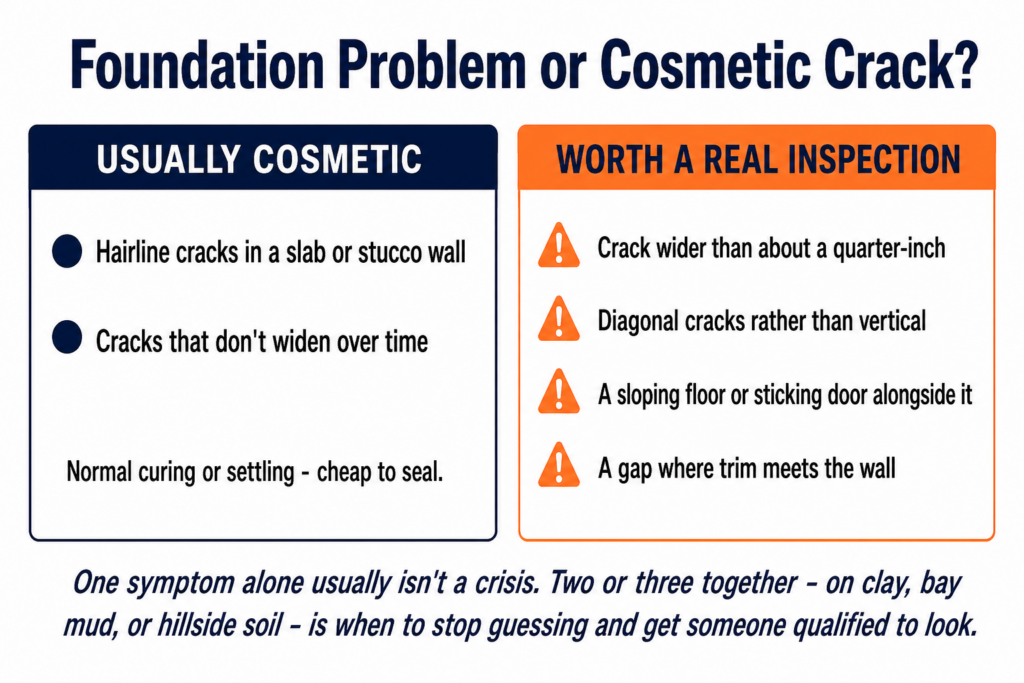
Foundation Problems vs. Seismic Retrofit: Two Different Issues
These get confused constantly, and they’re not the same thing. A seismic retrofit — bolting the house to its foundation, bracing a cripple wall, adding shear walls — is about keeping the house attached to the foundation during an earthquake. It doesn’t address the foundation itself cracking, settling, or heaving from soil movement, which is what this article covers.
A house can need one, the other, or both. If your inspection report mentions “unbolted cripple walls” or “soft story,” that’s retrofit territory. If it mentions cracking, settlement, or differential movement, that’s the foundation problem this article is about. I’ve had sellers pay for a full seismic retrofit and still have a lender flag the actual foundation crack a month later — they’re genuinely separate line items, not two names for the same fix.
Foundation Repair Bay Area Cost Breakdown by Repair Type
Most Bay Area foundation repairs run $8,000 to $15,000. Steel push piers or helical piers are the standard fix for a foundation that’s settling or losing bearing capacity, and typically run $10,000 to $25,000 for the project. Full underpinning, needed when the damage is more extensive, jumps to $15,000 to $50,000 or more. On the far end, a complete foundation replacement can run $30,000 to $100,000+. That’s usually only needed on a severely compromised foundation, or an older brick or stone foundation under a pre-1940 house. Hillside lots add specialized engineering on top of the base repair cost, typically another 20% to 40%.
I’ve walked sellers through bids that quoted three different numbers for what turned out to be the same underlying problem. The difference almost always came down to which repair method the contractor was pricing, not who was more honest. That’s why I always want to know the actual failure mode — settling, heaving, or lateral movement — before I trust any number, mine or anyone else’s.
If a geotechnical report is warranted (soil conditions are uncertain, or the lender’s underwriter wants one), budget $2,000 to $5,000 for it. That’s a real cost, but it’s a small one relative to guessing wrong on a $20,000 repair scope. Major repairs like this are exactly the kind of unplanned cost that can upend a seller’s timeline or budget — especially when they surface during a buyer’s inspection, not before listing.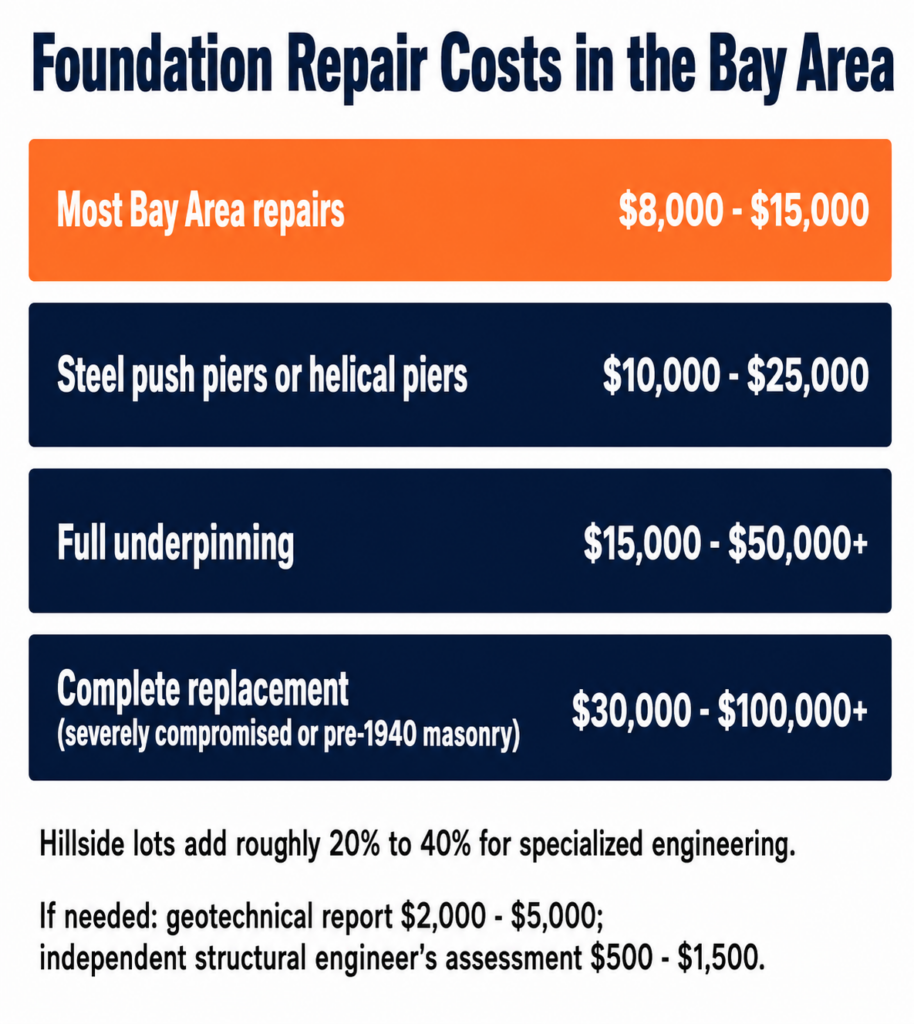
If You Already Have a Repair Bid, How to Sanity-Check It
If a contractor already gave you a number, don’t just accept it — or panic at it — without a second look. A bid that skips explaining the actual cause (clay, bay mud, hillside movement, or something else) and jumps straight to a dollar figure is a red flag. So is a bid that’s dramatically higher or lower than the ranges above without an obvious reason like unusual depth, access problems, or historic masonry.
An independent structural engineer’s assessment — separate from any repair contractor’s bid — runs $500 to $1,500. It gives you an unbiased read on what’s actually necessary before you commit to a repair scope. I tell sellers this all the time: a $1,000 second opinion that saves you from a $10,000 overcorrection is one of the best-spent dollars in this whole process. Selling a fixer-upper as-is covers the broader version of this same instinct — get the real number before you decide what to do with it.
Does Homeowners Insurance Ever Cover Foundation Repair?
Almost never, and I’d rather tell you that straight than let you find out from a denied claim. Standard homeowners insurance covers sudden, unexpected damage — a burst pipe, a fire, a tree falling on the house. Foundation movement from soil expansion, settling, or drainage issues happens gradually, which puts it squarely in the “maintenance issue,” not “covered peril,” category for almost every policy I’ve seen. The one exception worth checking is if a sudden, specific event caused the damage — a burst water main, for example — but that’s the exception, not the rule.
How Foundation Problems Affect Buyer Financing and Appraisals
This is the part that surprises sellers who assume “it’s just a crack” the most. A foundation issue that shows up on an appraisal or a buyer’s inspection report can stall or kill financing, even when you’re perfectly willing to pay for the fix yourself. Conventional and FHA lenders both have property-condition standards. An appraiser who flags active structural movement can require it be resolved, or credited for, before the loan funds — regardless of how reasonable your explanation is.
I’ve seen deals go sideways here specifically because everyone assumed a small crack wouldn’t matter to underwriting. It’s not really about how bad the crack looks. It’s about whether the appraiser or the underwriter treats it as an open question mark on the property’s condition. That uncertainty is what stalls financing — not necessarily the repair cost itself.
If a lender’s repair requirement is putting your timeline or budget at risk, Twin Home Buyer can talk through whether fixing it, negotiating credits, or selling as-is fits your situation better. Get a cash offer today.
Your Legal Disclosure Obligation: What California’s TDS Requires
California’s Transfer Disclosure Statement, under Civil Code §1102, requires you to disclose known material defects about the property. A foundation issue you’re aware of is exactly the kind of thing that statute is built around. This applies regardless of how you sell — traditional listing, as-is, or direct to a buyer like Twin Home Buyer. Selling a certain way doesn’t change what you’re legally required to say about what you know.
I’ll be direct about where my expertise ends here. I can tell you what I see in the foundation itself. I can’t tell you how to fill out a disclosure form, or what counts as “known” in a legal sense. That’s a conversation for a real estate attorney or the California Department of Real Estate — not something to guess at because a deadline is approaching.
Twin Home Buyer does not provide legal, tax, title, tenant, bankruptcy, divorce, probate, lending, or code-compliance services.
What This Looks Like in Oakland, Livermore, and Berkeley
The specific problem tends to track the soil. In parts of Oakland, especially flatland areas built on bay mud or fill, uneven settling is the more common story. One section of the house sinks slower or faster than the rest. Livermore runs on expansive clay soil, and the seasonal swell-shrink cycle from wet winters to dry summers is what drives most of the movement I see out there. In the Berkeley hills and similar hillside lots around the East Bay, it’s more often differential settlement from slope creep and drainage. That tends to need more specialized, and pricier, engineering than a flatland repair.
None of this means one city is worse off than another. It means the fix looks different depending on which failure mode you’re actually dealing with — exactly why I don’t quote a number until I know the cause.
Does Selling to a Cash Buyer Get You Out of Disclosing This?
No. Selling directly to a cash buyer — including Twin Home Buyer — does not remove your disclosure obligation under the TDS. If you’ve heard that a direct sale means you don’t have to say anything, that’s not accurate, and I wouldn’t want you finding that out the hard way. What a direct sale changes is the financing risk. There’s no lender or appraiser who can kill the deal over the condition, because the buyer is factoring the condition into the offer itself. It doesn’t change what the law requires you to disclose about what you know.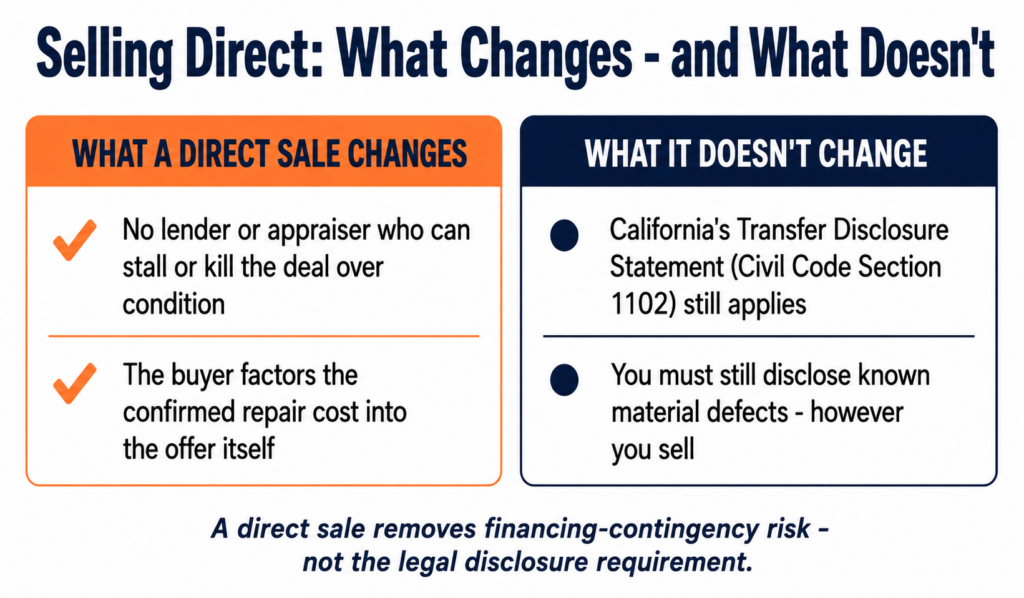
My General Contractor License means I can look at a foundation issue and tell you plainly what I’m seeing. It’s the same way I’d evaluate it as a licensed contractor on any other property — not a substitute for legal advice, just an honest read on the physical problem.
Twin Home Buyer is affiliated with Matrix Group One Inc. in San Carlos, a California licensed general contractor, CSLB License #1066892.
Worked Example: A Livermore Seller’s Foundation Surprise
The following is an illustrative, anonymized example based on situations that come up regularly — not a specific transaction record.
A longtime owner of a 1970s ranch-style home in Livermore, built on the valley’s expansive clay soil, is getting ready to list. New cracking shows up along interior door frames, alongside a sloping section of hallway floor. Once a buyer’s inspection flags it during escrow, a geotechnical report ($3,200) confirms clay-driven heave, and a push-pier repair bid comes back at $22,000. The buyer’s lender won’t fund without the repair — or an equivalent price reduction — in hand.
Rather than delay the sale for repairs, and risk hitting the same wall with the next financed buyer, the seller works with a direct buyer instead. That buyer factors the confirmed repair cost into the offer and closes without a financing contingency.
Twin Home Buyer does not provide legal, tax, title, tenant, bankruptcy, divorce, probate, lending, or code-compliance services.
Self-Check Questions Before You List or Accept an Offer
- Have I actually confirmed the cause (soil movement, drainage, original construction) or am I assuming the worst from a crack I saw?
- Is my home on expansive clay, bay mud/fill soil, or a hillside lot — and does that change what kind of repair I’m likely facing?
- Do I know what I’m legally required to disclose under the TDS, separate from what I choose to fix?
- If a buyer’s lender requires the repair before funding, do I have $8,000 to $15,000 (or more, for a bigger job) available on short notice, or does a direct sale make more sense?
If you’re weighing these questions and want a second opinion, Twin Home Buyer can talk through whether fixing it, negotiating credits, or selling as-is fits your situation better. Get a cash offer today.
Your Honest Options at This Point
Getting a licensed evaluation and, if needed, a geotechnical report, then fixing the issue before listing takes financing risk off the table entirely. That path works if you have the time and the budget for it. Listing as-is with a traditional buyer, disclosing fully under the TDS, and negotiating repair credits or a price adjustment after inspection is a normal, workable path. A real estate agent experienced with older Bay Area housing stock can help manage that negotiation. Getting ahead of the inspection findings with the buyer’s side beats reacting to them. If you’re not selling soon, you can hold off and monitor the issue with a licensed professional’s input. But the disclosure obligation doesn’t disappear just because you’re not selling today — it applies whenever you eventually do. Selling directly to a buyer, including Twin Home Buyer, is another path — it can remove the financing-contingency risk by factoring a confirmed repair cost into the offer. That doesn’t make the disclosure obligation itself go away.
Whether the right move is fixing the foundation, negotiating the paperwork, or selling as-is, it helps to know your real numbers first. If you’d rather talk it through, you can call or text (415)-415-TWIN, or get a cash offer today.
Twin Home Buyer does not provide legal, tax, title, tenant, bankruptcy, divorce, probate, lending, or code-compliance services.
FAQs
Does selling to a cash buyer mean I don’t have to disclose foundation problems?
No. The Transfer Disclosure Statement obligation applies regardless of who’s buying or how the deal is financed. A direct sale removes financing-contingency risk, not the legal disclosure requirement.
How much does foundation repair cost in the Bay Area?
Most repairs run $8,000 to $15,000. Steel push piers or helical piers typically run $10,000 to $25,000, full underpinning $15,000 to $50,000+, and complete replacement of a severely compromised or older masonry foundation can run $30,000 to $100,000+. Hillside lots add 20% to 40% for specialized engineering.
Will foundation problems stop a buyer from getting a mortgage?
They can. Conventional and FHA lenders both have property-condition standards, and an appraiser who flags active structural movement can require it be resolved or credited for before the loan funds.
What’s the difference between a foundation problem and a seismic retrofit?
A seismic retrofit bolts and braces the house to its foundation for earthquake safety. A foundation problem is the foundation itself cracking, settling, or heaving from soil movement — a different issue with a different fix.
Does homeowners insurance ever cover foundation repair?
Almost never. Standard policies cover sudden, unexpected damage, not the gradual soil movement that causes most Bay Area foundation issues.
Real People. Real Results.
What Our Clients Say
Rafael P.

Stress free process, paid all the closing costs and didn’t have to do any cleaning or repairs. Juan Diaz and team are men of their word. They close faster than any realtor listing ever could.
Robert R.
Juan Diaz and his team deliver on their promises and go above and beyond. Their professionalism, honesty, and hard work are very much respected. I recommend them 100%!
Edgar R.
Called Twin Home Buyer with questions. They listened, offered honest advice, and followed up just like they said they would. Super kind and no pressure. Great people!
Jose J.
Awesome to deal with. They let me know upfront if it wasn't the right match and even recommended a great realtor. This company genuinely cares about homeowners.
