I’m Juan Diaz, CEO of Twin Home Buyer. I’ve spent 27 years buying, repairing, and rebuilding houses across the Bay Area, and I’ve sat across the table from more than a few families who inherited a house without realizing the mortgage was still very much alive.
Here’s the part people don’t expect: the mortgage doesn’t know someone died. It doesn’t pause while the family sorts out probate, and it doesn’t care whose name is on the trust paperwork yet. Payments keep coming due, on schedule, whether anyone’s watching or not.
Most heirs assume they’re stuck with one of two choices — pay the loan off in full, or start over with a brand-new mortgage and a credit check. Neither is automatically true. You may have more real options than you think, but only if you deal with the loan itself, not just the paperwork.
If you’re earlier in the process — still sorting out the basics of selling an inherited house in California — that’s the place to start. This article picks up from there, focused specifically on what happens to an existing mortgage.
Quick Answer
If you inherit a house in California with an active mortgage, the loan doesn’t stop — payments are still due. A qualifying heir can generally keep and continue paying the existing loan under the Garn-St. Germain Act without a credit check or new closing costs, as long as they’re a relative of the borrower and typically occupy the home as a primary residence. Other real options are refinancing into your own name or selling the house and paying off the loan from the proceeds. Once authority to act is confirmed, contact the loan servicer directly — that may not be the original lender, since loans get sold and transferred often.
If you’re managing an inherited property and aren’t sure how the mortgage, paperwork, or timeline affects your options, Twin Home Buyer can help you understand where things stand before you commit to a path. Get a cash offer today.
The Mortgage Doesn’t Know Someone Died
That’s the mistake that costs families the most: assuming the loan is somehow “on hold” while probate or trust administration plays out. It isn’t. The servicer keeps expecting a payment on the same day every month, and if nobody’s making it, the loan can fall behind fast — not because of anything wrong with the house, but because everyone was focused on paperwork instead of the bill.
A missed payment or two during probate doesn’t have to be catastrophic, but it’s the kind of problem that’s much easier to prevent than to fix after the fact. If you’ve just learned you’re inheriting a house with a mortgage still on it, the first question isn’t “what do I do with the house” — it’s “who is making sure the payment gets made this month.”
Who’s Actually Authorized to Deal With the Loan?
Before a servicer will discuss the loan with you at all, they’ll want to know who’s actually authorized to act. That depends on how the property was held: if it was in a trust, a successor trustee generally has authority without going through probate. If it wasn’t in a trust, an appointed executor or administrator typically needs to be confirmed through probate first. Joint tenancy with survivorship works differently again.
This article isn’t the place to walk through that whole process — having the legal authority to sell and acting as administrator or executor cover that in more depth. What matters here is simpler: figure out where you stand on authority first, because the servicer generally won’t talk through loan options with someone who can’t yet prove they’re allowed to act.
Your Real Options: Assume It, Refinance It, Sell It, or Address It If You’re Already Behind
Once authority is sorted out, an heir generally has four honest paths, not one obvious answer:
- Assume the existing loan (Garn-St. Germain): May make sense if you qualify — relative of the borrower, primary-residence occupancy, four units or fewer — and the existing rate and terms are favorable. This is especially common with older, lower-rate loans, which is exactly the kind of loan a lot of longtime Bay Area homeowners are still paying off.
- Refinance into your own name: May make sense if you don’t qualify for assumption, want different loan terms, or need to buy out other heirs’ shares of the property.
- Sell and pay off the loan from proceeds: May make sense if no heir wants to keep the property, the loan and any additional liens still leave worthwhile equity, or the family wants a clean, faster resolution instead of an ongoing shared decision.
- Contact the servicer about loss mitigation: This is for anyone whose payments have already lapsed. It isn’t a last resort — it’s a real, available path, and federal rules require the servicer to work with a confirmed heir on this even before a loan is formally assumed.

None of these is automatically the right answer. The right one depends on eligibility, the actual numbers, and what the family wants.
The Garn-St. Germain Act: How a Qualifying Heir Can Keep the Existing Loan
Most people have never heard of the Garn-St. Germain Depository Institutions Act. It’s the reason an heir isn’t always forced into a new loan just to keep a house in the family.
Mortgages typically include a due-on-sale clause. That lets the lender demand the full balance the moment the property changes hands. Garn-St. Germain carves out an exception to that. A qualifying relative can inherit the property, keep living in it, and the lender generally can’t call the loan due over the transfer. The heir can keep making payments under the existing loan instead — often at the original interest rate. No new credit check, no new closing costs, and no forced refinance.
Twin Home Buyer does not provide legal, tax, title, tenant, bankruptcy, divorce, probate, lending, or code-compliance services. Whether you qualify to assume the loan comes down to three things. Your relationship to the person who passed. Whether you plan to occupy the home as your primary residence. And the size of the property. The loan servicer or a real estate/consumer finance attorney can confirm your specific eligibility.
What “Qualifying” Actually Means (and Why You Shouldn’t Assume Either Way)
I’ve seen people assume they’re covered by Garn-St. Germain when they’re not. I’ve also seen people assume they’re locked out when they actually qualify. Neither assumption is safe.
Three conditions generally have to line up. You’re a relative of the person who passed. The property is residential with four or fewer units. And — for the strongest protection — you plan to occupy it as your primary residence. Planning to keep the house as a rental instead? Dealing with a more complicated ownership picture — multiple heirs, a trust with conditions, an LLC? The answer isn’t automatic either way.

Confirm this with the loan servicer directly, or with a real estate or consumer finance attorney. Don’t decide it from a blog post. The exact authority to act on the loan or the property depends on your own paperwork — a trust, a will, or probate. A servicer may need to review that paperwork before they’ll even discuss the loan with you.
What Happens If Payments Already Lapsed During Probate
If a payment or two has already been missed while the family was sorting out authority, that’s a fixable situation, not a lost cause — but it needs to be addressed directly, not ignored.
Under federal servicing rules, once a servicer confirms someone as a “successor in interest,” that person gets the same core servicing rights the original borrower had: monthly statements, loss mitigation options, and dispute rights. The servicer is required to work with a confirmed heir on these options even before the loan is formally assumed. A HUD-approved housing counselor can also walk through the options at no cost, and the Consumer Financial Protection Bureau’s own regulations spell out these successor-in-interest protections directly. HUD’s housing counseling program can connect you with a free counselor — call 800-569-4287.
The one thing not to do is nothing. A lapsed payment during probate is common enough that servicers have a process for it — but that process only starts once someone contacts them.
A Real Bay Area Example: An Inherited House in East Oakland’s Fruitvale Flats
The following is an illustrative, anonymized example based on situations that come up regularly — not a specific transaction record.
Take a longtime family home in East Oakland’s Fruitvale flats, the kind of neighborhood where a lot of families bought decades ago and have stayed ever since. The parent who owned it passes away, and the adult child inheriting the house finds an old, low-rate mortgage still on it — plus a smaller second-position HELOC the parent took out years earlier for repairs.
The low rate on the primary loan makes assuming it genuinely attractive, since refinancing today would almost certainly mean a higher payment. But the second lien changes the math. Assuming the first loan doesn’t make the HELOC disappear — it still has to be paid or accounted for, whether the heir keeps the house or sells it. Working through trust paperwork at the same time as figuring out two separate loans is a lot to manage on top of grief, which is exactly why sorting out authority first and then tackling the loan situation, one piece at a time, tends to go better than trying to solve everything at once.
What a Second Mortgage or Lien Changes About the Math
A single, straightforward first mortgage is one conversation. A second mortgage, a HELOC, or a lien on top of it is a different one entirely, because assuming or refinancing the primary loan doesn’t automatically resolve what else is attached to the property.
If you’re planning to keep the house, that second lien still needs its own plan — paid down, refinanced along with the first loan, or negotiated directly with that lender. If you’re planning to sell, every lien on the property gets paid out of the proceeds at closing, in order, before anyone else sees a dollar. That means the real number to focus on isn’t the sale price — it’s what’s left after every loan and lien tied to the property gets paid off.

If a second mortgage or a lien is making the numbers harder to figure out, Twin Home Buyer can look at the property as-is and help you understand what a direct sale might net once those are accounted for. Get a cash offer today.
Don’t Forget Carrying Costs and Property Taxes While You Decide
The mortgage isn’t the only bill that keeps coming. Insurance, property taxes, and basic upkeep all keep accruing while the family works through this decision. None of that pauses for probate either.
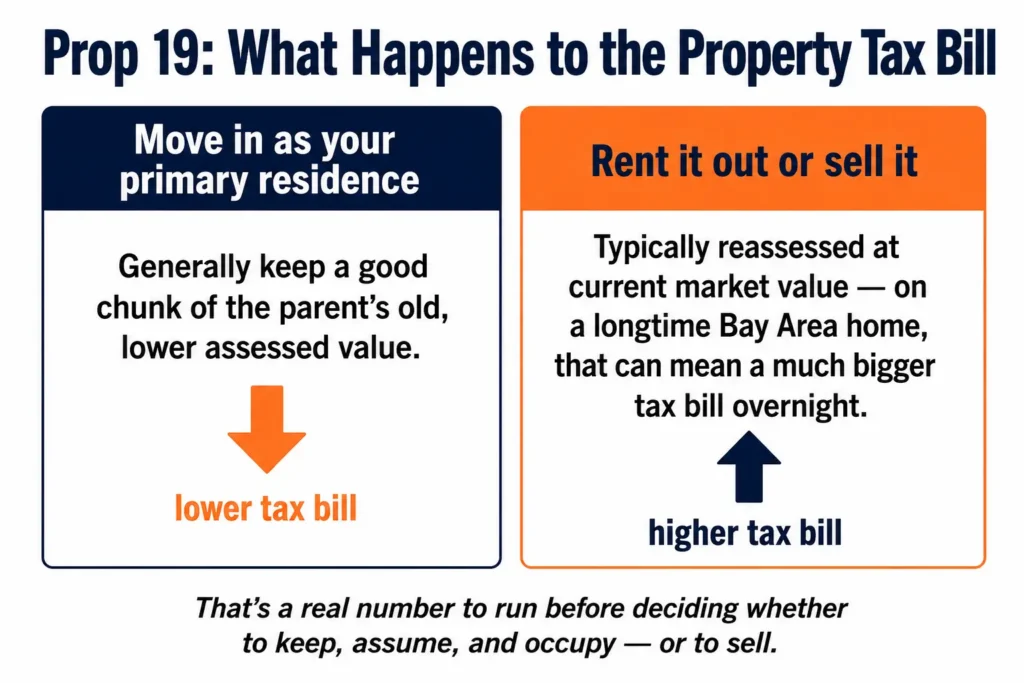
Property taxes deserve their own look because of Prop 19. An heir who moves into the home as a primary residence can generally keep a good chunk of the parent’s old, lower assessed value. Rent the house out or sell it instead, and it typically gets reassessed at current market value — which on a longtime Bay Area home can mean a much bigger tax bill overnight. That’s a real number to run before deciding whether to keep, assume, and occupy, or to sell.
Questions to Ask Yourself Before Deciding
- Do you know who the current loan servicer actually is? (It may not be the original lender if the loan has been sold.)
- Has authority to act — trustee, executor, administrator, or confirmed heir — actually been established yet?
- Are you a relative of the person who passed, and do you plan to live in the house as your primary residence?
- Is there a second mortgage, HELOC, or lien on the property?
- Have payments continued on schedule since the death, or has anything already been missed?
If you’re weighing your own answers to these and want a second opinion, Twin Home Buyer can help you think through what they mean for your options. Get a cash offer today.
When Keeping and Assuming the Loan Makes Sense
Assuming the existing loan tends to make the most sense when you actually qualify — relative of the borrower, planning to occupy the home, four units or fewer — and the existing rate and terms are genuinely favorable, which is common with older Bay Area loans that were originated well below today’s rates. It also tends to make sense when one heir clearly wants the property and the occupancy plan realistically fits.
When Selling Makes More Sense Than Assuming or Refinancing
Selling tends to make more sense when no heir actually wants to keep or manage the property, when the loan balance plus any second lien still leaves worthwhile proceeds, or when the family would rather avoid an ongoing mortgage payment on a house nobody’s living in. It also tends to make sense when the honest answer to the questions above points toward more complexity than the family wants to manage together.
What Twin Home Buyer Looks At on an Inherited, Mortgaged Property
When we look at an inherited house with an existing loan, the numbers that matter are the loan balance, any second mortgage or lien, the property’s condition, and where things actually stand on authority to sell. That’s a different starting point than pricing a typical listed home, because a direct sale still has to account for what’s owed before anyone nets anything.
A cash buyer may offer flexibility on timing and condition, but a sale still has to close through escrow, which means the loan payoff, any liens, and title still need to be confirmed — a cash offer isn’t the same as a closing.
Twin Home Buyer does not provide legal, tax, title, tenant, bankruptcy, divorce, probate, lending, or code-compliance services. Assuming the loan, refinancing, or selling can all be the right move — it depends on your eligibility, your numbers, and what your family actually wants. If you’d rather talk it through, you can call or text (415)-415-TWIN, or get a cash offer today.
FAQs
Do I have to pay off an inherited mortgage immediately?
No. There’s no rule requiring an heir to pay off the loan in full right away. Payments simply need to keep being made on schedule while you decide between assuming, refinancing, or selling.
Can I just take over my parent’s mortgage payments?
Making the payments and legally assuming the loan aren’t automatically the same thing. Under the Garn-St. Germain Act, a qualifying relative can generally assume the existing loan without a new credit check, but eligibility depends on your relationship to the borrower, planned occupancy, and the size of the property — confirm your specific situation with the servicer.
What is the Garn-St. Germain Act, and does it automatically apply to me?
It’s a federal law that stops a lender from enforcing a due-on-sale clause when a qualifying relative inherits and occupies the property. It doesn’t apply automatically to every heir — the conditions above have to be met, and the servicer or an attorney can confirm your eligibility.
What happens if mortgage payments are missed during probate?
It’s a fixable situation if addressed directly. Once a servicer confirms you as a successor in interest, federal rules require them to work with you on loss mitigation options, even before the loan is formally assumed. A HUD-approved housing counselor can help at no cost.
Can I sell an inherited house before the mortgage is paid off?
Yes. The loan gets paid off out of the sale proceeds at closing, along with any other liens on the property, as long as authority to sell has already been established.
Will a cash buyer take the house no matter what is owed on it?
Not automatically. Any loan balance, second lien, or title issue still has to be resolved through escrow before a sale can actually close — a cash offer isn’t the same as a closing.
Real People. Real Results.
What Our Clients Say
Rafael P.

Stress free process, paid all the closing costs and didn’t have to do any cleaning or repairs. Juan Diaz and team are men of their word. They close faster than any realtor listing ever could.
Robert R.
Juan Diaz and his team deliver on their promises and go above and beyond. Their professionalism, honesty, and hard work are very much respected. I recommend them 100%!
Edgar R.
Called Twin Home Buyer with questions. They listened, offered honest advice, and followed up just like they said they would. Super kind and no pressure. Great people!
Jose J.
Awesome to deal with. They let me know upfront if it wasn't the right match and even recommended a great realtor. This company genuinely cares about homeowners.
