 Every inherited house comes with its own complications, but a stranger already living inside the property is the one that panics families the most. I’m Juan Diaz, CEO of Twin Home Buyer — twenty-seven years of buying Bay Area houses in every condition and every family situation is what tells me this problem is almost always more manageable than it feels.
An inherited house with squatters inside sounds like a legal nightmare. Most of what circulates online about it is either wrong or wildly exaggerated.
“What actually stops a squatter from taking your inherited house? A legal bar built from several strict requirements at once — years of open, continuous possession, every property tax bill paid in full the whole time, and more — not just showing up and staying put.”
Quick Answer
An unauthorized occupant in an inherited Bay Area house cannot legally claim ownership without meeting California’s adverse possession requirement — a demanding, multi-part test that includes open and continuous possession for five years plus paying every property tax bill assessed on the parcel for that entire period. Simply living in the house, even for years, doesn’t by itself transfer ownership. Removal generally requires a formal legal process, and the exact path and timeline depend on how the person entered, whether they ever had permission, and whether they’re claiming any form of tenancy. Some direct sales can move forward even with an occupant still in place, though the sale itself doesn’t erase a valid tenancy or possession right — the details need to be worked out with the buyer, escrow, and an attorney.
If you’re not sure where you stand with an occupant in an inherited property, Twin Home Buyer can help you understand your options before you decide anything. Get a cash offer today.
Why This Happens: How an Inherited House Ends Up With an Unauthorized Occupant
This is a more common Bay Area pattern than most heirs expect. A homeowner dies, the family lives out of the area or is consumed with grief and logistics, and the house sits checked-on-occasionally instead of lived-in. A vacant house is a visible signal, and somewhere in that gap — a few weeks, a couple of months — someone moves in.
I’ve seen this happen to families who did everything right. Nobody was negligent. A house just can’t watch itself, and an empty one in almost any Bay Area neighborhood gets noticed by someone eventually.
First Things First: Do You Even Have Legal Authority to Act on This Property Yet?
Before you can legally do anything about an occupant, you need to know whether you actually have the authority to act on the property at all. If the estate is still in probate, or a trust hasn’t yet named you as trustee, your standing to remove someone — or to sell — may not be fully established yet.
This is the step I see skipped constantly, because the occupant problem feels urgent and the authority question feels like paperwork. But acting before your authority is confirmed can create its own legal mess on top of the one you’re already dealing with. Confirming your legal authority to sell an inherited property, and understanding the difference between an administrator and an executor, both come before the occupancy question, not after. This isn’t legal advice — confirm your actual authority to act with a probate attorney before doing anything else with the property.
Is This Actually a Squatter, or Could It Be a Family Member Who Won’t Leave?
Not every unauthorized occupant is a stranger. A sibling, a cousin, or another relative staying in the house is common — sometimes someone who lived there with the deceased, sometimes someone who just moved in after the death. Either way, they get handled differently than a stranger with no connection to the family at all.
I always ask this question first on a property like this, because the answer changes everything downstream. A stranger is straightforwardly a trespass or unlawful-detainer situation. A family member complicates things emotionally and sometimes legally, especially if they’re claiming any kind of right to stay.
What If the Occupant Claims the Deceased Gave Them Permission?
This scenario comes up more than you’d think, and it’s genuinely more complicated than a stranger squatting with no story at all. A verbal statement normally doesn’t, by itself, transfer title to real property — California requires a will or a properly executed deed for that. But a claim that the deceased gave permission can still create a real factual and legal dispute about the person’s status, and depending on the specifics, it may raise questions about a license to occupy, a tenant at will arrangement, or another alleged right. That status doesn’t get resolved by simply telling the person to leave.
If a relative is the one making this claim, an estate attorney may consider several tools depending on the facts — including a Probate Code §850 petition, which lets the court confirm the property belongs to the estate and order the occupant to surrender possession. It isn’t a one-size-fits-all process, and which approach fits depends on what’s actually being claimed. I’d rather a family know these options exist than assume arguing it out at the kitchen table is the only path forward.
Squatter, Trespasser, or Tenant? Why the Distinction Matters
How long someone has been in the house is one factor, but it doesn’t automatically determine their legal status. There’s no California statute that flips a switch on a fixed day and turns a stranger into a tenant. What actually matters is how the person entered, whether anyone gave permission, whether they’ve paid anything toward rent or expenses, what documents (if any) they can point to, and whether they’re claiming tenancy or an ownership interest. Penal Code §602 is California’s general trespass law, but the specific “30 days” language sometimes cited alongside it actually concerns hotel and motel occupancy — it isn’t a blanket rule for houses.
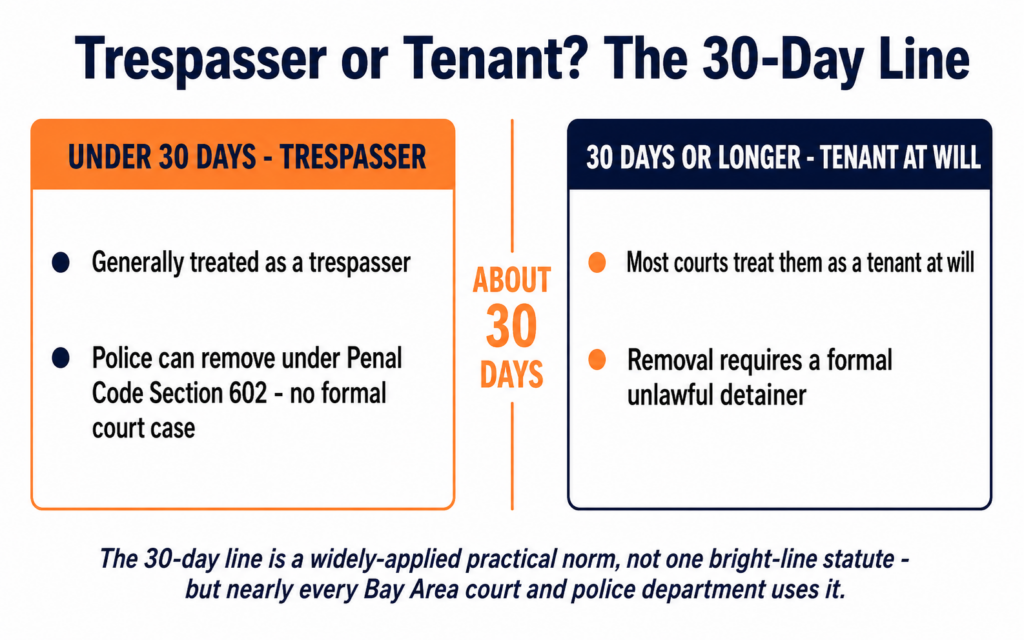
Time in the property can still matter in practice — someone there a short while with no relationship to the family looks a lot more like straightforward trespass, while someone who’s been there for months with some kind of arrangement starts to look more like a tenancy dispute that needs a formal unlawful detainer. But don’t assume you know which one applies, or that police will simply remove someone, based on a day count alone. Getting the actual facts of the situation in front of an attorney is what determines the right process. None of this is legal advice — occupant status depends on the specific facts, so don’t rely on a general rule of thumb without confirming your situation with an attorney.
What California’s Adverse Possession Law Actually Requires
This is the fear I hear most, and it’s almost always overblown. California adverse possession under Code of Civil Procedure §325 requires proof of several elements together, not just one: possession that’s open, adverse to the true owner, and continuous for five straight years, under a claim of right — plus timely payment of every property tax bill assessed on the parcel for that entire five-year period, provable with certified county tax records. Simply living in a house, even for a long time, doesn’t satisfy this test by itself.
In my experience, actually clearing this bar is rare. Most occupants haven’t been in the house anywhere close to five years, and even fewer have been paying someone else’s property taxes the whole time. It isn’t a technicality that occasionally saves a homeowner — meeting every element at once is genuinely difficult.
The Real Removal Process and Timeline
Once you’ve confirmed authority and determined the occupant needs formal removal, the unlawful detainer process runs through a set sequence. A written notice, filing with the court, formal service on the occupant, then a response window. If the occupant doesn’t move out or contest it, a judgment follows, and a Writ of Possession that the sheriff enforces.
That response window matters. As of a 2025 change (AB 2347), occupants now get 10 court days to respond instead of 5 — stretching the timeline in the opposite direction from what a lot of “fast squatter removal” content implies. There’s no universal completion date, though: how long the whole process takes depends on the required notice period, service, the court’s calendar, whether the occupant responds or contests it, and the sheriff’s scheduling for enforcement. An uncontested case with no complications may move faster than a contested one, but treat any specific timeframe someone gives you as a rough estimate, not a guarantee.
One more thing worth knowing: state law isn’t always the whole picture. Depending on the city, local just-cause, rent-control, or relocation rules can add requirements on top of state law once someone is treated as having any form of tenancy. This is general information, not legal advice — confirm both state and local rules with an attorney before serving a notice or promising a buyer the property will be delivered vacant.
If a drawn-out removal process isn’t something you want to manage while also handling an estate, Twin Home Buyer can talk through whether a direct sale — with the occupancy addressed as part of the deal — fits your situation. Get a cash offer today.
Why You Can’t Just Change the Locks
I understand the instinct. It’s your house, someone’s in it who shouldn’t be, and changing the locks feels like the obvious move. Don’t do it — especially before you know whether the person has any form of tenancy or possession right, since that’s exactly when the exposure is worst. California’s self-help eviction penalty under Civil Code §789.3 allows actual damages, plus an additional award of up to $100 for each day the violation continues, with a minimum of $250 for each separate cause of action, plus the occupant’s attorney’s fees.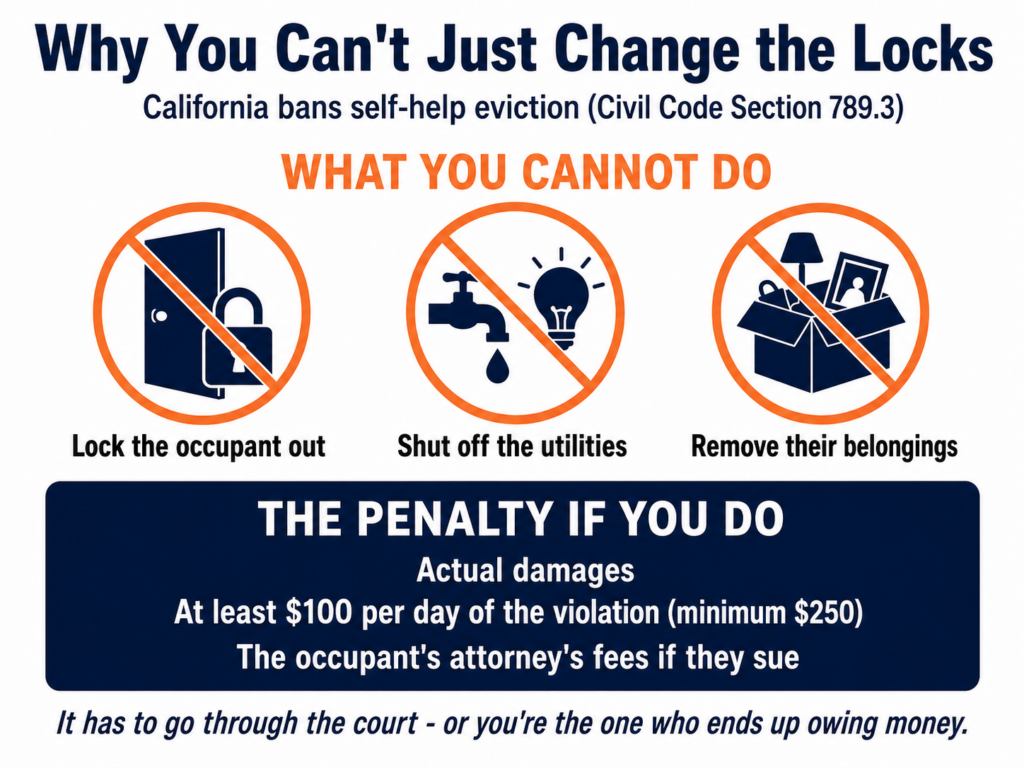
The California Courts Self-Help Center is direct about this: an owner can’t lock someone out, shut off the utilities, or remove their belongings — it has to go through the court. This isn’t legal advice — have a California attorney confirm the lawful process for your specific situation before attempting to take possession yourself.
Fact-Check: The “AB 1418” Squatter Law You May Have Read About Isn’t Real
I want to be blunt about this one, because it’s circulating widely and it’s flatly wrong. California’s 2025-2026 session AB 1418 is a real bill — it’s about health care workforce data reporting. It has nothing to do with squatters, evictions, or removal timelines. Some online articles incorrectly attribute a 15-to-21-day expedited eviction process and a $1,000-to-$5,000 penalty to this bill number. The official bill text contains no such provisions.
Here’s what’s actually true instead: AB 897, which would have made removing an undocumented occupant easier, was rejected by the legislature in 2025 — it never became law. AB 2347, which did become law effective January 1, 2025, moved the response window the other direction, from 5 court days to 10. If anything, the real legal trend this year made removal take slightly longer, not shorter. I’d rather tell you that plainly than let you make a decision based on a law that doesn’t exist.
Does Vacant-Property or Homeowners Insurance Cover This Situation?
Often not, and there’s a real trap here worth knowing about before it costs you. Don’t assume the existing homeowners policy keeps working unchanged after the owner’s death, during an extended vacancy, or once an unauthorized person moves in — policy language varies by insurer, and this is exactly the kind of gap that can turn a squatter’s presence into an uninsured loss. Many standard policies limit or void coverage once a home has sat unoccupied somewhere in the 30-to-60-day range, and a policy can also lapse at the owner’s death if the estate doesn’t notify the insurer and keep it updated. Maintaining coverage is part of the executor’s fiduciary duty, not optional paperwork.
If you need coverage during this window, vacant-property insurance exists as an option, and it’s commonly priced meaningfully higher than a standard policy — industry estimates run in the 25% to 50% range, though actual pricing depends on the insurer and the property. I tell heirs the same thing every time: don’t assume the house is covered just because a premium is still getting paid automatically from an old account. Notify the insurer, disclose the property’s actual condition and occupancy, and get the specifics of what’s covered in writing. This isn’t legal or insurance advice — policy terms are specific to your policy, so confirm coverage directly with your insurer or an attorney before assuming anything is or isn’t covered.
Selling an Inherited House With Squatters Before the Occupant Is Removed
Some investors, including direct buyers, may be willing to purchase a property with an unresolved occupant, and that surprises most heirs. But it isn’t automatic, and it doesn’t erase a valid tenancy or right to possession — the occupancy has to be disclosed and specifically addressed in the purchase agreement, with the buyer, escrow or title, and their attorneys sorting out who takes on the risk and responsibility after closing. Unresolved occupancy can substantially narrow the pool of traditional, financed buyers, since it complicates both financing and the agent’s liability picture. This isn’t legal advice — whether a sale can proceed with an unresolved occupant, and what can safely be promised about vacant delivery, depends on the facts and needs to be confirmed with your attorney and the buyer’s team.
That gap between what a financed buyer can typically accept and what a direct buyer may be willing to work through is real, even if it isn’t a guarantee. This situation doesn’t have to freeze your timeline the way it feels like it should, but it does need to be handled honestly in the paperwork, not glossed over.
What This Actually Costs and How Long It Really Takes
Court costs alone — filing fee, process server, sheriff lockout — run roughly $450 to $1,000 as of California’s current statewide court fee schedule. The filing fee itself is set by the claim amount: $240 up to $10,000, $385 between $10,000 and $35,000, $435 above that. Handle the filing yourself and that’s close to the whole bill. Bring in an attorney, and an uncontested case can total somewhere around $3,700 to $6,000 or more once their fees are added on top of court costs, though this varies by county, the specifics of the case, and the attorney handling it. Contested cases run higher on the attorney side alone.
Weigh that against what it costs to carry a vacant, at-risk property while the process plays out. Property taxes, a possible vacant-insurance premium, utilities, and the risk of damage nobody’s there to catch early all add up the longer things take. For a lot of heirs, that carrying-cost math — not a single legal-fee number — is what actually tips the decision. Get a current fee schedule and a written estimate for your specific property before treating any number here as fixed.
Worked Example: A Vallejo Heir’s Occupancy Surprise
The following is an illustrative, anonymized example based on situations that come up regularly — not a specific transaction record.
An heir inherits a modest Vallejo home from an aunt who lived alone and had been in declining health for the last year of her life. The house sits vacant for about two months after her death while the family sorts out next steps. When the heir visits to start clearing it out, someone is living inside — no lease, no relationship to the family, apparently having moved in sometime during the vacancy.
The heir’s first instinct is to change the locks immediately. Instead, the heir confirms their own authority to act on the estate first, then gets the actual facts of how and when the person moved in front of an attorney before deciding on a removal process. From there, they work with a direct buyer who can close on the sale with the occupancy situation disclosed and factored into the offer, while the formal removal process proceeds separately.
Twin Home Buyer does not provide legal, tax, title, tenant, bankruptcy, divorce, probate, lending, or code-compliance services.
Self-Check Questions Before You Decide
- Have I actually confirmed my legal authority to act on this property, separate from the occupancy issue?
- Do I actually know how this occupant entered, whether anyone gave permission, and whether they’re claiming any form of tenancy — not just how long they’ve been there?
- Am I assuming adverse possession is a real risk here, or have I checked what it actually requires (multiple elements together, including five years of continuous, open possession and paid property taxes)?
- Have I looked into changing locks or shutting off utilities myself, and do I understand the legal penalty for doing that?
If you’re weighing these questions and want a second opinion, Twin Home Buyer can talk through whether handling removal yourself, working with an attorney, or selling directly fits your situation better. Get a cash offer today.
Your Honest Options at This Point
Confirming your authority to act, then handling the formal removal process yourself with an attorney, is a real option — if you have the time and the estate can carry the property in the meantime. Listing traditionally once the occupant is removed and your authority is confirmed is workable too, though most financed buyers won’t accept the property while it’s occupied. A real estate agent experienced with probate and inherited properties can help manage that timeline and coordinate with the estate’s attorney — worth considering if you’d rather not run point on it alone. Getting a preliminary consultation with a landlord-tenant attorney is worth it if either your authority or the occupant’s exact status is unclear. And selling directly to a buyer, including Twin Home Buyer, may let you close with the occupant’s situation disclosed and factored into the deal rather than waiting for removal to finish first — without pretending the legal process itself can be skipped or that a sale erases anyone’s existing rights.
Whether the right move is handling this yourself, working with an attorney, or selling directly, it helps to understand your real situation first. If you’d rather talk it through, you can call or text (415)-415-TWIN, or get a cash offer today.
This article provides general information and is not legal advice. Occupant status, notice requirements, probate authority, insurance coverage, and sale procedures depend on the facts and may be affected by local law. Consult a qualified California attorney before serving a notice, changing possession, removing belongings, or entering a contract that promises vacant delivery.
Twin Home Buyer does not provide legal, tax, title, tenant, bankruptcy, divorce, probate, lending, or code-compliance services.
FAQs
Can a squatter really take ownership of an inherited house in California?
Not in any way that happens quickly or accidentally. Adverse possession requires proving several elements together — open, continuous possession for five years under a claim of right, plus paying every property tax bill for that entire period — and simply living in the house doesn’t satisfy that test by itself. It’s a bar almost no occupant actually meets.
How long does it take to remove an unauthorized occupant from a house in California?
There’s no fixed statewide timeline. It depends on the required notice, service, the court’s calendar, whether the occupant responds or contests the case, and the sheriff’s scheduling. An uncontested case with no complications generally moves faster than a contested one, but treat any specific number you hear as a rough estimate, not a guarantee.
Can I change the locks on a squatter in my inherited house?
No. Self-help eviction — changing locks, shutting off utilities, removing belongings — violates Civil Code §789.3 and can cost you actual damages, plus an additional award of up to $100 for each day of the violation (with at least $250 awarded per separate violation), plus the occupant’s attorney’s fees.
Is the “AB 1418” squatter law real?
California’s 2025-2026 session AB 1418 is a real bill, but it’s about health care workforce data — it has nothing to do with squatters or evictions. Some online articles incorrectly attribute a squatter-removal provision to this bill number; the official bill text contains no such provision.
Can I sell an inherited house in California with someone living in it who shouldn’t be there?
In some cases, yes — some direct buyers may purchase a property with an unresolved occupant, with the situation disclosed and addressed in the purchase agreement. It isn’t automatic and doesn’t erase a valid tenancy or possession right. Most traditional, financed buyers have a much harder time with an occupied, unresolved property.
Real People. Real Results.
What Our Clients Say
Rafael P.

Stress free process, paid all the closing costs and didn’t have to do any cleaning or repairs. Juan Diaz and team are men of their word. They close faster than any realtor listing ever could.
Robert R.
Juan Diaz and his team deliver on their promises and go above and beyond. Their professionalism, honesty, and hard work are very much respected. I recommend them 100%!
Edgar R.
Called Twin Home Buyer with questions. They listened, offered honest advice, and followed up just like they said they would. Super kind and no pressure. Great people!
Jose J.
Awesome to deal with. They let me know upfront if it wasn't the right match and even recommended a great realtor. This company genuinely cares about homeowners.
