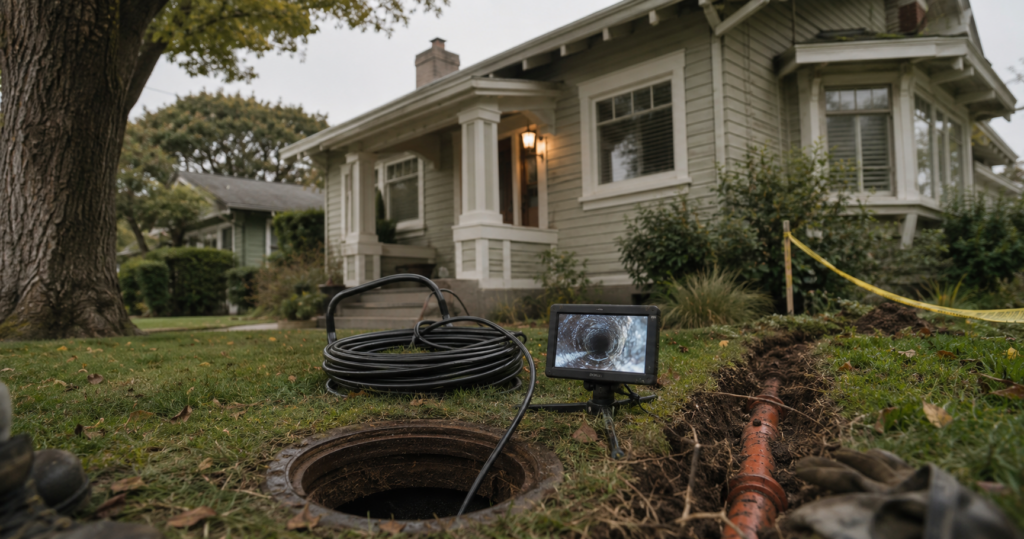
A C36 Plumbing Contractor License isn’t something most cash-buyer companies can put behind their name — I can. I’m Juan Diaz, CEO of Twin Home Buyer. After 27 years buying, repairing, and rebuilding houses across the Bay Area, that license means sewer lateral problems are something I evaluate myself instead of handing them off to someone else.
Most East Bay sellers have never heard of sewer lateral compliance until it shows up mid-escrow — usually from a title company or a buyer’s agent flagging something nobody budgeted for.
Selling your house doesn’t cause the problem. It exposes one that was already there: an old clay, cast-iron, or Orangeburg pipe running from the house to the street that’s never been tested, sitting under a property that’s about to change hands.
“Is a failed pressure test going to blow up your closing date? Not if you catch it in time — and even if you don’t, there’s still a legal way to keep escrow moving.”
If you’re already running into delays for other reasons, what can delay an as-is home sale in the Bay Area covers the broader list. This article is the deep dive on one specific trigger.
Quick Answer
In most East Bay cities served by EBMUD — Oakland, Alameda, Albany, Emeryville, Piedmont, El Cerrito, and Richmond Annex — selling a house is one of three events that requires a sewer lateral Compliance Certificate. Berkeley runs its own separate program. If the lateral fails its required pressure test and can’t be fixed before closing, sellers can negotiate a Time Extension Certificate: a refundable $4,500 deposit that gives up to 6 months (180 days) to complete the work after closing.
If you’re not sure whether your lateral has ever been tested, Twin Home Buyer can help you understand where things stand before you list. Get a cash offer today.
What Is the East Bay Sewer Lateral Program, and Why Does Selling Trigger It?
The East Bay Regional Private Sewer Lateral (PSL) Program, run through EBMUD, requires a Compliance Certificate whenever one of three things happens: you buy or sell a property, you complete a remodel worth more than $100,000, or you change your water meter size. Selling is the trigger most homeowners never see coming. It’s not something they did to the pipe — it’s just what happens whenever title changes hands. In 27 years of doing repair work across the East Bay, I’ve seen the sale trigger catch people off guard almost every time. Nothing about the house actually changed. The clock started the moment you decided to sell, not because anything failed.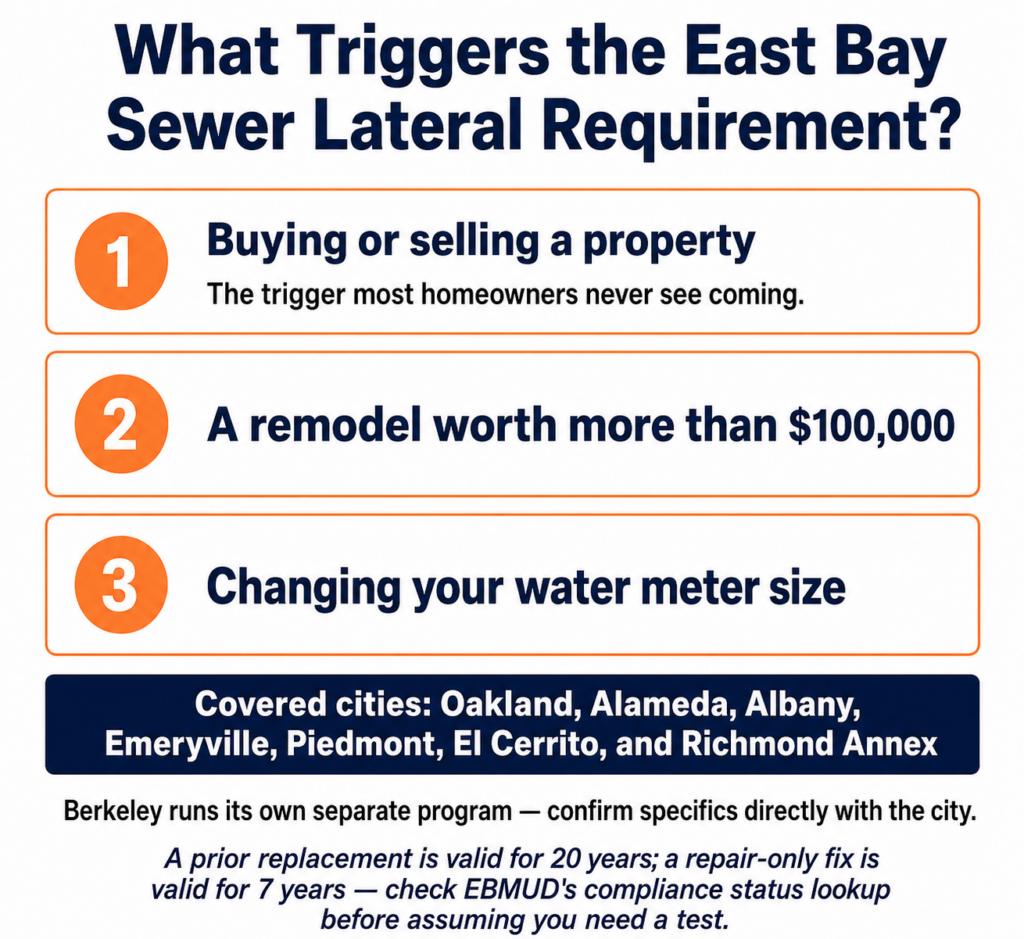
The program covers Oakland, Alameda, Albany, Emeryville, Piedmont, El Cerrito, and Richmond Annex. Berkeley isn’t part of this program — it runs its own separate sewer lateral requirement, so if your property is in Berkeley, confirm the specifics directly with the city.
A Compliance Certificate means EBMUD has confirmed your private sewer lateral is leak-free. Without one — or a Time Extension Certificate in hand — escrow doesn’t close.
Sewer Lateral vs. the Main Sewer Line — Who’s Responsible for What
This is where a lot of confusion starts, and I get this question on almost every older property I look at. The private sewer lateral is the pipe running from your house to the connection point at the street or property line — that’s the homeowner’s responsibility, not EBMUD’s. The main sewer line running under the street itself is EBMUD’s responsibility.
I’ve had sellers point to a soggy patch in the yard and tell me that’s a city problem. It almost never is. If the wet spot is between your house and the street, it’s your lateral, and it’s on you to deal with before you can sell. So when a pressure test finds a problem, it’s almost always on your side of that connection point, not the city’s — that’s exactly why the compliance requirement falls on the seller, not the utility. You own the pipe, so you own the certificate.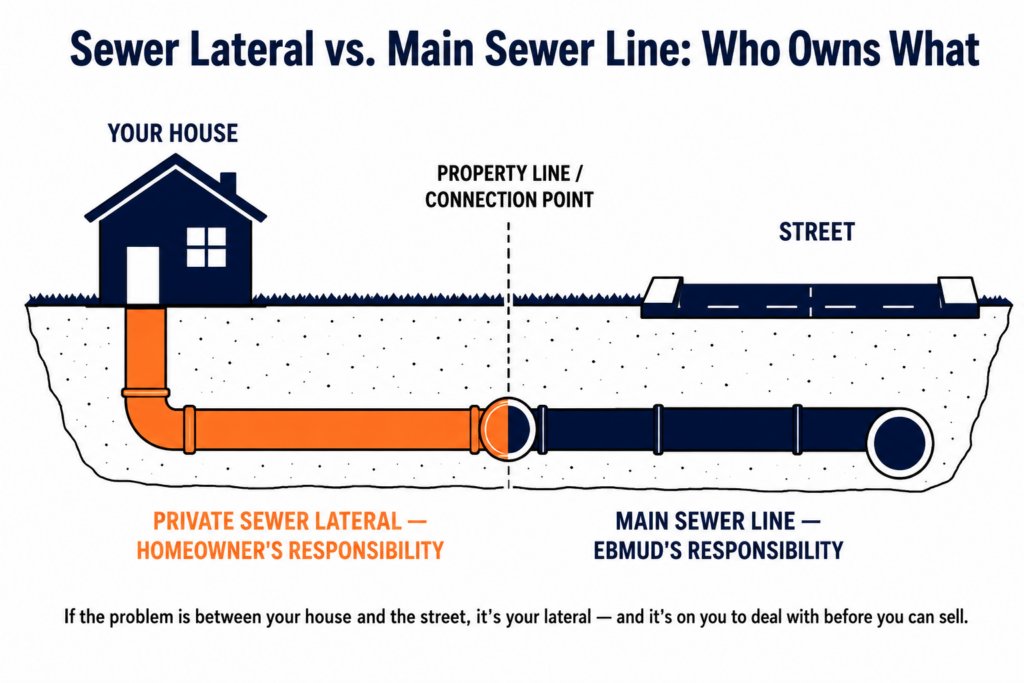
Why Older East Bay Homes Fail the Pressure Test
Homes built before 1950 in this service area were often plumbed with clay pipe, and some later homes used cast-iron or Orangeburg (tar-impregnated fiber) laterals — all of which degrade with age. Tree roots find hairline cracks and grow into them. Joints shift as soil settles over decades. None of this is visible from the surface, and none of it shows up unless someone actually runs a pressure test.
I’ve pulled camera inspections on laterals that looked fine from the cleanout and still failed the test. The actual damage was thirty feet down the line, well past where anyone would think to look. Orangeburg pipe worries me the most of the three. It can look intact on camera and still be structurally compromised, because it tends to fail by losing its round shape under soil pressure rather than cracking somewhere obvious. Age alone doesn’t tell you what you’re dealing with. Only a real test does.
Wet-weather infiltration through cracked laterals is a real, documented problem for the whole regional sewer system, not just an individual homeowner’s issue. That’s part of why EBMUD ties the requirement to ownership changes instead of leaving it voluntary.
What a Compliance Certificate Actually Requires
Getting a Compliance Certificate is a defined process, and it’s more straightforward than most sellers expect once they know the order of operations. You check your property’s status, then hire a contractor to inspect it — and repair or replace the lateral if needed. EBMUD schedules its own inspection to confirm the lateral is leak-free, and the certificate is issued once it passes.
The part that actually trips people up isn’t the process — it’s the timing. Scheduling a contractor and then scheduling EBMUD’s inspection on top of that can eat more calendar time than sellers expect. That’s especially true if repair work has to happen first. If you’re already deep into escrow when this surfaces, that timing pressure is exactly why the Time Extension Certificate exists — more on that below. Code violations on a property often surface through a similarly specific inspection-and-documentation process. This isn’t unique to sewer laterals, but the sewer lateral rule is one of the most commonly missed, because it’s triggered by the sale itself rather than by an obvious visible problem.
How to Check If Your Home’s Lateral Has Already Been Certified
Before assuming you need a test at all, check whether one’s already on file. EBMUD’s compliance status lookup can show you directly whether your property already has a valid certificate. A prior owner may have completed a full replacement (valid for 20 years) or a repair-only fix (valid for 7 years), and if that window hasn’t closed yet, you may not need anything further.
This is the step I see skipped the most. Sellers who’ve owned a house for decades often don’t remember, or never knew, that a previous owner already handled this. The paperwork gets buried in an old escrow file instead of passed down with the house. A five-minute lookup can save you from pricing out a repair you don’t actually need. Worth checking before you assume the worst.
What It Costs to Fix a Failed Lateral
If your lateral fails, standard replacements typically run $5,000 to $15,000. Complex jobs — deep excavation, street or sidewalk restoration, multiple agency permits — can run $15,000 to $30,000 or more. Bay Area contractors report the most common all-in range as $8,000 to $18,000.
The number that actually matters isn’t the average, it’s which method your property needs. A trenchless repair — pulling a new liner through the existing pipe — can come in well under a full dig-and-replace job, but it doesn’t work for every failure. If the pipe has collapsed or shifted badly, you’re looking at open trenching, which can mean landscaping, hardscape, or even a driveway getting torn up and put back. I always tell sellers to get the actual scope of failure from the inspection before assuming which end of that range they’re in. Major repairs like this are exactly the kind of unplanned cost that can upend a seller’s timeline or budget mid-escrow, especially when they show up after an offer’s already been accepted.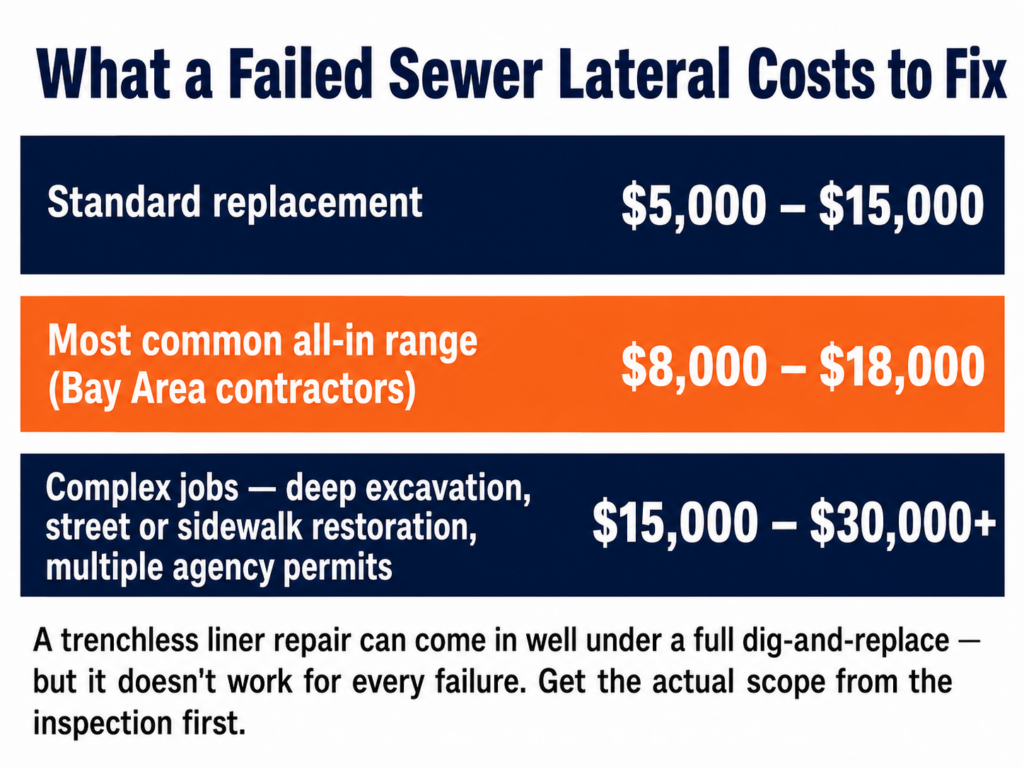
If a failed test would strain your budget more than your timeline, Twin Home Buyer can talk through your options before it gets to that point. Get a cash offer today.
The Time Extension Certificate: How to Keep Escrow Moving Without the Repair Done Yet
If the lateral fails and there isn’t time to fix it before closing, a Time Extension Certificate is the legitimate tool for keeping escrow on schedule anyway. It requires a refundable $4,500 deposit and gives you up to 180 days (about 6 months) after closing to complete the work.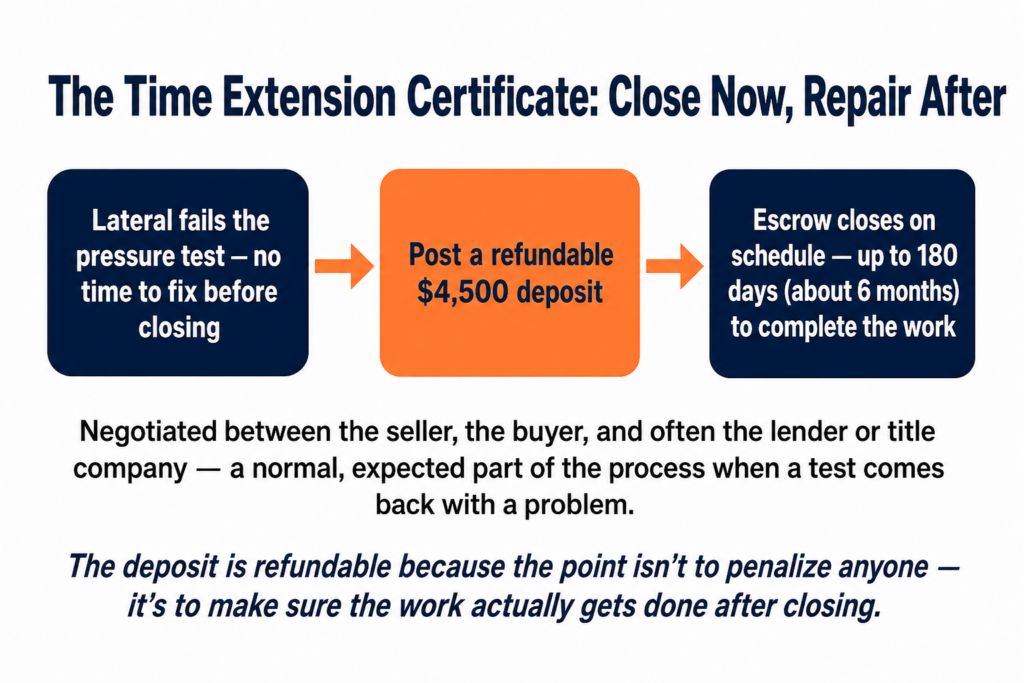
I’ve sat at the table for exactly this conversation more than once — a test comes back bad a week or two before closing, and everyone in the room assumes the deal is dead. It usually isn’t. Handled well, this doesn’t have to become a reason a sale falls out of escrow. It gets negotiated between the seller, the buyer, and often the lender or title company. It’s a normal, expected part of the process when a test comes back with a problem. The deposit is refundable specifically because the point isn’t to penalize anyone — it’s to make sure the work actually gets done after closing.
Does Sewer Lateral Compliance Apply If I Sell to a Cash Buyer?
Yes. Sewer lateral compliance applies regardless of who’s buying. Selling directly to a cash buyer — including Twin Home Buyer — doesn’t exempt anyone from this requirement. If you’ve heard that a cash buyer can close no matter what, that’s not accurate here: the trigger is the transfer of title itself, not the type of buyer or how the deal is financed.
What a direct sale can offer is flexibility on how the requirement gets handled. That could mean negotiating who takes on the certificate process, or agreeing to absorb a needed repair after closing — but it’s not an exemption from the law itself. My own C36 Plumbing Contractor License means I can look at a failed test result and tell you plainly what you’re actually looking at. It’s the same way I’d evaluate it as a licensed contractor on any other property.
Twin Home Buyer is affiliated with Matrix Group One Inc. in San Carlos, a California licensed general contractor, CSLB License #1066892.
If You Inherited the House, Does This Still Apply to You?
Not right away — but it depends on how you inherited it. Fiduciary and estate transfers are exempt from the sewer lateral compliance trigger, and so are direct-family-line transfers: spouse or registered domestic partner, parent to child, grandparent to grandchild, or great-grandparent to great-grandchild. That exemption does not extend to transfers between siblings, aunts and uncles, nieces and nephews, or cousins — those would have triggered the requirement even at the inheritance step. Either way, once you go to sell the house to someone outside the family, the exemption is over and the same compliance rules apply as any other sale.
If you’re still working out the basics of selling an inherited house in California, or specifically navigating Alameda County’s probate court process, those questions come first. This sewer lateral requirement is something to fold into that timeline once you’re ready to sell, not before.
Worked Example: A West End Alameda Seller’s Lateral Surprise
The following is an illustrative, anonymized example based on situations that come up regularly — not a specific transaction record.
Take a longtime owner of a 1930s bungalow in West End Alameda, a neighborhood with a lot of original-era clay laterals from its early housing boom. The seller lists the house, and the buyer’s title company flags that no Compliance Certificate is on file. A pressure test finds root intrusion and a cracked joint. A full replacement quote comes back around $9,500.
Rather than delay closing six to eight weeks for the repair, the seller and the buyer’s lender agree to a Time Extension Certificate. $4,500 refundable deposit, escrow closes on schedule, and the seller completes the repair within the six-month window.
Twin Home Buyer does not provide legal, tax, title, tenant, bankruptcy, divorce, probate, lending, or code-compliance services.
Self-Check Questions Before You List or Accept an Offer
- Has this house’s sewer lateral ever been tested or certified?
- Is the house pre-1950s construction in the original service area, or pre-1980s more broadly?
- If I list and a test fails during escrow, do I have $5,000 to $15,000 or more available to fix it on short notice, or would a Time Extension Certificate or a flexible buyer make more sense?
- Am I assuming a cash offer skips this requirement entirely? (It doesn’t.)
If you’re weighing these questions and want a second opinion, Twin Home Buyer can talk through whether fixing it, negotiating a Time Extension Certificate, or selling as-is fits your situation better. Get a cash offer today.
Your Honest Options at This Point
Testing and fixing the lateral before listing takes the issue off the table entirely, if you have the time and the budget. Listing as-is with a traditional buyer and negotiating a Time Extension Certificate if the test fails mid-escrow is a normal, workable path most sellers don’t realize is available. A real estate agent who’s handled this before can help too — a good one will get ahead of it, coordinating the contractor and EBMUD timeline with the title company so it doesn’t turn into a mid-escrow surprise. If you’re not selling soon, you can hold off. But remember: the certificate is still required the moment a $100,000+ remodel or a water meter change happens, so it doesn’t disappear just because you’re not selling today. And selling directly to a buyer, including Twin Home Buyer, can offer flexibility on who handles the certificate or the timing of the repair, without pretending the underlying requirement goes away.
What Twin Home Buyer Looks At on a House With Sewer Lateral Questions
When we look at a property in Oakland or anywhere else in the East Bay service area, three things matter most:
- Whether a Compliance Certificate is already on file
- What a pressure test would likely find, given the home’s age and pipe material
- What repair or Time Extension Certificate costs should realistically be factored into the numbers
Twin Home Buyer does not provide legal, tax, title, tenant, bankruptcy, divorce, probate, lending, or code-compliance services. Whether the right move is fixing the lateral, negotiating the paperwork, or selling as-is, it helps to know where you stand before escrow forces the decision. If you’d rather talk it through first, you can call or text (415)-415-TWIN, or get a cash offer today.
FAQs
Does selling to a cash buyer skip the sewer lateral requirement?
No. The requirement is triggered by the transfer of title itself, not by who’s buying or how they’re financing it. A cash sale can offer flexibility on handling the certificate or repair, but it doesn’t exempt anyone from the underlying compliance requirement.
How much does a sewer lateral replacement cost in the East Bay?
Standard replacements typically run $5,000 to $15,000, and complex jobs — deep excavation, street or sidewalk restoration, multiple agency permits — can run $15,000 to $30,000 or more. Bay Area contractors report the most common all-in range as $8,000 to $18,000.
What is a Time Extension Certificate and how long does it last?
It’s a way to close escrow on schedule when a Compliance Certificate can’t be obtained in time. It requires a refundable $4,500 deposit and gives up to 180 days (about 6 months) after closing to complete the needed work.
Does Berkeley have the same sewer lateral program as the rest of the East Bay?
No. Berkeley runs its own separate sewer lateral program, distinct from the EBMUD Regional PSL Program that covers Oakland, Alameda, Albany, Emeryville, Piedmont, El Cerrito, and Richmond Annex. If your property is in Berkeley, confirm the specifics directly with the city.
Is an inherited house exempt from the sewer lateral requirement?
It depends on the relationship. Fiduciary and estate transfers are exempt, and so are direct-family-line transfers — spouse/domestic partner, parent-child, grandparent-grandchild, or great-grandparent-great-grandchild. Transfers between siblings, aunts/uncles, nieces/nephews, or cousins don’t qualify for that exemption. Either way, once you sell the inherited house to someone outside the family, the same compliance rules apply as any other sale.
Real People. Real Results.
What Our Clients Say
Rafael P.

Stress free process, paid all the closing costs and didn’t have to do any cleaning or repairs. Juan Diaz and team are men of their word. They close faster than any realtor listing ever could.
Robert R.
Juan Diaz and his team deliver on their promises and go above and beyond. Their professionalism, honesty, and hard work are very much respected. I recommend them 100%!
Edgar R.
Called Twin Home Buyer with questions. They listened, offered honest advice, and followed up just like they said they would. Super kind and no pressure. Great people!
Jose J.
Awesome to deal with. They let me know upfront if it wasn't the right match and even recommended a great realtor. This company genuinely cares about homeowners.
